







Question: True or False 50. When using the weighted average method to calculate cost per equivalent unit, the cost is calculated as total costs/equivalent units for
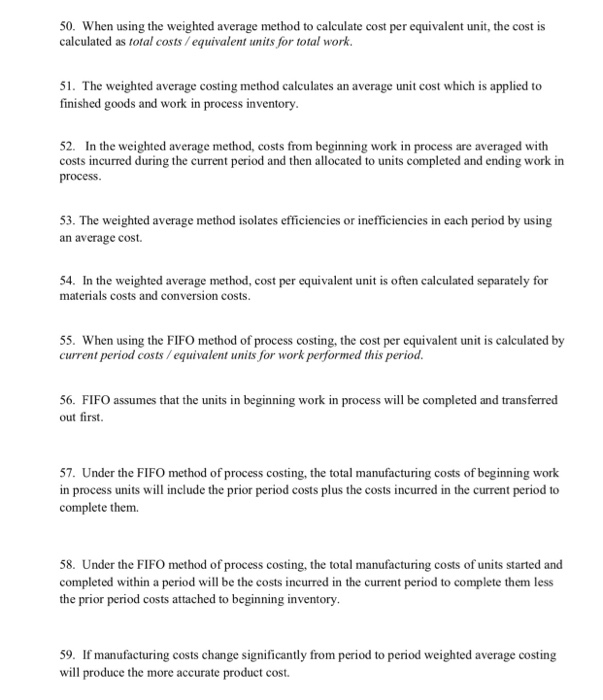
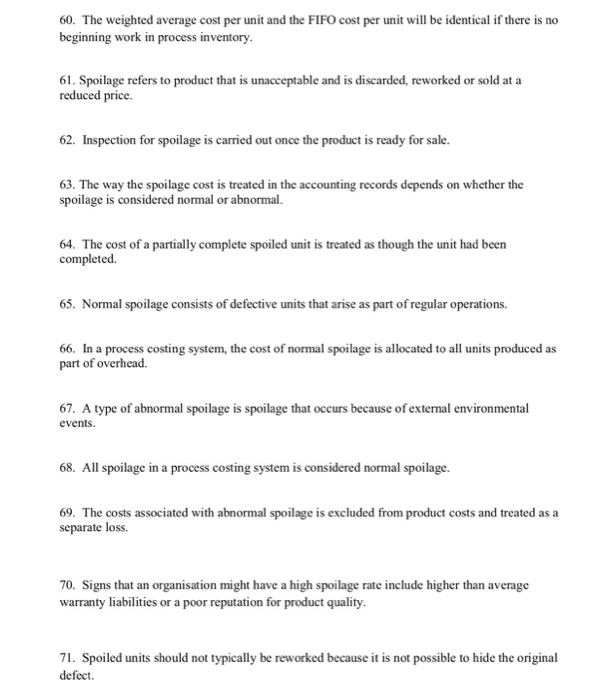
50. When using the weighted average method to calculate cost per equivalent unit, the cost is calculated as total costs/equivalent units for total work 51. The weighted average costing method calculates an average unit cost which is applied to finished goods and work in process inventory 52. In the weighted average method, costs from beginning work in process are averaged with costs incurred during the current period and then allocated to units completed and ending work in process 53. The weighted average method isolates efficiencies or inefficiencies in each period by using an average cost. 54. In the weighted average method, cost per equivalent unit is often calculated separately for materials costs and conversion costs 55. When using the FIFO method of process costing, the cost per equivalent unit is calculated by current period costs/equivalent units for work performed this period 56. FIFO assumes that the units in beginning work in process will be completed and transferred out first 57. Under the FIFO method of process costing, the total manufacturing costs of beginning work in process units will include the prior period costs plus the costs incurred in the current period to complete them. 58. Under the FIFO of completed within a period will be the costs incurred in the current period to complete them less the prior period costs attached to beginning inventory method of process costing, the total manufacturing costs of units started and 59. If manufacturing costs change significantly from period to period weighted average costing will produce the more accurate product cost. 60. The weighted average cost per unit and the FIFO cost per unit will be identical if there is no beginning work in process inventory 61. Spoilage refers to product that is unacceptable and is discarded, reworked or sold ata reduced price. 62. Inspection for spoilage is carried out once the product is ready for sale 63. The way the spoilage cost is treated in the accounting records depends on whether the spoilage is considered normal or abnormal. 64. The cost of a partially complete spoiled unit is treated as though the unit had been completed 65. Normal spoilage consists of defective units that arise as part of regular operations. 66. In a process costing system, the cost of normal spoilage is allocated to all units produced as part of overhead. 67. A type of abnormal spoilage is spoilage that occurs because of external environmental events 68. All spoilage in a process costing system is considered normal spoilage. oali rd o nd bted as a separate loss 70. Signs that an organisation might have a high spoilage rate include higher than average warranty liabilities or a poor reputation for product quality 71. Spoiled units should not typically be reworked because it is not possible to hide the original defect
Step by Step Solution
There are 3 Steps involved in it

Get step-by-step solutions from verified subject matter experts
 Study Help