







Question: true or false Below is Required Homework Leverage is created when a company accumulates significant amounts of Cash. A Balance Sheet is the financial statement

true or false
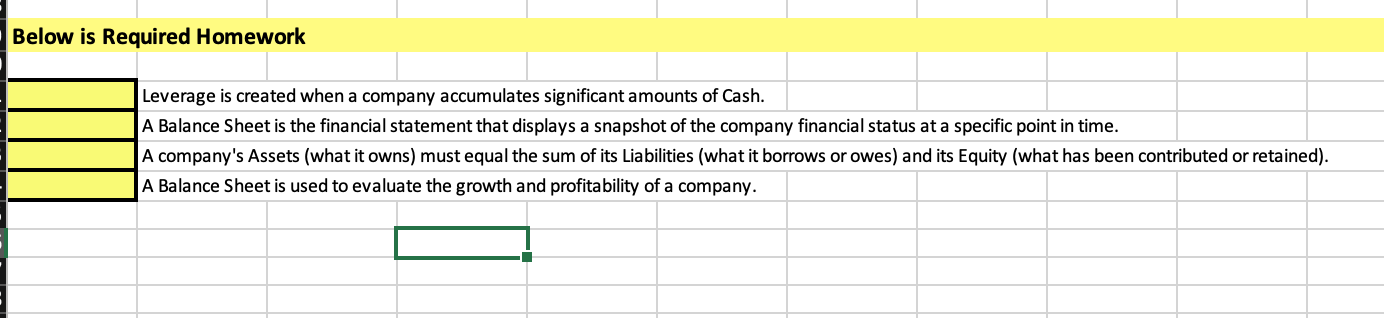
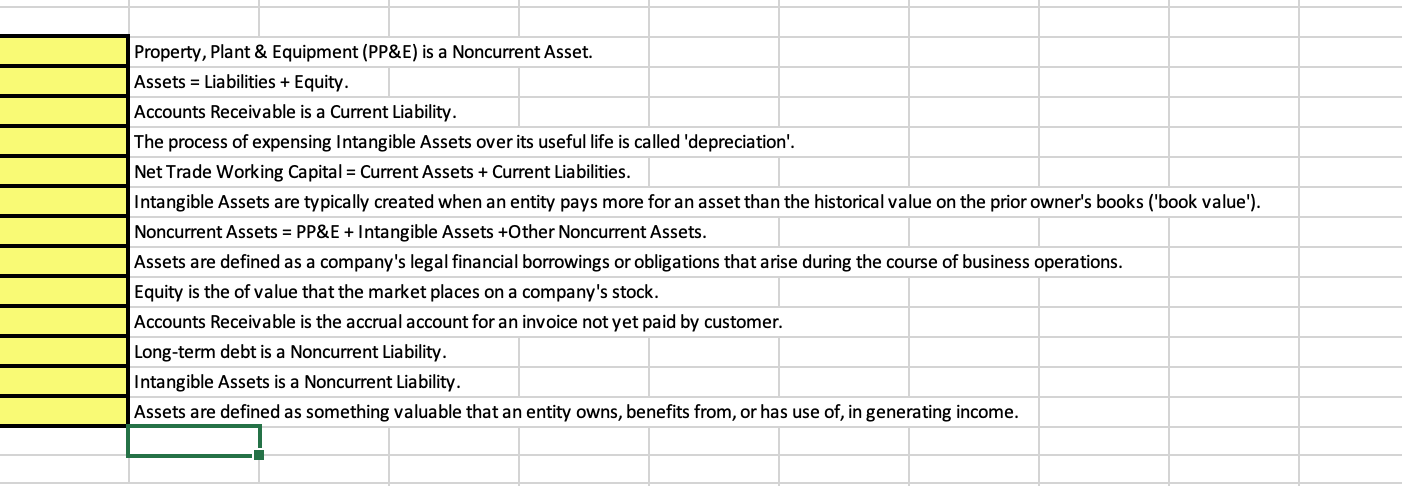
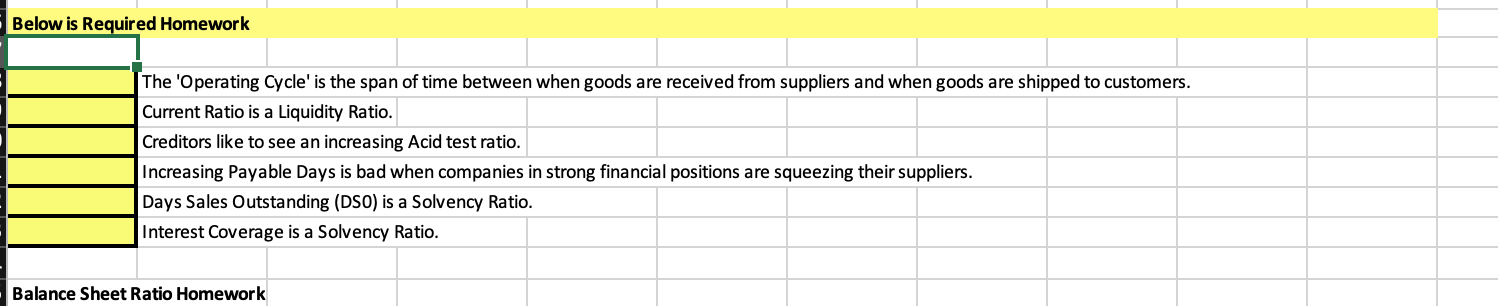
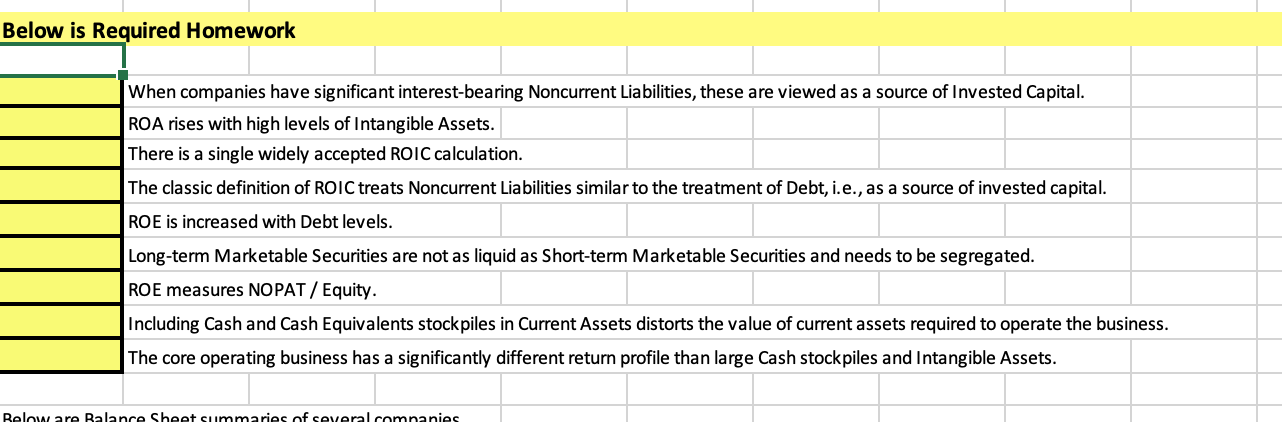

Below is Required Homework Leverage is created when a company accumulates significant amounts of Cash. A Balance Sheet is the financial statement that displays a snapshot of the company financial status at a specific point in time. A company's Assets (what it owns) must equal the sum of its Liabilities (what it borrows or owes) and its Equity (what has been contributed or retained). A Balance Sheet is used to evaluate the growth and profitability of a company.Property, Plant & Equipment (PP&E) is a Noncurrent Asset. Assets = Liabilities + Equity. Accounts Receivable is a Current Liability. The process of expensing Intangible Assets over its useful life is called 'depreciation'. Net Trade Working Capital = Current Assets + Current Liabilities. Intangible Assets are typically created when an entity pays more for an asset than the historical value on the prior owner's books ('book value"). Noncurrent Assets = PP&E + Intangible Assets +Other Noncurrent Assets. Assets are defined as a company's legal financial borrowings or obligations that arise during the course of business operations. Equity is the of value that the market places on a company's stock. Accounts Receivable is the accrual account for an invoice not yet paid by customer. Long-term debt is a Noncurrent Liability. Intangible Assets is a Noncurrent Liability. Assets are defined as something valuable that an entity owns, benefits from, or has use of, in generating income.Below is Required Homework The 'Operating Cycle' is the span of time between when goods are received from suppliers and when goods are shipped to customers. Current Ratio is a Liquidity Ratio. Creditors like to see an increasing Acid test ratio. Increasing Payable Days is bad when companies in strong financial positions are squeezing their suppliers. Days Sales Outstanding (DSO) is a Solvency Ratio. Interest Coverage is a Solvency Ratio. Balance Sheet Ratio HomeworkBelow is Required Homework When companies have significant interest-bearing Noncurrent Liabilities, these are viewed as a source of Invested Capital. ROA rises with high levels of Intangible Assets. There is a single widely accepted ROIC calculation. The classic definition of ROIC treats Noncurrent Liabilities similar to the treatment of Debt, i.e., as a source of invested capital. ROE is increased with Debt levels. Long-term Marketable Securities are not as liquid as Short-term Marketable Securities and needs to be segregated. ROE measures NOPAT / Equity. Including Cash and Cash Equivalents stockpiles in Current Assets distorts the value of current assets required to operate the business. The core operating business has a significantly different return profile than large Cash stockpiles and Intangible Assets. RoNewCos have accumulated large amounts of Cash with Net Cash position reversing the Net Debt position of the OldCos. Companies have become significantly more capital intensive and NewCos require significantly more PP&E as do the OldCos. Companies have experienced significant increases in accounts receivable because of cash based sales in direct to consumer businesses. Tangible Capital Invested in Operations (Tangible CIO) has declined consistently and NewCos have significantly less than that of OldCos. Not only have the Non-Cash Working Capital decline for OldCos, NewCos require dramatically lower (negative) levels
Step by Step Solution
There are 3 Steps involved in it

Get step-by-step solutions from verified subject matter experts
 Study Help