







Question: true or false, the variability within groups reects only (6) . Random error is the combined effects of all uncontrolled factors such as individual differences
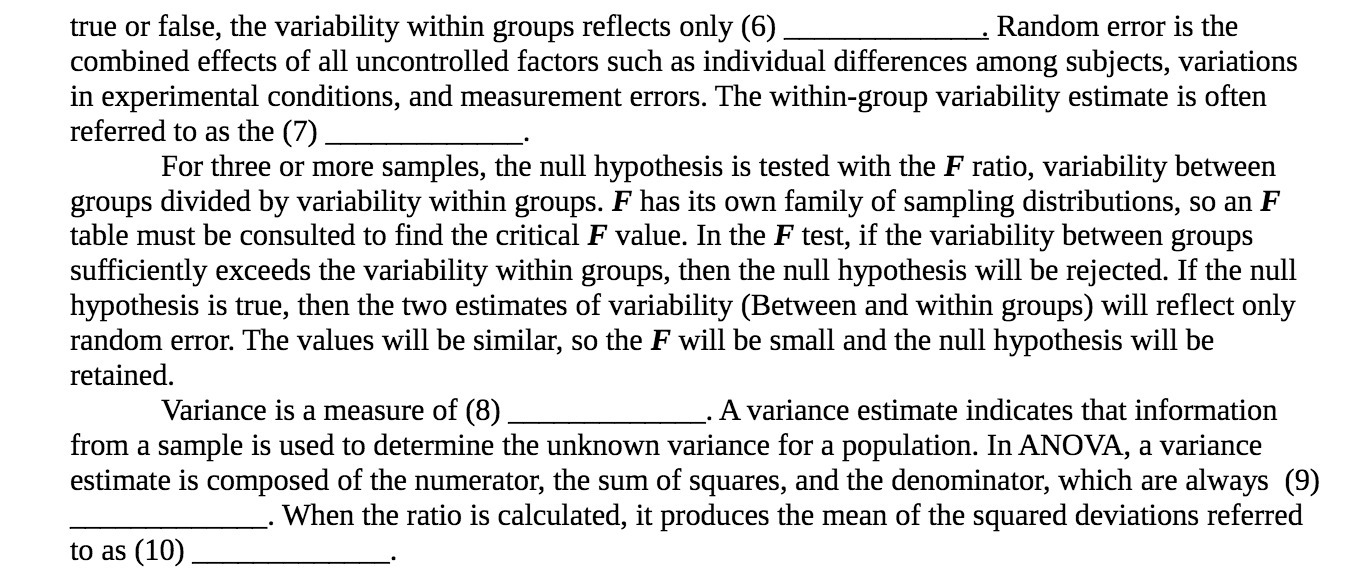
true or false, the variability within groups reects only (6) . Random error is the combined effects of all uncontrolled factors such as individual differences among subjects, variations in experimental conditions, and measurement errors. The within-group variability estimate is often referred to as the (7) . For three or more samples, the null hypothesis is tested with the F ratio, variability between groups divided by variability within groups. F has its own family of sampling distributions, so an F table must be consulted to find the critical F value. In the F test, if the variability between groups sufficiently exceeds the variability within groups, then the null hypothesis will be rejected. If the null hypothesis is true, then the two estimates of variability (Between and within groups) will reflect only random error. The values will be similar, so the F will be small and the null hypothesis will be retained. Variance is a measure of (8) . A variance estimate indicates that information from a sample is used to determine the unknown variance for a population. In ANOVA, a variance estimate is composed of the numerator, the sum of squares, and the denominator, which are always (9) . When the ratio is calculated, it produces the mean of the squared deviations referred to as
Step by Step Solution
There are 3 Steps involved in it

Get step-by-step solutions from verified subject matter experts
 Study Help