



Question: True or false? True or false TTROM 25. Fundamental purposes of the principle of indemnity is to reduce physical hazards. 26. Fundamental purposes of the
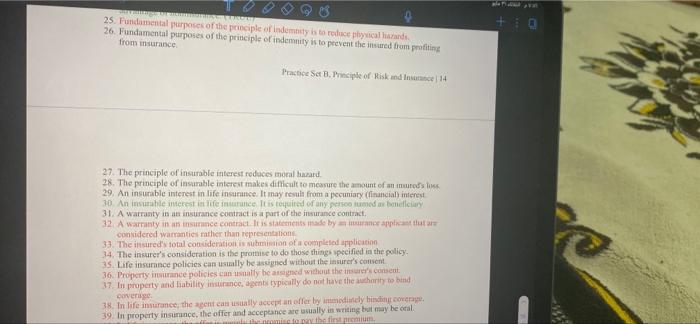
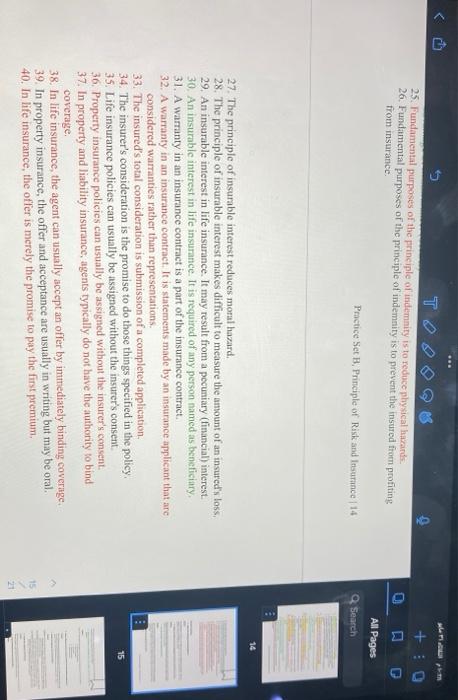
TTROM 25. Fundamental purposes of the principle of indemnity is to reduce physical hazards. 26. Fundamental purposes of the principle of indemnity is to prevent the insured from profiting from insurance. Practice Set B. Principle of Risk and Insurance 14 27. The principle of insurable interest reduces moral hazard. 28. The principle of insurable interest makes difficult to measure the amount of an insured's loss 29. An insurable interest in life insurance. It may result from a pecuniary (financial) interest 30. An insurable interest in life insurance. It is required of any persoo tumed as beneficiary 31. A warranty in an insurance contract is a part of the insurance contract. 32. A warranty in an insurance contract. It is statements made by an insurance applicant that are considered warranties rather than representations 33. The insured's total consideration is submission of a completed application 34. The insurer's consideration is the promise to do those things specified in the policy. 35. Life insurance policies can usually be assigned without the insurer's consent 36. Property insurance policies can usually be assigned without the insurer's consent 37. In property and liability insurance, agents typically do not have the authority to bind coverage. 38. In life insurance, the agent can usually accept an offer by immediately binding coverage. 39. In property insurance, the offer and acceptance are usually in writing but may be oral. velat the promise to pay the first premium. R TOO 25. Fundamental purposes of the principle of indemnity is to reduce physical hazards. 26. Fundamental purposes of the principle of indemnity is to prevent the insured from profiting from insurance. Practice Set B, Principle of Risk and Insurance | 14 27. The principle of insurable interest reduces moral hazard. 28. The principle of insurable interest makes difficult to measure the amount of an insured's loss. 29. An insurable interest in life insurance. It may result from a pecuniary (financial) interest. 30. An insurable interest in life insurance. It is required of any person named as beneficiary. 31. A warranty in an insurance contract is a part of the insurance contract. 32. A warranty in an insurance contract. It is statements made by an insurance applicant that are considered warranties rather than representations. 33. The insured's total consideration is submission of a completed application. 34. The insurer's consideration is the promise to do those things specified in the policy. 35. Life insurance policies can usually be assigned without the insurer's consent. 36. Property insurance policies can usually be assigned without the insurer's consent. 37. In property and liability insurance, agents typically do not have the authority to bind coverage. 38. In life insurance, the agent can usually accept an offer by immediately binding coverage. 39. In property insurance, the offer and acceptance are usually in writing but may be oral. 40. In life insurance, the offer is merely the promise to pay the first premium, lo 15 +10 All Pages Search 14 15
Step by Step Solution
There are 3 Steps involved in it

Get step-by-step solutions from verified subject matter experts