







Question: True/False, Explain (30 points) Be sure to include an explanation for why the statement is true or false. Question 1 A common empirical strategy for
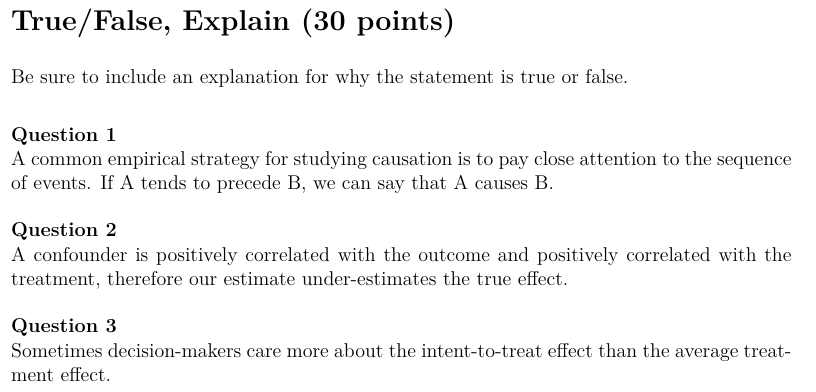
True/False, Explain (30 points) Be sure to include an explanation for why the statement is true or false. Question 1 A common empirical strategy for studying causation is to pay close attention to the sequence of events. If A tends to precede B, we can say that A causes B. Question 2 A confounder is positively correlated with the outcome and positively correlated with the treatment, therefore our estimate under-estimates the true effect. Question 3 Sometimes decision-makers care more about the intent-to-treat effect than the average treat- ment effect
Step by Step Solution
There are 3 Steps involved in it
1 Expert Approved Answer
Step: 1 Unlock

Question Has Been Solved by an Expert!
Get step-by-step solutions from verified subject matter experts
Step: 2 Unlock
Step: 3 Unlock
 Study Help