







Question: True/False Indicate whether the statement is true or false. 16. The derivatives of the reciprocal trigonometric functions can be found using the chain rule and
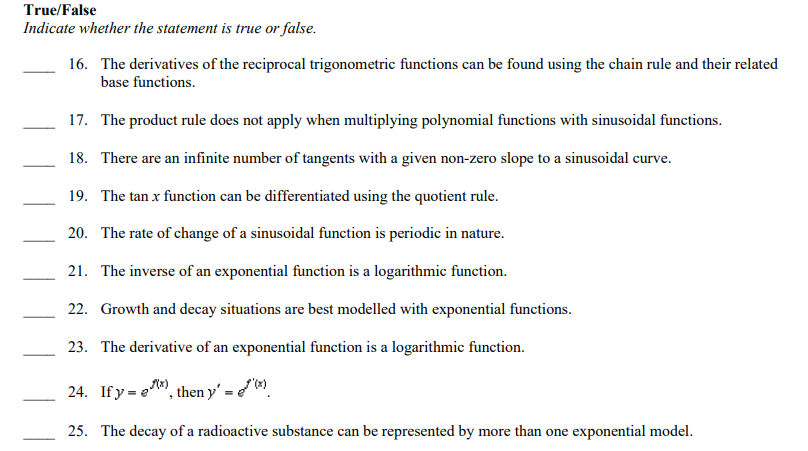

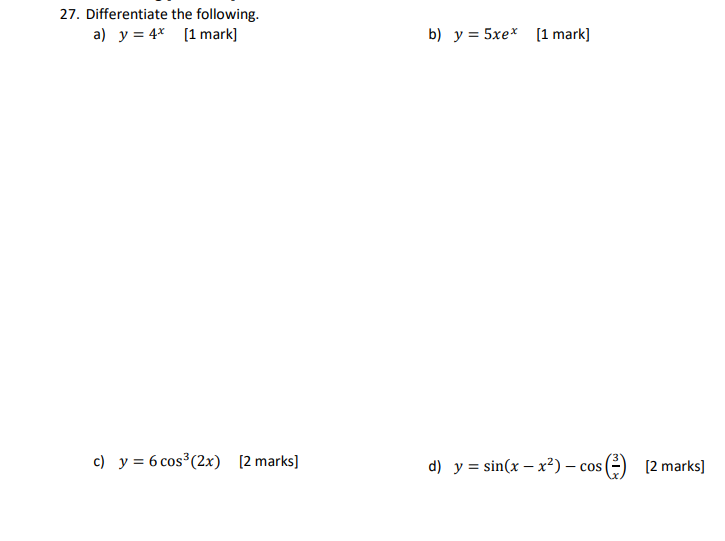

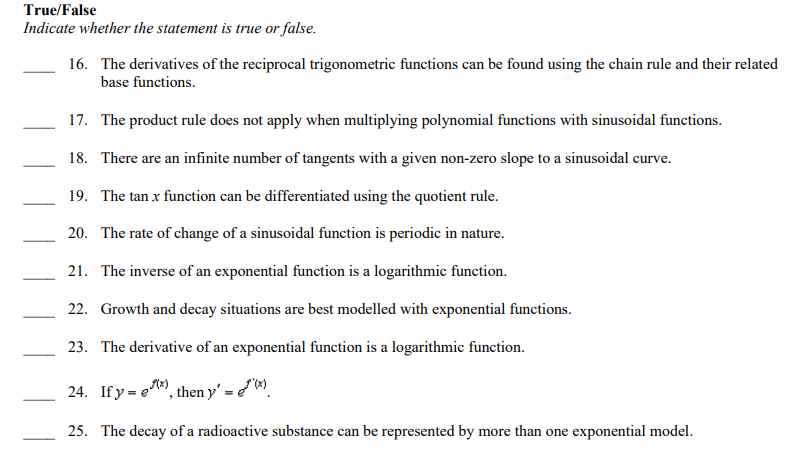


True/False Indicate whether the statement is true or false. 16. The derivatives of the reciprocal trigonometric functions can be found using the chain rule and their related base functions. 17. The product rule does not apply when multiplying polynomial functions with sinusoidal functions. 18. There are an infinite number of tangents with a given non-zero slope to a sinusoidal curve. 19. The tan x function can be differentiated using the quotient rule. 20. The rate of change of a sinusoidal function is periodic in nature. 21. The inverse of an exponential function is a logarithmic function. 22. Growth and decay situations are best modelled with exponential functions. 23. The derivative of an exponential function is a logarithmic function. 24. Ify = e , then y' = () 25. The decay of a radioactive substance can be represented by more than one exponential model. 27. Differentiate the following. a) y = 4* [1 mark] b) y = 5xe* [1 mark] c) y = 6cos3(2x) [2 marks] d) y = sin(x - x2) - cos (=) [2 marks]
Step by Step Solution
There are 3 Steps involved in it

Get step-by-step solutions from verified subject matter experts
 Study Help