







Question: Try This 11.1 . Write a response for items 36. Pattern your explanation after the samples provided in the instructions. Your responses do not have
- Try This 11.1. Write a response for items 36. Pattern your explanation after the samples provided in the instructions. Your responses do not have to be lengthy; however, make sure that in addition to identifying the tension, you explain it. (20 points)
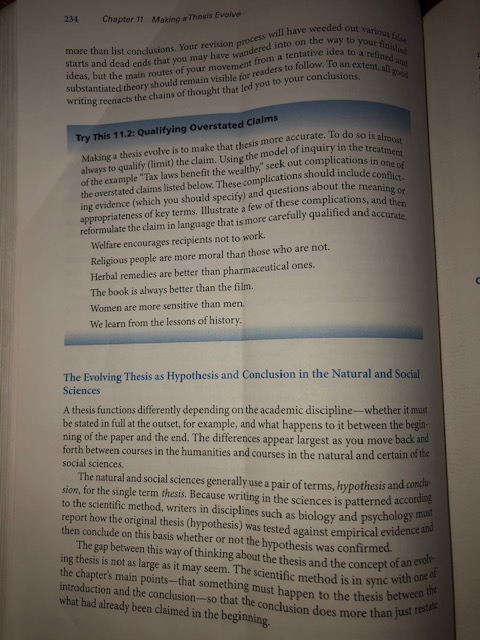
- Try This 11.2. Write a response for all six sentences. Number your responses 16. Be sure to specify the conflicting evidence before you revise the sentence. (30 points)
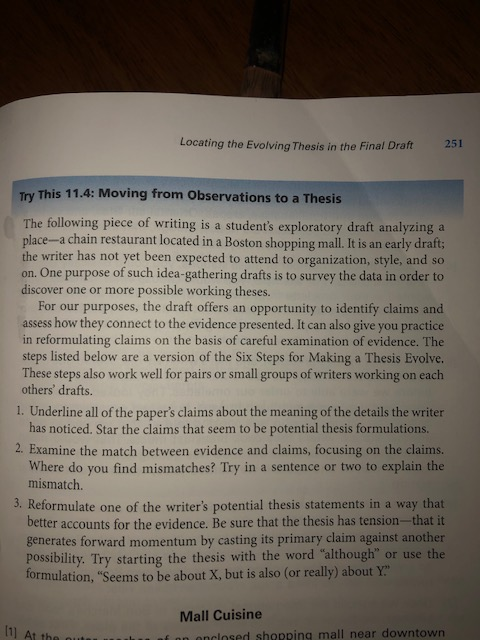
- Try This 11.4. Complete the exercise as follows. (20 points)
- Part 1. First, provide two examples of the papers claims. Write them out and indicate the paragraph number they come from. It will help you to underline all of the claims, as directed in the textbooks instruction; however, you need submit only two of them. Second, state a claim that you think is a thesis formulation; again, indicate the paragraph number where your found it.
- Part 2. Pick one mismatch that you find and explain it in a sentence or two.
- Part 3. Complete according to the textbook instructions.
more than list conclusions. Your revision process will have weeded out various starts and dead ends that you may have wandered into on the way to your litt ideas, but the main routes of your movement from a tentative idea to a clined and substantiated theory should remain visible for readers to follow. To an extent, and Making a thesis evolve is to make that thesis more accurate. To do so is almost of the example "Tax laws benefit the wealthy seck out complications in one of the overstated claims listed below. These complications should include conflict- ing evidence (which you should specify) and questions about the meaning or appropriateness of key terms. Illustrate a few of these complications, and then reformulate the claim in language that is more carefully qualified and accurate, ing thesis is not as large as it may seem. The scientific method is in sync with one of the chapter's main points--that something must happen to the thesis between the always to qualify (limit) the claim. Using the model of inquiry in the treatment introduction and the conclusion so that the conclusion does more than just resta 234 Chapter 11 Making a Thesis Evolve writing reenacts the chains of thought that led you to your conclusions, Try This 11.2: Qualifying Overstated Claims The gap between this way of thinking about the thesis and the concept of an evol The Evolving Thesis as Hypothesis and Conclusion in the Natural and Social Sciences A thesis functions differently depending on the academic discipline-whether it must be stated in full at the outset, for example, and what happens to it between the begin ning of the paper an end. The differences appear largest as you move back and forth between courses in the humanities and courses in the natural and certain of the social sciences The natural and social sciences generally use a pair of terms, hypothesis and concha sions, for the single term thesis. Because writing in the sciences is patterned according to the scientific method, writers in disciplines such as biology and psychology mo report how the original thesis (hypothesis) was tested against empirical evidence and then conclude on this basis whether or not the hypothesis was confirmed Welfare encourages recipients not to work Religious people are more moral than those who are not Herbal remedies are better than pharmaceutical ones. The book is always better than the film. Women are more sensitive than men. We learn from the lessons of history. what had already been claimed in the beginning. Locating the Evolving Thesis in the Final Draft 251 Try This 11.4: Moving from Observations to a Thesis The following piece of writing is a student's exploratory draft analyzing a place-achain restaurant located in a Boston shopping mall. It is an early draft; the writer has not yet been expected to attend to organization, style, and so on. One purpose of such idea-gathering drafts is to survey the data in order to discover one or more possible working theses. For our purposes, the draft offers an opportunity to identify claims and assess how they connect to the evidence presented. It can also give you practice in reformulating claims on the basis of careful examination of evidence. The steps listed below are a version of the Six Steps for Making a Thesis Evolve. These steps also work well for pairs or small groups of writers working on each others' drafts. 1. Underline all of the paper's claims about the meaning of the details the writer has noticed. Star the claims that seem to be potential thesis formulations. 2. Examine the match between evidence and claims, focusing on the claims. Where do you find mismatches? Try in a sentence or two to explain the mismatch 3. Reformulate one of the writer's potential thesis statements in a way that better accounts for the evidence. Be sure that the thesis has tension-that it generates forward momentum by casting its primary claim against another possibility. Try starting the thesis with the word "although" or use the formulation, "Seems to be about X, but is also (or really) about Y" 111 At the Mall Cuisine on onclosed shopping mall near downtown more than list conclusions. Your revision process will have weeded out various starts and dead ends that you may have wandered into on the way to your litt ideas, but the main routes of your movement from a tentative idea to a clined and substantiated theory should remain visible for readers to follow. To an extent, and Making a thesis evolve is to make that thesis more accurate. To do so is almost of the example "Tax laws benefit the wealthy seck out complications in one of the overstated claims listed below. These complications should include conflict- ing evidence (which you should specify) and questions about the meaning or appropriateness of key terms. Illustrate a few of these complications, and then reformulate the claim in language that is more carefully qualified and accurate, ing thesis is not as large as it may seem. The scientific method is in sync with one of the chapter's main points--that something must happen to the thesis between the always to qualify (limit) the claim. Using the model of inquiry in the treatment introduction and the conclusion so that the conclusion does more than just resta 234 Chapter 11 Making a Thesis Evolve writing reenacts the chains of thought that led you to your conclusions, Try This 11.2: Qualifying Overstated Claims The gap between this way of thinking about the thesis and the concept of an evol The Evolving Thesis as Hypothesis and Conclusion in the Natural and Social Sciences A thesis functions differently depending on the academic discipline-whether it must be stated in full at the outset, for example, and what happens to it between the begin ning of the paper an end. The differences appear largest as you move back and forth between courses in the humanities and courses in the natural and certain of the social sciences The natural and social sciences generally use a pair of terms, hypothesis and concha sions, for the single term thesis. Because writing in the sciences is patterned according to the scientific method, writers in disciplines such as biology and psychology mo report how the original thesis (hypothesis) was tested against empirical evidence and then conclude on this basis whether or not the hypothesis was confirmed Welfare encourages recipients not to work Religious people are more moral than those who are not Herbal remedies are better than pharmaceutical ones. The book is always better than the film. Women are more sensitive than men. We learn from the lessons of history. what had already been claimed in the beginning. Locating the Evolving Thesis in the Final Draft 251 Try This 11.4: Moving from Observations to a Thesis The following piece of writing is a student's exploratory draft analyzing a place-achain restaurant located in a Boston shopping mall. It is an early draft; the writer has not yet been expected to attend to organization, style, and so on. One purpose of such idea-gathering drafts is to survey the data in order to discover one or more possible working theses. For our purposes, the draft offers an opportunity to identify claims and assess how they connect to the evidence presented. It can also give you practice in reformulating claims on the basis of careful examination of evidence. The steps listed below are a version of the Six Steps for Making a Thesis Evolve. These steps also work well for pairs or small groups of writers working on each others' drafts. 1. Underline all of the paper's claims about the meaning of the details the writer has noticed. Star the claims that seem to be potential thesis formulations. 2. Examine the match between evidence and claims, focusing on the claims. Where do you find mismatches? Try in a sentence or two to explain the mismatch 3. Reformulate one of the writer's potential thesis statements in a way that better accounts for the evidence. Be sure that the thesis has tension-that it generates forward momentum by casting its primary claim against another possibility. Try starting the thesis with the word "although" or use the formulation, "Seems to be about X, but is also (or really) about Y" 111 At the Mall Cuisine on onclosed shopping mall near downtown
Step by Step Solution
There are 3 Steps involved in it
1 Expert Approved Answer
Step: 1 Unlock

Question Has Been Solved by an Expert!
Get step-by-step solutions from verified subject matter experts
Step: 2 Unlock
Step: 3 Unlock
 Study Help