







Question: Trying to write this program using python. Does anyone know what to do? Subsets of a set can be generated using a mask. A good
Trying to write this program using python. Does anyone know what to do?
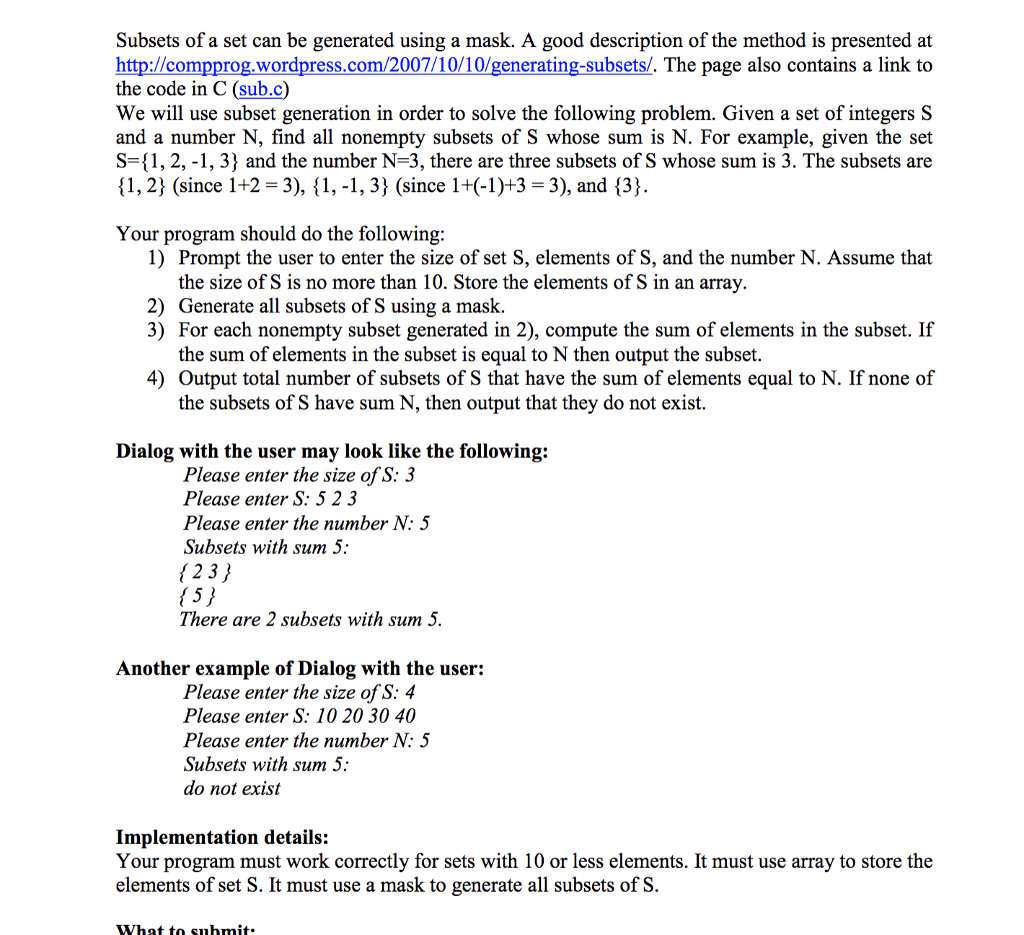
Subsets of a set can be generated using a mask. A good description of the method is presented at http://compprog.wordpress.com/2007/10/10/generating-subsets/. The page also contains a link to the code in C (sub.c) We will use subset generation in order to solve the following problem. Given a set of integers S and a number N, find all nonempty subsets of S whose sum is N. For example, given the set S-{1,2,-1, 3) and the number N-3, there are three subsets of S whose sum is 3. The subsets are (1,2) (since 1+2-3), {1,-1,3) (since 1+-1)+3-3), and {3) Your program should do the following: 1) Prompt the user to enter the size of set S, elements of S, and the number N. Assume that the size of S is no more than 10. Store the elements of S in an array. 2) Generate all subsets of S using a mask. 3) For each nonempty subset generated in 2), compute the sum of elements in the subset. If the sum of elements in the subset is equal to N then output the subset. 4) Output total number of subsets of S that have the sum of elements equal to N. If none of the subsets of S have sum N, then output that they do not exist. Dialog with the user may look like the following: Please enter the size of S: 3 Please enter S: 5 2 3 Please enter the number N: 5 Subsets with sum 5 (23 There are 2 subsets with sum 5. Another example of Dialog with the user: Please enter the size ofS: 4 Please enter S: 10 20 30 40 Please enter the number N: 5 Subsets with sum 5: do not exist Implementation details: Your program must work correctly for sets with 10 or less elements. It must use array to store the elements of set S. It must use a mask to generate all subsets of S What to suhmit
Step by Step Solution
There are 3 Steps involved in it

Get step-by-step solutions from verified subject matter experts
 Study Help