







Question: Tuple Out Dice Game For this project, you will implement a simulation of a simple dice game with the following rules: This game may have
"Tuple Out" Dice Game
For this project, you will implement a simulation of a simple dice game with the following rules:
This game may have one or more players.
The object of the game is to score the most points, or to be the first to reach a certain score.
Players take turns rolling dice to score points, as described below.
Each turn, the active player rolls three dice:
If all three dice are rolled with the same number, the player has "tupled out", and ends their turn with zero points. For example, rolling three s at the same time.
If two dice have the same value, they are "fixed", and they cannot be rerolled.
The player can reroll any dice that are not "fixed", as often as they would like, until they decide to stop, or until they "tuple out" get three of the same number
When a player decides to stop, they score points equal to the total of the three dice, and then their turn ends.
If a player "tuples out", their turn ends and they score points for that turn.
Ideas for additional options and features of the "Tuple Out" Dice Game
When is the game over? I recommend either playing until one player reaches a score of or playing for five total turns. But you could play around with some different options.
How and when will you display the running scores, so that players know what the current scores are?
Can the game record the scores for each game, including who won?
Can the game record something like "high score" records over many games, or a running tally of how many games a particular player has won?
Can you implement an AI player strategy that a player could play against?
Would the game be better or more interesting if the dice were changed, including the number of dice or the number of values on each die?
What about adding rules for additional special scoring?
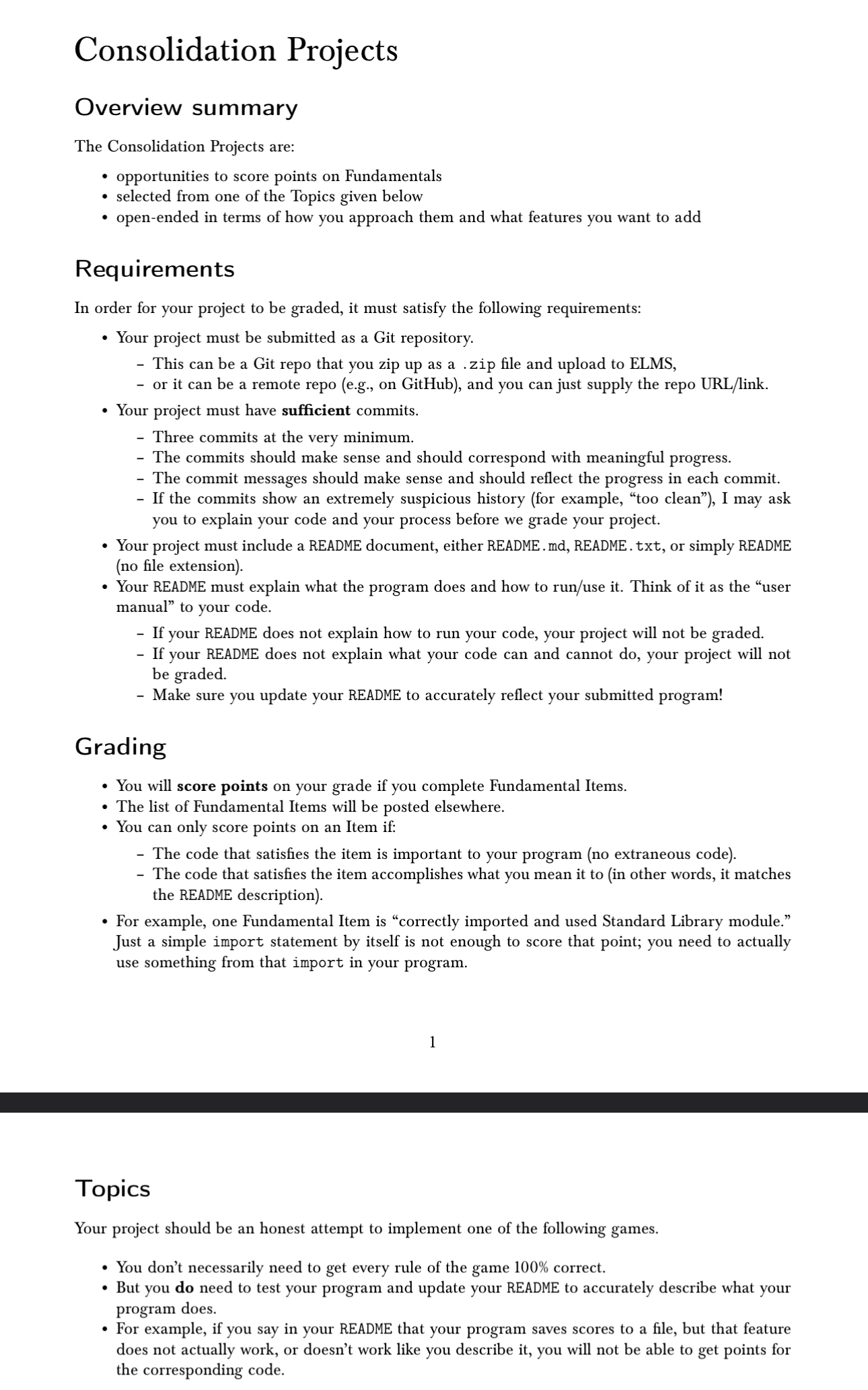
Consolidation Projects
Overview summary
The Consolidation Projects are:
opportunities to score points on Fundamentals
selected from one of the Topics given below
openended in terms of how you approach them and what features you want to add
Requirements
In order for your project to be graded, it must satisfy the following requirements:
Your project must be submitted as a Git repository.
This can be a Git repo that you zip up as a zip file and upload to ELMS,
or it can be a remote repo eg on GitHub and you can just supply the repo URLlink
Your project must have sufficient commits.
Three commits at the very minimum.
The commits should make sense and should correspond with meaningful progress.
The commit messages should make sense and should reflect the progress in each commit.
If the commits show an extremely suspicious history for example, "too clean" I may ask you to explain your code and your process before we grade your project.
Your project must include a README document, either
README.md README.txt or simply README no file extension
Your README must explain what the program does and how to runuse it Think of it as the "user manual" to your code.
If your README does not explain how to run your code, your project will not be graded.
If your README does not explain what your code can and cannot do your project will not be graded.
Make sure you update your README to accurately reflect your submitted program!
Grading
You will score points on your grade if you complete Fundamental Items.
The list of Fundamental Items will be posted elsewhere.
You can only score points on an Item if:
The code that satisfies the item is important to your program no extraneous code
The code that satisfies the item accomplishes what you mean it to in other words, it matches the README description
For example, one Fundamental Item is "correctly imported and used Standard Library module." Just a simple import statement by itself is not enough to score that point; you need to actually use something from that import in your program.
Topics
Your project should be an honest attempt to implement one of the following games.
You don't necessarily need to get every rule of the game correct.
But you do need to test your program and update your README to accurately describe what your program does.
For example, if you say in your README that your program saves scores to a file, but that feature does not actually work, or doesn't work like you describe it you will not be able to get points for the corresponding code.
Step by Step Solution
There are 3 Steps involved in it
1 Expert Approved Answer
Step: 1 Unlock

Question Has Been Solved by an Expert!
Get step-by-step solutions from verified subject matter experts
Step: 2 Unlock
Step: 3 Unlock
 Study Help