







Question: Ture or False. Only need to explain the false problems. The False problems are 10.2, 10.5, 10.6, 10.8, 10.9, 10.10, 10.11, 10.13, 10.14, 10.19, 10.20
Ture or False. Only need to explain the false problems. The False problems are 10.2, 10.5, 10.6, 10.8, 10.9, 10.10, 10.11, 10.13, 10.14, 10.19, 10.20 Only explain these problems
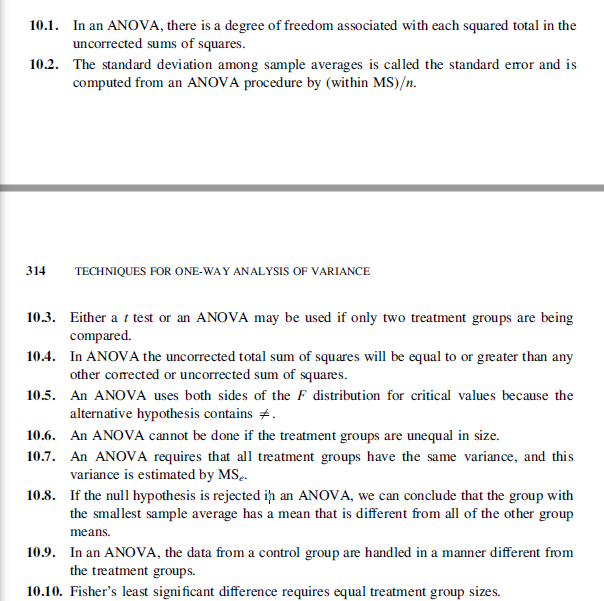
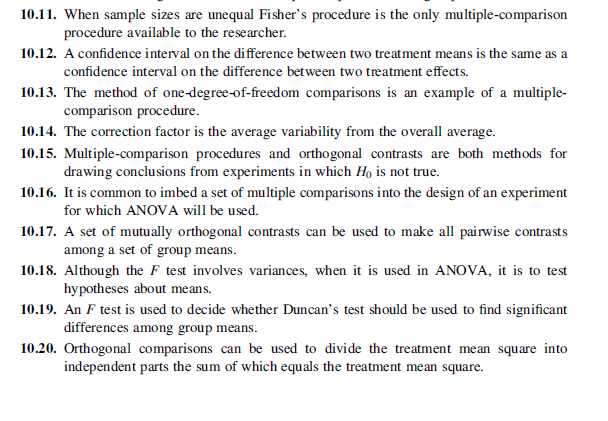
10.1. In an ANOVA, there is a degree of freedom associated with each squared total in the uncorrected sums of squares. 10.2. The standard deviation among sample averages is called the standard error and is computed from an ANOVA procedure by (within MS). 314 TECHNIQUES FOR ONE-WAY ANALYSIS OF VARIANCE 10.3. Either a 1 test or an ANOVA may be used if only two treatment groups are being compared 10.4. In ANOVA the uncorrected total sum of squares will be equal to or greater than any other corrected or uncorrected sum of squares. 10.5. An ANOVA uses both sides of the F distribution for critical values because the alternative hypothesis contains #. 10.6. An ANOVA cannot be done if the treatment groups are unequal in size. 10.7. An ANOVA requires that all treatment groups have the same variance, and this variance is estimated by MS. 10.8. If the null hypothesis is rejected in an ANOVA, we can conclude that the group with the smallest sample average has a mean that is different from all of the other group means. 10.9. In an ANOVA, the data from a control group are handled in a manner different from the treatment groups. 10.10. Fisher's least significant difference requires equal treatment group sizes. 10.11. When sample sizes are unequal Fisher's procedure is the only multiple-comparison procedure available to the researcher. 10.12. A confidence interval on the difference between two treatment means is the same as a confidence interval on the difference between two treatment effects. 10.13. The method of one-degree-of-freedom comparisons is an example of a multiple- comparison procedure. 10.14. The correction factor is the average variability from the overall average. 10.15. Multiple-comparison procedures and orthogonal contrasts are both methods for drawing conclusions from experiments in which He is not true. 10.16. It is common to imbed a set of multiple comparisons into the design of an experiment for which ANOVA will be used. 10.17. A set of mutually orthogonal contrasts can be used to make all pairwise contrasts among a set of group means. 10.18. Although the F test involves variances, when it is used in ANOVA, it is to test hypotheses about means. 10.19. An F test is used to decide whether Duncan's test should be used to find significant differences among group means. 10.20. Orthogonal comparisons can be used to divide the treatment mean square into independent parts the sum of which equals the treatment mean squareStep by Step Solution
There are 3 Steps involved in it
1 Expert Approved Answer
Step: 1 Unlock

Question Has Been Solved by an Expert!
Get step-by-step solutions from verified subject matter experts
Step: 2 Unlock
Step: 3 Unlock
 Study Help