





Question: Tutorial 1: try, scan and upload these exercises to Blackboard before attending your tutorial in Week 3. Those submitted by the notified deadline will be
Tutorial 1: try, scan and upload these exercises
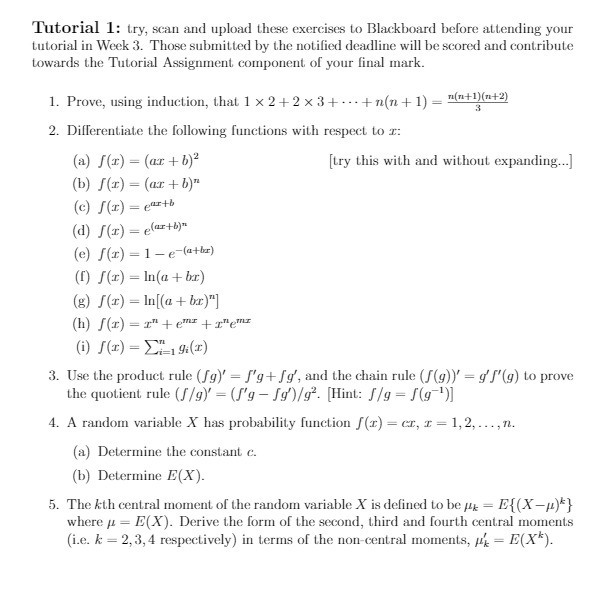
Tutorial 1: try, scan and upload these exercises to Blackboard before attending your tutorial in Week 3. Those submitted by the notified deadline will be scored and contribute towards the Tutorial Assignment component of your final mark. 1. Prove, using induction, that 1 x 2 + 2 x 3 + . . . + n(n + 1) _ "(n+1)(n+2) 3 2. Differentiate the following functions with respect to r: (a) S(x) = (ar +6)2 [try this with and without expanding...] (b) /(x) = (ar + b)" (c) /(x) = earth (d) /(x) = e(artb)" (e) /(x) = 1 -e-(athx) ([) S(x) = In(a + br) (g) /(x) = In[(a + br)"] (h) /(x) = ptem +gems (i) S(x) = Eng.(:) 3. Use the product rule (fg)' = 'g + /g', and the chain rule (S(9))' = g'f'(g) to prove the quotient rule (f/g)' = (S'g - fg')/g2. [Hint: f/g =/(g-1)] 4. A random variable X has probability function /(x) = cr, = = 1, 2, ..., n. (a) Determine the constant c. (b) Determine E(X). 5. The kth central moment of the random variable X is defined to be /x = E{(X-/)*} where u = E(X). Derive the form of the second, third and fourth central moments (i.e. k = 2,3, 4 respectively) in terms of the non-central moments, * = E(X*)

Step by Step Solution

There are 3 Steps involved in it

1 Expert Approved Answer
Step: 1 Unlock blur-text-image

Question Has Been Solved by an Expert!

Get step-by-step solutions from verified subject matter experts

Step: 2 Unlock
Step: 3 Unlock

Students Have Also Explored These Related Mathematics Questions!