







Question: TUTORIAL 4-Threads 1. Using a table, distinguish between a Program, Process and a Thread. Include a section on what is required to create them.
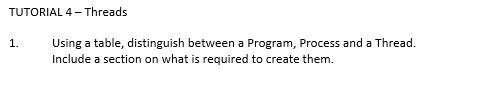
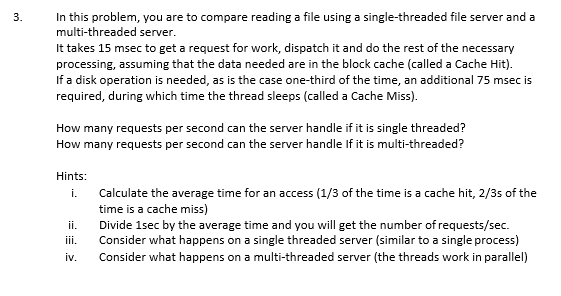
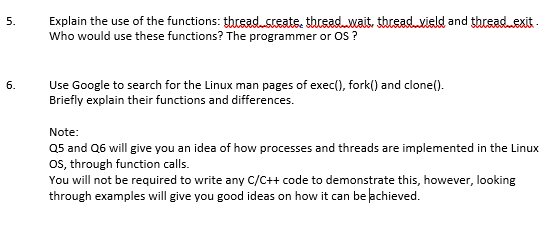
TUTORIAL 4-Threads 1. Using a table, distinguish between a Program, Process and a Thread. Include a section on what is required to create them. 3. In this problem, you are to compare reading a file using a single-threaded file server and a multi-threaded server. It takes 15 msec to get a request for work, dispatch it and do the rest of the necessary processing, assuming that the data needed are in the block cache (called a Cache Hit). If a disk operation is needed, as is the case one-third of the time, an additional 75 msec is required, during which time the thread sleeps (called a Cache Miss). How many requests per second can the server handle if it is single threaded? How many requests per second can the server handle If it is multi-threaded? Hints: i. ii. iii. iv. Calculate the average time for an access (1/3 of the time is a cache hit, 2/3s of the time is a cache miss) Divide 1sec by the average time and you will get the number of requests/sec. Consider what happens on a single threaded server (similar to a single process) Consider what happens on a multi-threaded server (the threads work in parallel) 5. Explain the use of the functions: thread create, thread wait, thread vield and thread..exit. Who would use these functions? The programmer or OS? 6. Use Google to search for the Linux man pages of exec(), fork() and clone(). Briefly explain their functions and differences. Note: Q5 and Q6 will give you an idea of how processes and threads are implemented in the Linux OS, through function calls. You will not be required to write any C/C++ code to demonstrate this, however, looking through examples will give you good ideas on how it can be achieved.
Step by Step Solution
There are 3 Steps involved in it

Get step-by-step solutions from verified subject matter experts
 Study Help