







Question: TUTORIAL 5: Week 6. (Ch. 9: AE Model and the multiplier (sections 9.4-9.5)/ Chapter 10: AD-AS model (sections 10.1-10.3)). Qu. 1(a) What is the multiplier
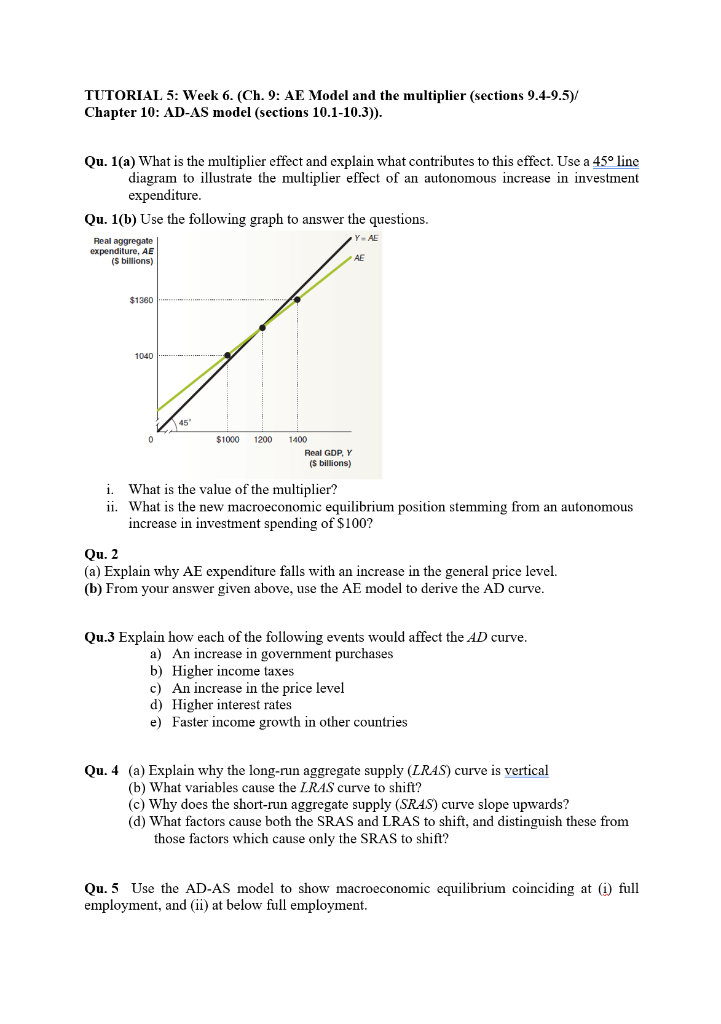
TUTORIAL 5: Week 6. (Ch. 9: AE Model and the multiplier (sections 9.4-9.5)/ Chapter 10: AD-AS model (sections 10.1-10.3)). Qu. 1(a) What is the multiplier effect and explain what contributes to this effect. Use a 45 line diagram to illustrate the multiplier effect of an autonomous increase in investment expenditure. Qu. 1(b) Use the following graph to answer the questions. i. What is the value of the multiplier? ii. What is the new macroeconomic equilibrium position stemming from an autonomous increase in investment spending of $100 ? Qu. 2 (a) Explain why AE expenditure falls with an increase in the general price level. (b) From your answer given above, use the AE model to derive the AD curve. Qu.3 Explain how each of the following events would affect the AD curve. a) An increase in government purchases b) Higher income taxes c) An increase in the price level d) Higher interest rates e) Faster income growth in other countries Qu. 4 (a) Explain why the long-run aggregate supply (LRAS) curve is vertical (b) What variables cause the LRAS curve to shift? (c) Why does the short-run aggregate supply (SRAS) curve slope upwards? (d) What factors cause both the SRAS and LRAS to shift, and distinguish these from those factors which cause only the SRAS to shift? Qu. 5 Use the AD-AS model to show macroeconomic equilibrium coinciding at (i) full employment, and (ii) at below full employment. TUTORIAL 5: Week 6. (Ch. 9: AE Model and the multiplier (sections 9.4-9.5)/ Chapter 10: AD-AS model (sections 10.1-10.3)). Qu. 1(a) What is the multiplier effect and explain what contributes to this effect. Use a 45 line diagram to illustrate the multiplier effect of an autonomous increase in investment expenditure. Qu. 1(b) Use the following graph to answer the questions. i. What is the value of the multiplier? ii. What is the new macroeconomic equilibrium position stemming from an autonomous increase in investment spending of $100 ? Qu. 2 (a) Explain why AE expenditure falls with an increase in the general price level. (b) From your answer given above, use the AE model to derive the AD curve. Qu.3 Explain how each of the following events would affect the AD curve. a) An increase in government purchases b) Higher income taxes c) An increase in the price level d) Higher interest rates e) Faster income growth in other countries Qu. 4 (a) Explain why the long-run aggregate supply (LRAS) curve is vertical (b) What variables cause the LRAS curve to shift? (c) Why does the short-run aggregate supply (SRAS) curve slope upwards? (d) What factors cause both the SRAS and LRAS to shift, and distinguish these from those factors which cause only the SRAS to shift? Qu. 5 Use the AD-AS model to show macroeconomic equilibrium coinciding at (i) full employment, and (ii) at below full employment
Step by Step Solution
There are 3 Steps involved in it

Get step-by-step solutions from verified subject matter experts
 Study Help