







Question: Tutorial Exercise IF (f(x ) dx = 9 and ( RX ) dx = 4.8 , find ( f( x ) dx . Part 1
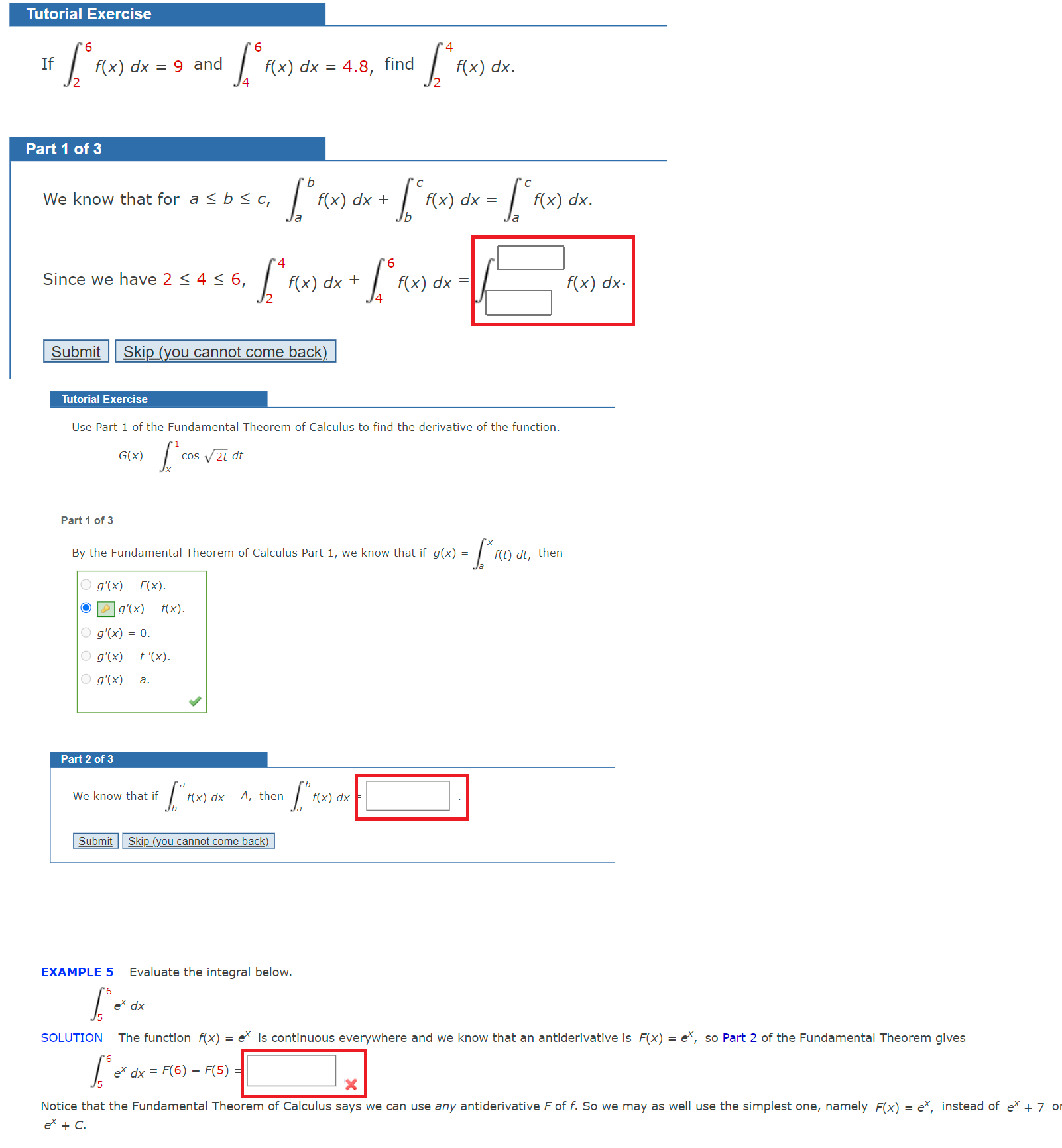
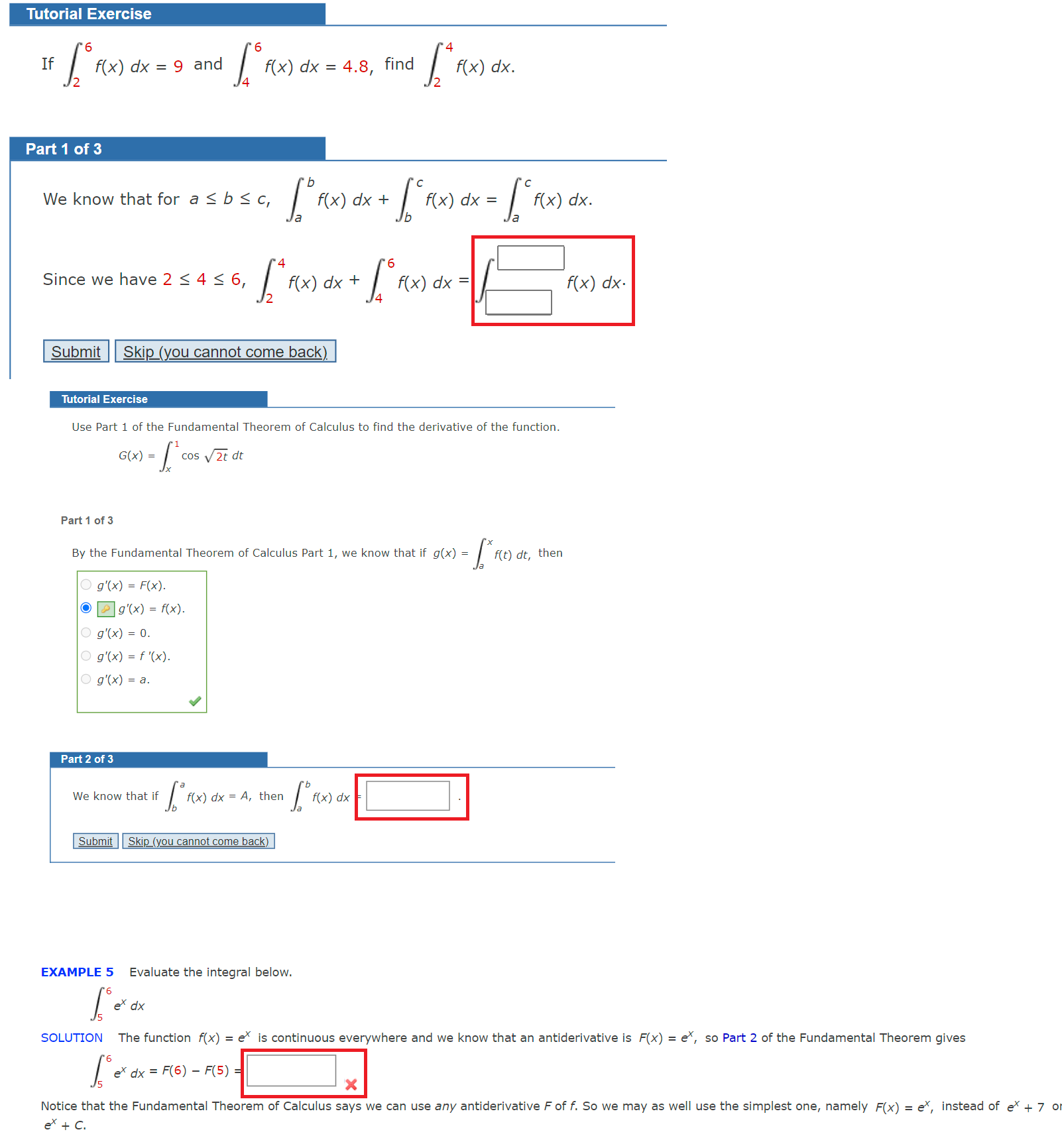
Tutorial Exercise IF ("f(x ) dx = 9 and ( RX ) dx = 4.8 , find ( f( x ) dx . Part 1 of 3 We know that for a s bsc. "f( x) dx+ "f(x) ax = ("f(x) dx. Since we have 2 = 4 5 6. "F(x ) dx + /, " rex ) ex - f f ( x) dx . Submit Skip (you cannot come back). Tutorial Exercise Use Part 1 of the Fundamental Theorem of Calculus to find the derivative of the function. G ( x ) = cos v zt dt Part 1 of 3 By the Fundamental Theorem of Calculus Part 1, we know that if g(x) - "f(t) at, then O g' ( x) = F(x). O g' ( x ) = f (x ) . O g'( x ) = 0. O g' ( x ) = f' ( x ) . g'(x) = a. Part 2 of 3 We know that if "(( x ) dx - A , then ( r( x ) dx Submit Skip (you cannot come back) EXAMPLE 5 Evaluate the integral below. ex ax SOLUTION The function f(x) = ex is continuous everywhere and we know that an antiderivative is F(x) = ex, so Part 2 of the Fundamental Theorem gives ( ex ax = F(6) - F(5) - Notice that the Fundamental Theorem of Calculus says we can use any antiderivative F of f. So we may as well use the simplest one, namely F(x) = ex, instead of ex + 7 o ex + C
Step by Step Solution
There are 3 Steps involved in it

Get step-by-step solutions from verified subject matter experts
 Study Help