







Question: Tutorial Exercise Maximize p = x - y + z + w subject to x + y + ZS6 y + z t W S6
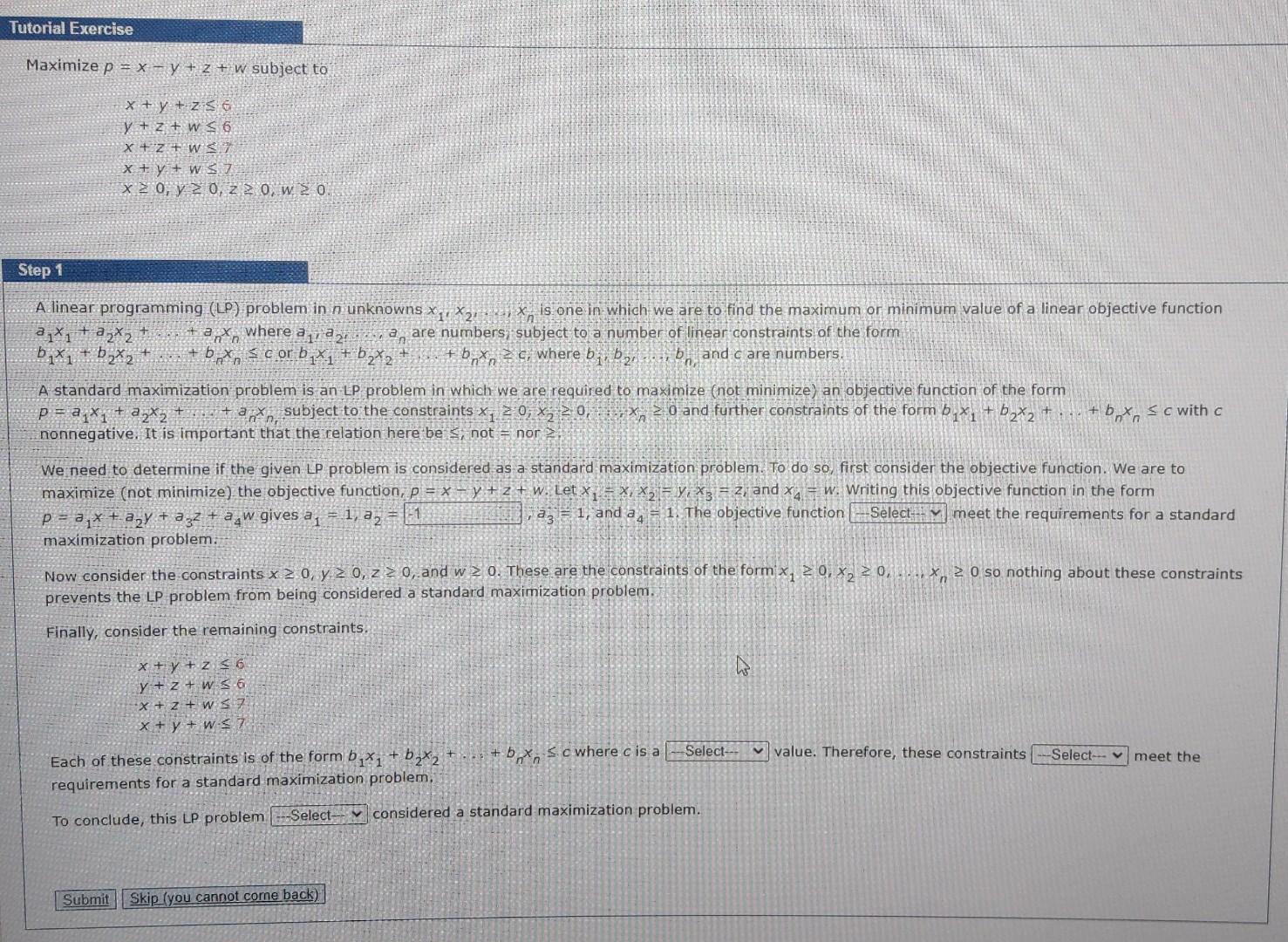
Tutorial Exercise Maximize p = x - y + z + w subject to x + y + ZS6 y + z t W S6 x + 2 + W51 x + y + W57 X 20, y 20, 220,w * 0. Step 1 A linear programming (LP) problem in n unknowns xq, X2: x is one in which we are to find the maximum or minimum value of a linear objective function 22 an to where a wraz a are numbers, subject to a number of linear constraints of the form b,x. + box, + + bx, scor b,x1 + b2x2 + banc, where biber on and c are numbers aqti A standard maximization problem is an LP problem in which we are required to maximize (not minimize) an objective function of the form P = a1X1 + a2x2 + subject to the constraints X1 2 0; x2 > 0, 0:n ? O and further constraints of the form biti+ b2x2 + nonnegative. It is important that the relation here be , not = nor , + box, sc with c We need to determine if the given LP problem is considered as a standard maximization problem. To do so, first consider the objective function. We are to maximize (not minimize) the objective function, p = x = y + 2 + w. Let x1 = x, X21= Y, X3 = 2, and x4 = w. Writing this objective function in the form P = a,x +azy + azz + aw gives a 1 = 1, az , az = 1, and a 4 = 1. The objective function ---Select--- M meet the requirements for a standard maximization problem. Now consider the constraints x 20, y 20,22 0, and w 2 0. These are the constraints of the form x, 2 0.x220, ....*, 20 so nothing about these constraints prevents the LP problem from being considered a standard maximization problem. Finally, consider the remaining constraints. x + y + z = 6 y + z + W-56 X + 2 + W57 x + y + W57 value. Therefore, these constraints -Select--- meet the Each of these constraints is of the form b,xi + b2x2 + ... + bhn sc where c is a Select-- requirements for a standard maximization problem, To conclude, this LP problem ---Select- considered a standard maximization problem. Submit Skip (you cannot come back)
Step by Step Solution
There are 3 Steps involved in it
1 Expert Approved Answer
Step: 1 Unlock

Question Has Been Solved by an Expert!
Get step-by-step solutions from verified subject matter experts
Step: 2 Unlock
Step: 3 Unlock
 Study Help