







Question: Tutorial Problem #3. As we discussed in lecture, a concentric cylinder viscometer is often used to measure the viscosity ( ) of Newtonian fluids. As
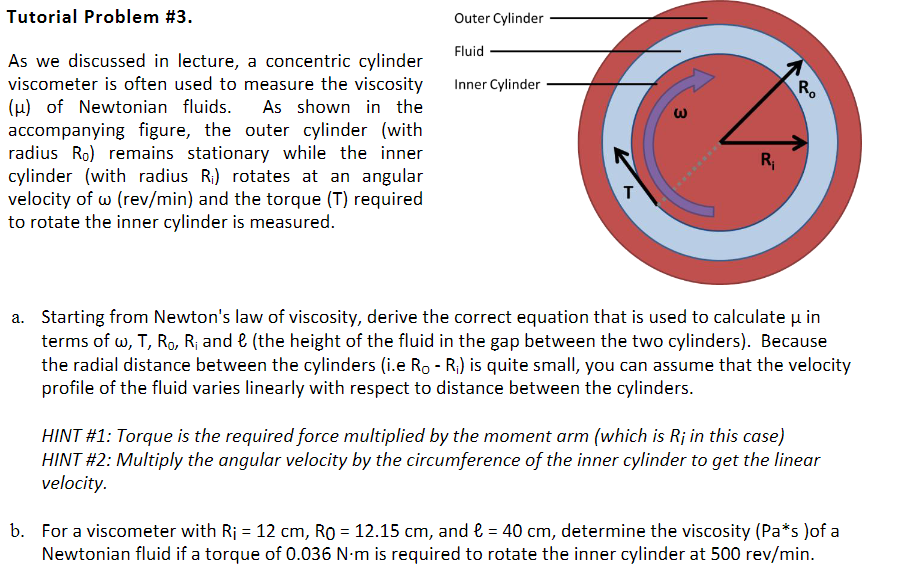
Tutorial Problem \#3. As we discussed in lecture, a concentric cylinder viscometer is often used to measure the viscosity ( ) of Newtonian fluids. As shown in the accompanying figure, the outer cylinder (with radius R0 ) remains stationary while the inner cylinder (with radius Ri ) rotates at an angular velocity of (rev/min) and the torque (T) required to rotate the inner cylinder is measured. a. Starting from Newton's law of viscosity, derive the correct equation that is used to calculate in terms of ,T,R0,Ri and (the height of the fluid in the gap between the two cylinders). Because the radial distance between the cylinders (i.e RRi ) is quite small, you can assume that the velocity profile of the fluid varies linearly with respect to distance between the cylinders. HINT \#1: Torque is the required force multiplied by the moment arm (which is Rj in this case) HINT \#2: Multiply the angular velocity by the circumference of the inner cylinder to get the linear velocity. b. For a viscometer with Rii=12cm,R0=12.15cm, and l=40cm, determine the viscosity (Pa*s )of a Newtonian fluid if a torque of 0.036Nm is required to rotate the inner cylinder at 500rev/min
Step by Step Solution
There are 3 Steps involved in it

Get step-by-step solutions from verified subject matter experts
 Study Help