







Question: Tweaking the Initial Assembly-Line Design From past experience, the engineering manager has found that the initial assembly-line design supplied by the engineers often needs to
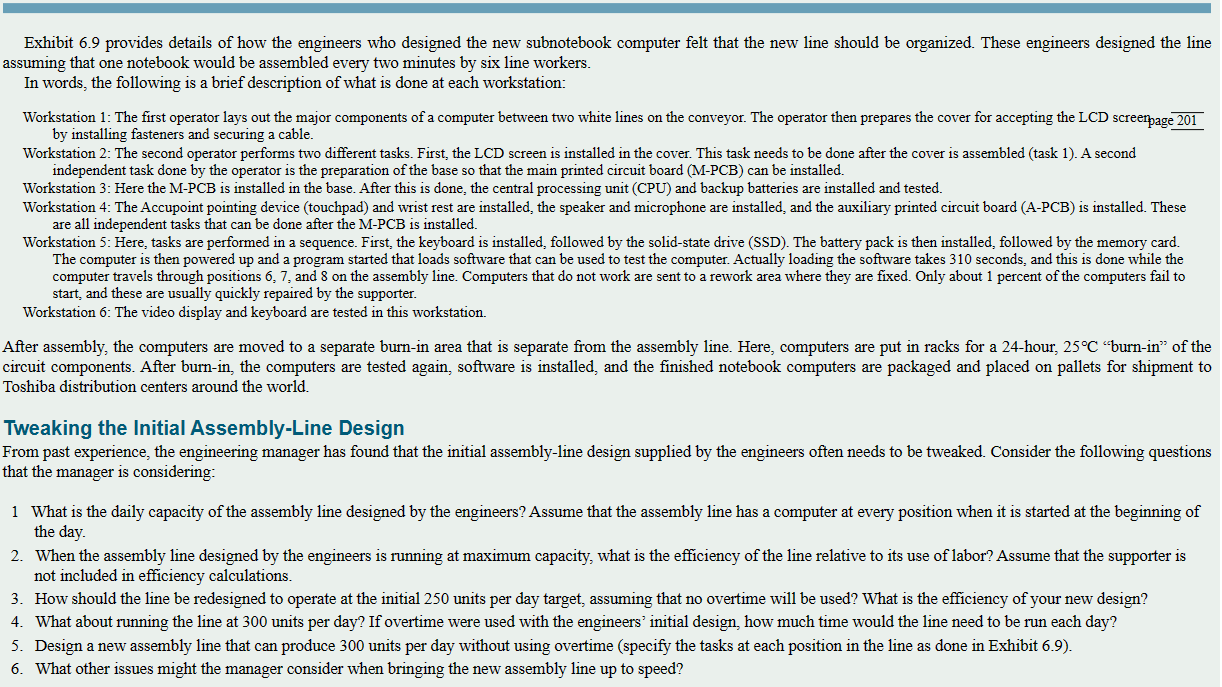
Tweaking the Initial Assembly-Line Design From past experience, the engineering manager has found that the initial assembly-line design supplied by the engineers often needs to be tweaked. Consider the following questions that the manager is considering:
1What is the daily capacity of the assembly line designed by the engineers? Assume that the assembly line has a computer at every position when it is started at the beginning of the day.
2.When the assembly line designed by the engineers is running at maximum capacity, what is the efficiency of the line relative to its use of labor? Assume that the supporter is not included in efficiency calculations.
3.How should the line be redesigned to operate at the initial 250 units per day target, assuming that no overtime will be used? What is the efficiency of your new design?
4.What about running the line at 300 units per day? If overtime were used with the engineers initial design, how much time would the line need to be run each day?
5.Design a new assembly line that can produce 300 units per day without using overtime (specify the tasks at each position in the line as done in Exhibit 6.9).
6.What other issues might the manager consider when bringing the new assembly line up to speed?
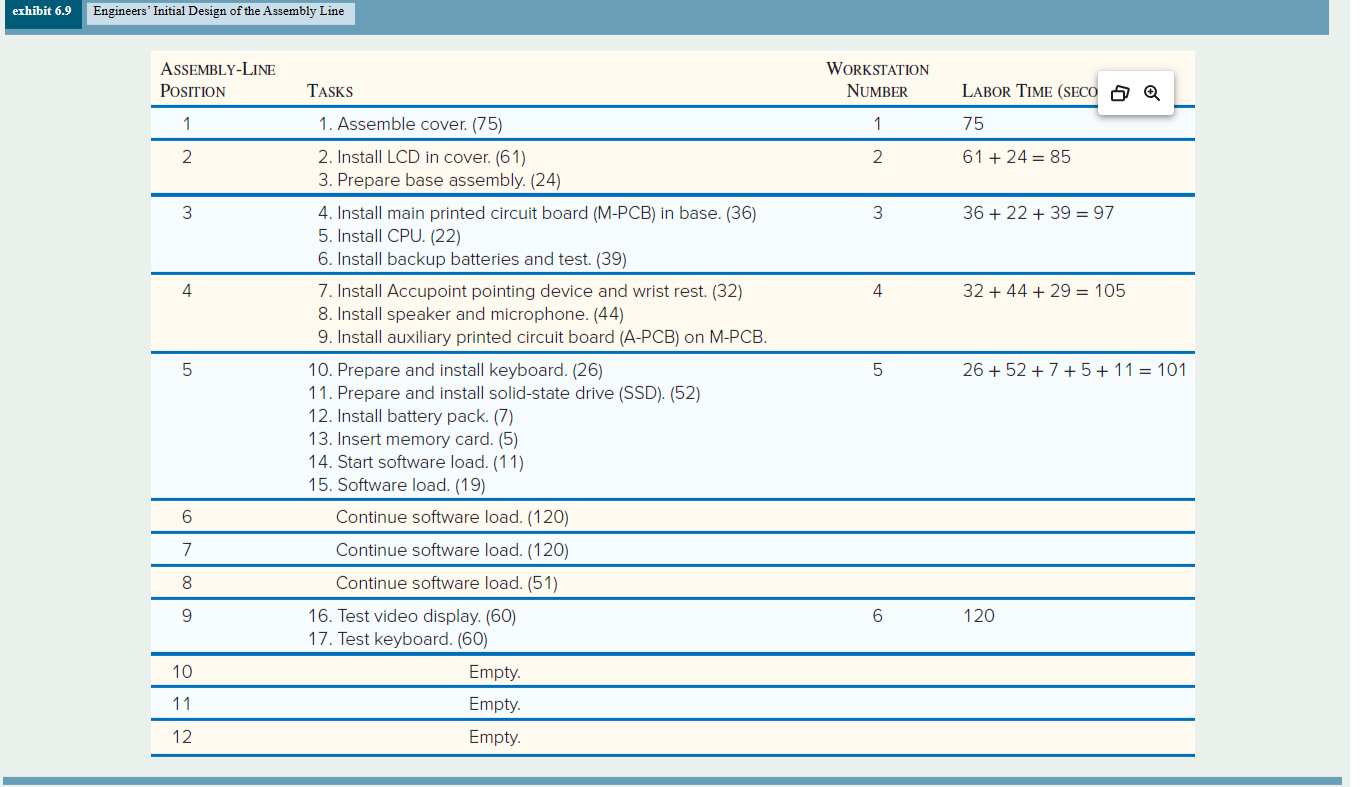
exhibit 6.9 Engineers' Initial Design of the Assembly Line Exhibit 6.9 provides details of how the engineers who designed the new subnotebook computer felt that the new line should be organized. These engineers designed the line assuming that one notebook would be assembled every two minutes by six line workers. In words, the following is a brief description of what is done at each workstation: Workstation 1: The first operator lays out the major components of a computer between two white lines on the conveyor. The operator then prepares the cover for accepting the LCD screetpage 201 by installing fasteners and securing a cable. Workstation 2: The second operator performs two different tasks. First, the LCD screen is installed in the cover. This task needs to be done after the cover is assembled (task 1). A second independent task done by the operator is the preparation of the base so that the main printed circuit board (M-PCB) can be installed. Workstation 3: Here the M-PCB is installed in the base. After this is done, the central processing unit (CPU) and backup batteries are installed and tested. Workstation 4: The Accupoint pointing device (touchpad) and wrist rest are installed, the speaker and microphone are installed, and the auxiliary printed circuit board (A-PCB) is installed. These are all independent tasks that can be done after the MPCB is installed. Workstation 5: Here, tasks are performed in a sequence. First, the keyboard is installed, followed by the solid-state drive (SSD). The battery pack is then installed, followed by the memory card. The computer is then powered up and a program started that loads software that can be used to test the computer. Actually loading the software takes 310 seconds, and this is done while the computer travels through positions 6,7 , and 8 on the assembly line. Computers that do not work are sent to a rework area where they are fixed. Only about 1 percent of the computers fail to start, and these are usually quickly repaired by the supporter. Workstation 6: The video display and keyboard are tested in this workstation. After assembly, the computers are moved to a separate burn-in area that is separate from the assembly line. Here, computers are put in racks for a 24 -hour, 25C "burn-in" of the circuit components. After burn-in, the computers are tested again, software is installed, and the finished notebook computers are packaged and placed on pallets for shipment to Toshiba distribution centers around the world. Tweaking the Initial Assembly-Line Design From past experience, the engineering manager has found that the initial assembly-line design supplied by the engineers often needs to be tweaked. Consider the following questions that the manager is considering: 1 What is the daily capacity of the assembly line designed by the engineers? Assume that the assembly line has a computer at every position when it is started at the beginning of the day. 2. When the assembly line designed by the engineers is running at maximum capacity, what is the efficiency of the line relative to its use of labor? Assume that the supporter is not included in efficiency calculations. 3. How should the line be redesigned to operate at the initial 250 units per day target, assuming that no overtime will be used? What is the efficiency of your new design? 4. What about running the line at 300 units per day? If overtime were used with the engineers' initial design, how much time would the line need to be run each day? 5. Design a new assembly line that can produce 300 units per day without using overtime (specify the tasks at each position in the line as done in Exhibit 6.9 ). 6. What other issues might the manager consider when bringing the new assembly line up to speed
Step by Step Solution
There are 3 Steps involved in it

Get step-by-step solutions from verified subject matter experts
 Study Help