



Question: Two agents meet to trade two goods. Agent 1 has preferences representable by utility func tion u1(m(1)) = m1)(mgl))3, while agent 2's preferences are representable
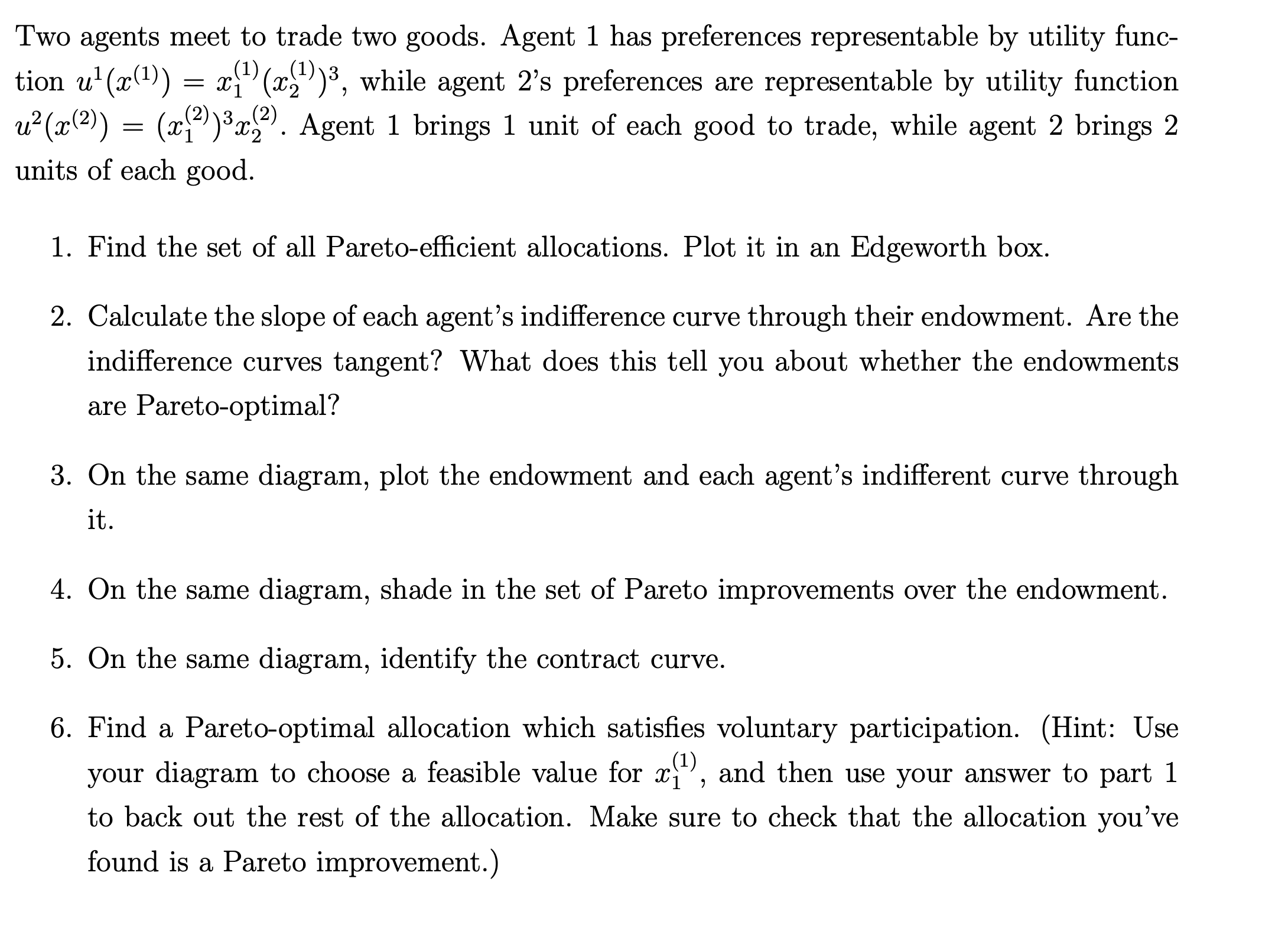
Two agents meet to trade two goods. Agent 1 has preferences representable by utility func tion u1(m(1)) = m1)(mgl))3, while agent 2's preferences are representable by utility function 130139)) = (11:52))33052). Agent 1 brings 1 unit of each good to trade, while agent 2 brings 2 units of each good. 1. Find the set of all Pareto-efcient allocations. Plot it in an Edgeworth box. 2. Calculate the slope of each agent's indifference curve through their endowment. Are the indifference curves tangent? What does this tell you about whether the endowments are Paretooptimal? 3. On the same diagram, plot the endowment and each agent's indifferent curve through it. 4. On the same diagram, shade in the set of Pareto improvements over the endowment. 5. On the same diagram, identify the contract curve. 6. Find a Paretooptimal allocation which satises voluntary participation. (Hint: Use your diagram to choose a feasible value for mil), and then use your answer to part 1 to back out the rest of the allocation. Make sure to check that the allocation you've found is a Pareto improvement.)
Step by Step Solution
There are 3 Steps involved in it

Get step-by-step solutions from verified subject matter experts