







Question: two algorithms for the selection problem, one simple randomized and one sophisticated deterministic algorithm. We learned that the recurrence for running time of the determinist
two algorithms for the selection problem, one simple randomized and one sophisticated deterministic algorithm. We learned that the recurrence for running time of the determinist algorithm is T(n) = T(1/5n)+T( 7/10n)+ (n) 1. Here T(1/5n) comes from Step 3 (see page 220) and T( 7/10n) from Step 5. What happens to the recurrence if each group size is 7, instead of 5? More precisely, you will get a new recurrence of the same form, T(n) = T(an) + T(bn) + (n). Then, what are a and b?
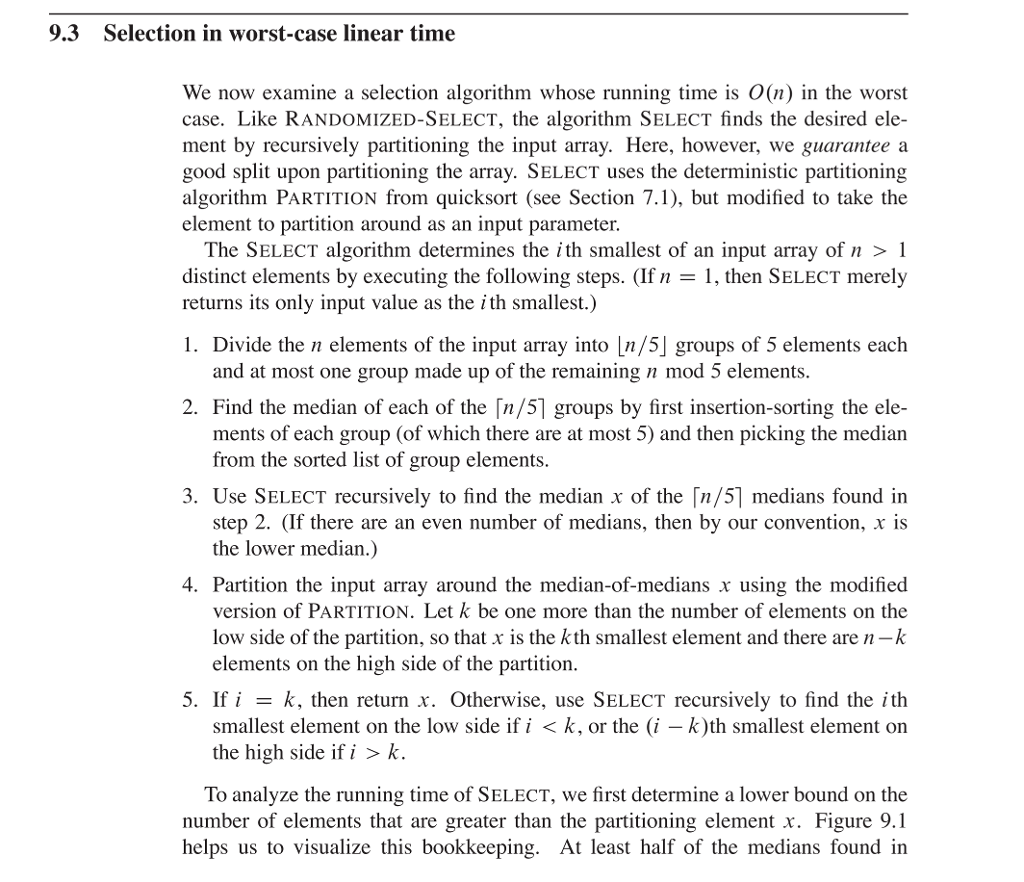
9.3 Selection in worst-case linear time We now examine a selection algorithm whose running time is O (n) in the worst case. Like RANDOMIZED-SELECT, the algorithm SELECT finds the desired ele ment by recursively partitioning the input array Here, however, we guarantee a good split upon partitioning the array. SELECT uses the deterministic partitioning algorithm PARTITION from quicksort (see Section 7.1), but modified to take the element to partition around as an input parameter. The SELECT algorithm determines the ith smallest of an input array of n 1 distinct elements by executing the following steps. (If n l, then SELECT merely returns its only input value as the ith smallest.) 1. Divide the n elements of the input array into Ln/5 groups of 5 elements each and at most one group made up of the remaining n mod 5 elements 2. Find the median of each of the n/51 groups by first insertion-sorting the ele- ments of each group (of which there are at most 5) and then picking the median from the sorted list of group elements. 3. Use SELECT recursively to find the median x of the n/51 medians found in Step 2. If there are an even number of medians, then by our convention, x is the lower median.) 4. Partition the input array around the median-of-medians x using the modified version of PARTITION. Let k be one more than the number of elements on the low side of the partition, so that x is the kth smallest element and there are n-k elements on the high side of the partition 5. If i k, then return x. Otherwise, use SELECT recursively to find the ith smallest element on the low side if i k, or the (i -k)th smallest element on the high side if i >k. To analyze the running time of SELECT, we first determine a lower bound on the number of elements that are greater than the partitioning element x. Figure 9.1 helps us to visualize this bookkeeping. At least half of the medians found in
Step by Step Solution
There are 3 Steps involved in it

Get step-by-step solutions from verified subject matter experts
 Study Help