







Question: Two independent samples occur when (1) in one sample are not paired with observations in the other sample. When a t test is conducted for
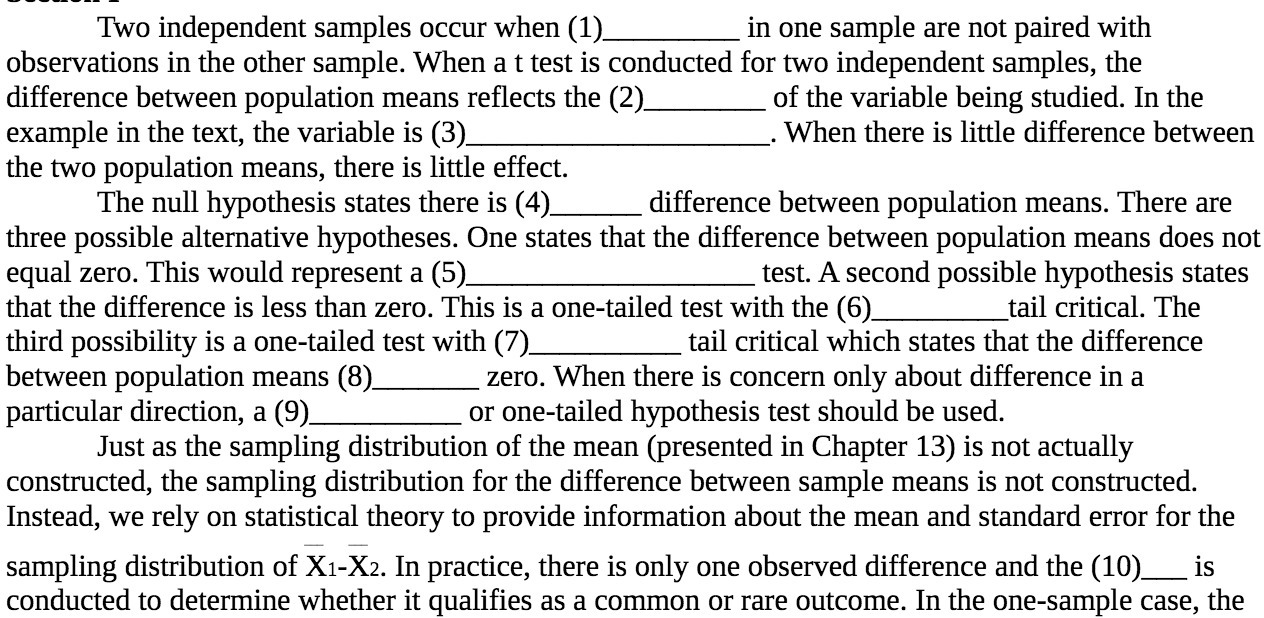
Two independent samples occur when (1) in one sample are not paired with observations in the other sample. When a t test is conducted for two independent samples, the difference between population means reects the (2) of the variable being studied. In the example in the text, the variable is (3) . When there is little difference between the two population means, there is little effect. The null hypothesis states there is (4) difference between population means. There are three possible alternative hypotheses. One states that the difference between population means does not equal zero. This would represent a (5) test. A second possible hypothesis states that the difference is less than zero. This is a one-tailed test with the (6) tail critical. The third possibility is a one-tailed test with (7) tail critical which states that the difference between population means (8) zero. When there is concern only about difference in a particular direction, a (9) or one-tailed hypothesis test should be used. Just as the sampling distribution of the mean (presented in Chapter 13) is not actually constructed, the sampling distribution for the difference between sample means is not constructed. Instead, we rely on statistical theory to provide information about the mean and standard error for the sampling distribution of I(i-iz. In practice, there is only one observed difference and the (10)_ is conducted to determine whether it qualifies as a common or rare outcome. In the one-sample case, the
Step by Step Solution
There are 3 Steps involved in it

Get step-by-step solutions from verified subject matter experts
 Study Help