



Question: Two individuals, A and B, with preferences over a private good, xi, and a public good, G, represented by the utility function, U(xi, G) =
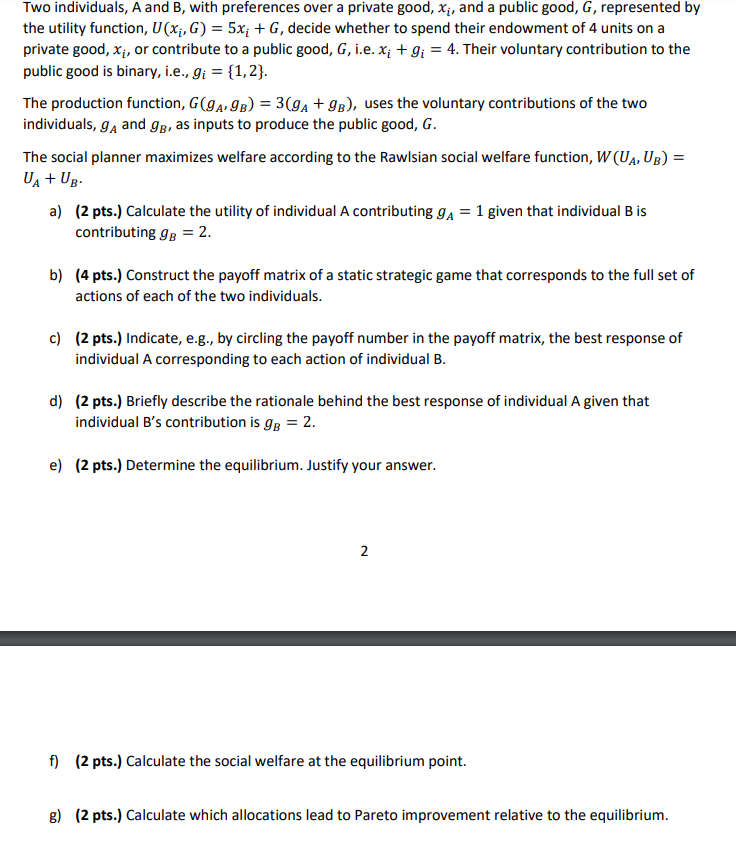
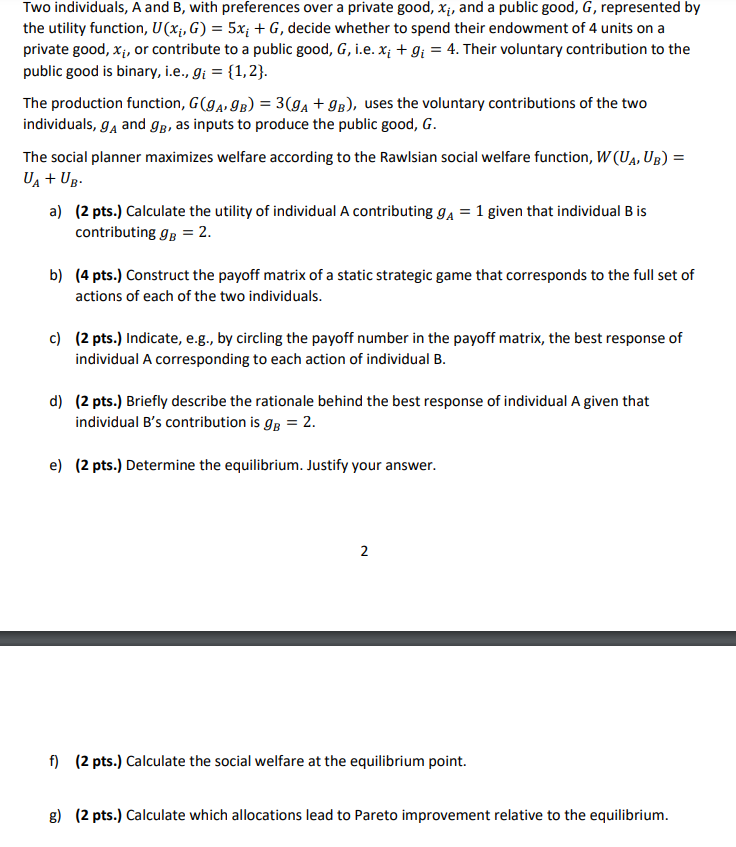
Two individuals, A and B, with preferences over a private good, xi, and a public good, G, represented by the utility function, U(xi, G) = 5x, + G, decide whether to spend their endowment of4 units on a private good, x,-, or contribute to a public good, 6, Le. x,- + g, : 4. Their voluntary contribution to the public good is binary, i.e., g,- : {1, 2}. The production function, Gmmggj : 3(9',! + g3), uses the voluntary contributions ofthe two individuals, ya and 9"}, as inputs to produce the public good, G. The social planner maximizes welfare according to the Rawlsian social welfare function, WlfUA, U3] : UA + US. a] {2 pts.) Calculate the utility ofindividual A contributing gA : 1 given that individual Bis contributing QB : 2. b} {4 pts.] Construct the payoff matrix of a static strategic game that corresponds to the full set of actions of each of the two individuals. c] {2 pts.] Indicate, e.g., by circling the payoff number in the payoff matrix, the best response of individual A corresponding to each action of individual B. d} {2 pts.) Briefly describe the rationale behind the best response of individual A given that individual B's contribution is ya = 2. e} {2 pts.] Determine the equilibrium. Justify your answer. f] {2 pts.) Calculate the social welfare at the equilibrium point. g} {2 pts.] Calculate which allocations lead to Pareto improvement relative to the equilibrium
Step by Step Solution
There are 3 Steps involved in it

Get step-by-step solutions from verified subject matter experts