







Question: Two LAN segments in two remote buildings are to be connected using wireless bridging. The first building is 10 meters high, while the second
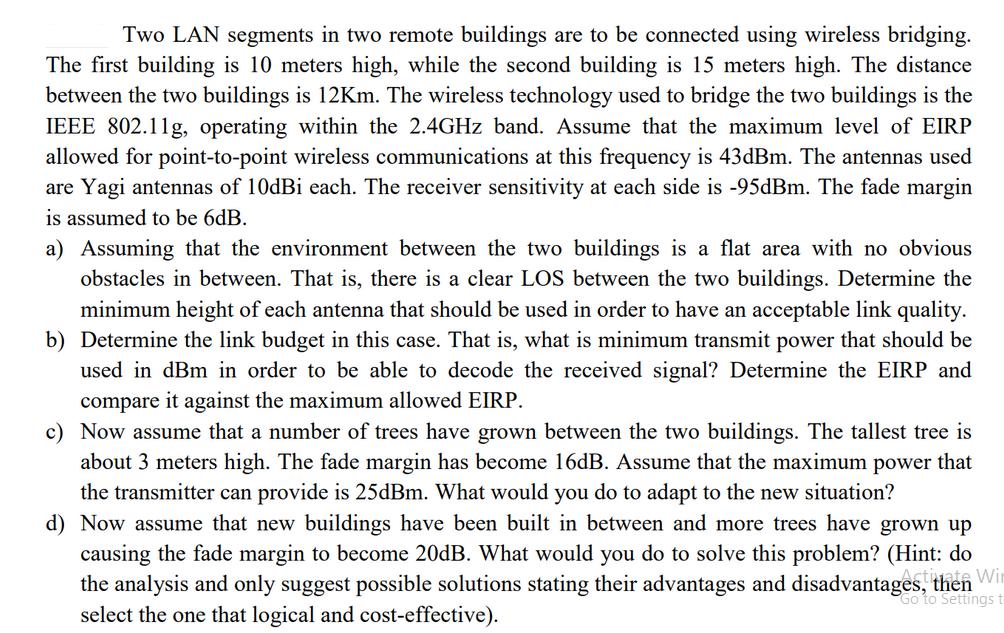
Two LAN segments in two remote buildings are to be connected using wireless bridging. The first building is 10 meters high, while the second building is 15 meters high. The distance between the two buildings is 12Km. The wireless technology used to bridge the two buildings is the IEEE 802.11g, operating within the 2.4GHz band. Assume that the maximum level of EIRP allowed for point-to-point wireless communications at this frequency is 43dBm. The antennas used are Yagi antennas of 10dBi each. The receiver sensitivity at each side is -95dBm. The fade margin is assumed to be 6dB. a) Assuming that the environment between the two buildings is a flat area with no obvious obstacles in between. That is, there is a clear LOS between the two buildings. Determine the minimum height of each antenna that should be used in order to have an acceptable link quality. b) Determine the link budget in this case. That is, what is minimum transmit power that should be used in dBm in order to be able to decode the received signal? Determine the EIRP and compare it against the maximum allowed EIRP. c) Now assume that a number of trees have grown between the two buildings. The tallest tree is about 3 meters high. The fade margin has become 16dB. Assume that the maximum power that the transmitter can provide is 25dBm. What would you do to adapt to the new situation? d) Now assume that new buildings have been built in between and more trees have grown up causing the fade margin to become 20dB. What would you do to solve this problem? (Hint: do the analysis and only suggest possible solutions stating their advantages and disadvantages, then Wir select the one that logical and cost-effective). Go to Settings t
Step by Step Solution
There are 3 Steps involved in it
a To determine the minimum height of each antenna for an acceptable link quality we can use the Fresnel zone clearance calculation The Fresnel zone is ... View full answer

Get step-by-step solutions from verified subject matter experts
 Study Help