







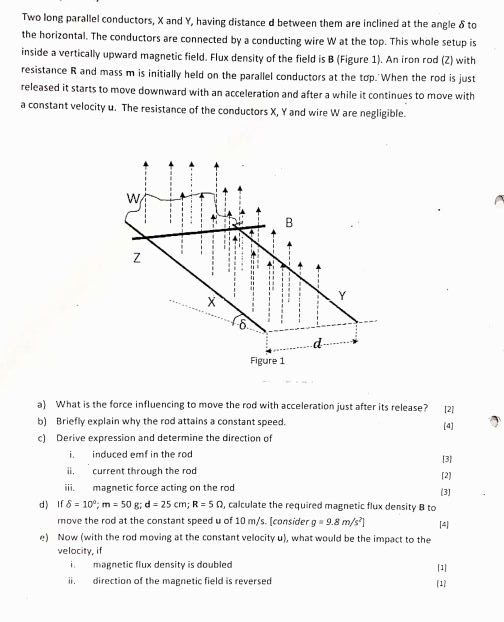
Question: Two long parallel conductors, X and Y , having distance d between them are inclined at the angle ( delta ) to
Two long parallel conductors, X and Y having distance d between them are inclined at the angle delta to the horizontal. The conductors are connected by a conducting wire W at the top. This whole setup is inside a vertically upward magnetic field. Flux density of the field is B Figure An iron rod Z with resistance mathbfR and mass m is initially held on the parallel conductors at the top. When the rod is just released it starts to move downward with an acceleration and after a while it continues to move with a constant velocity u The resistance of the conductors mathrmXmathrmY and wire W are negligible.
a What is the force influencing to move the rod with acceleration just after its release?
b Briefly explain why the rod attains a constant speed.
c Derive expression and determine the direction of
i induced emf in the rod
ii current through the rod
iii. magnetic force acting on the rod
d If deltacirc ; mathrmmmathrm~g ; mathrmdmathrm~cm ; mathrmROmega calculate the required magnetic flux density B to move the rod at the constant speed u of mathrm~mmathrmsconsider gmathrm~mmathrms
e Now with the rod moving at the constant velocity u what would be the impact to the velocity, if
i magnetic flux density is doubled
ii direction of the magnetic field is reversed
Step by Step Solution
There are 3 Steps involved in it
1 Expert Approved Answer
Step: 1 Unlock

Question Has Been Solved by an Expert!
Get step-by-step solutions from verified subject matter experts
Step: 2 Unlock
Step: 3 Unlock
 Study Help