Question: Two medical laboratories (lab 1 and lab 2) join forces to develop a new antibiotic. Each laboratory must decide how many researchers to assign to
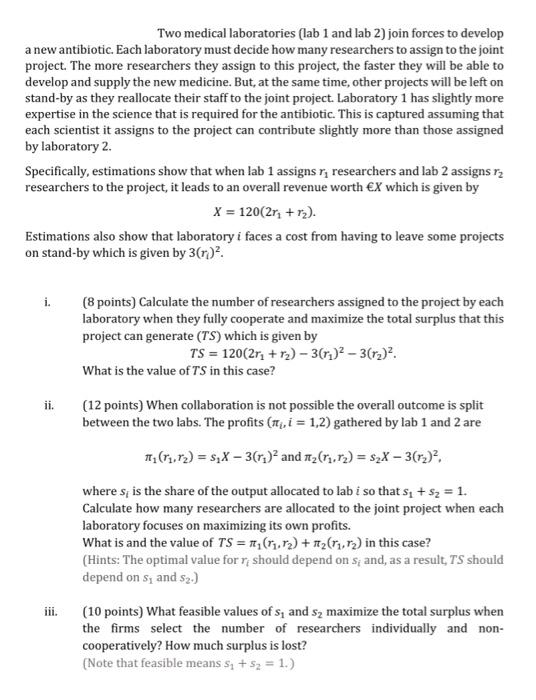
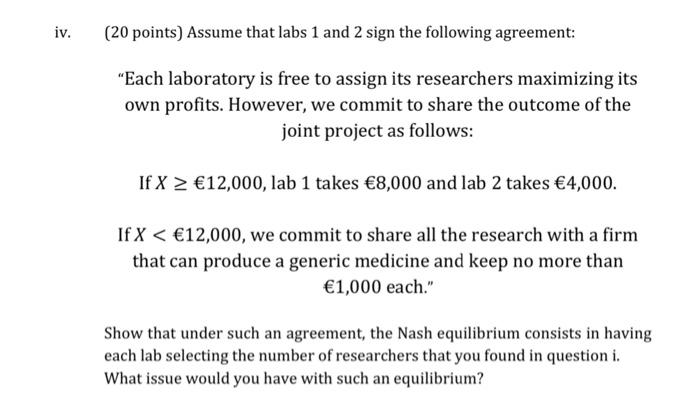
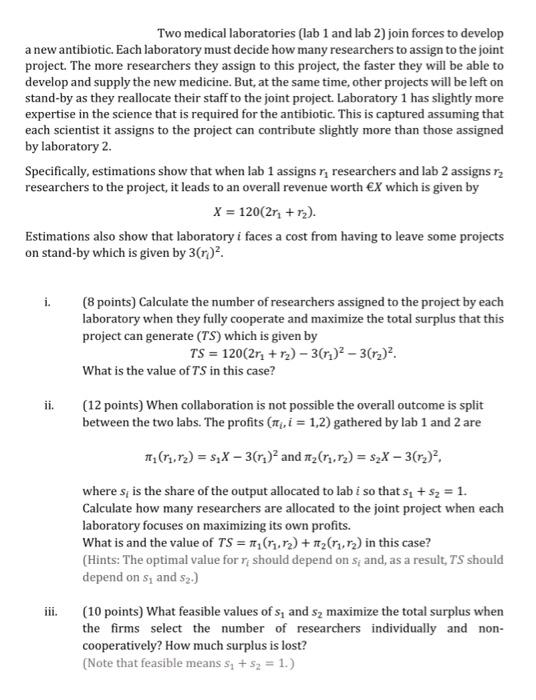
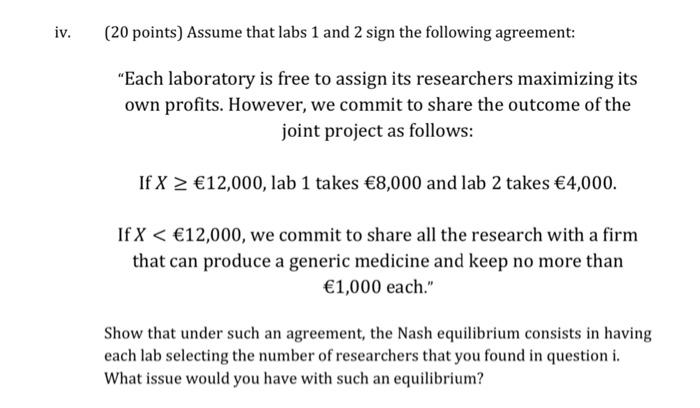
Two medical laboratories (lab 1 and lab 2) join forces to develop a new antibiotic. Each laboratory must decide how many researchers to assign to the joint project. The more researchers they assign to this project, the faster they will be able to develop and supply the new medicine. But, at the same time, other projects will be left on stand-by as they reallocate their staff to the joint project. Laboratory 1 has slightly more expertise in the science that is required for the antibiotic. This is captured assuming that each scientist it assigns to the project can contribute slightly more than those assigned by laboratory 2. Specifically, estimations show that when lab 1 assigns, researchers and lab 2 assigns rz researchers to the project, it leads to an overall revenue worth X which is given by X = 120(2t+ ra). Estimations also show that laboratory i faces a cost from having to leave some projects on stand-by which is given by 3(r)? i. (8 points) Calculate the number of researchers assigned to the project by each laboratory when they fully cooperate and maximize the total surplus that this project can generate (TS) which is given by TS = 120(2r, + r) -367)2 3(x2) What is the value of TS in this case? ii. (12 points) When collaboration is not possible the overall outcome is split between the two labs. The profits (i = 1,2) gathered by lab 1 and 2 are 111(1,1%) = s,X-3(r) and 12(11.12) = s X-3() where si is the share of the output allocated to lab i so that s1 + $a = 1. Calculate how many researchers are allocated to the joint project when each laboratory focuses on maximizing its own profits. What is and the value of TS = (1, 2) + 2(71,72) in this case? (Hints: The optimal value for r, should depend on s; and, as a result, TS should depend on S, and $2.) (10 points) What feasible values of sy and sy maximize the total surplus when the firms select the number of researchers individually and non- cooperatively? How much surplus is lost? (Note that feasible means , + 5z = 1.) iv. (20 points) Assume that labs 1 and 2 sign the following agreement: "Each laboratory is free to assign its researchers maximizing its own profits. However, we commit to share the outcome of the joint project as follows: If X > 12,000, lab 1 takes 8,000 and lab 2 takes 4,000. If X 12,000, lab 1 takes 8,000 and lab 2 takes 4,000. If X









 Study Help