







Question: Two players play two different simultaneous move games one after the other, the first game is called game A, the second one is called
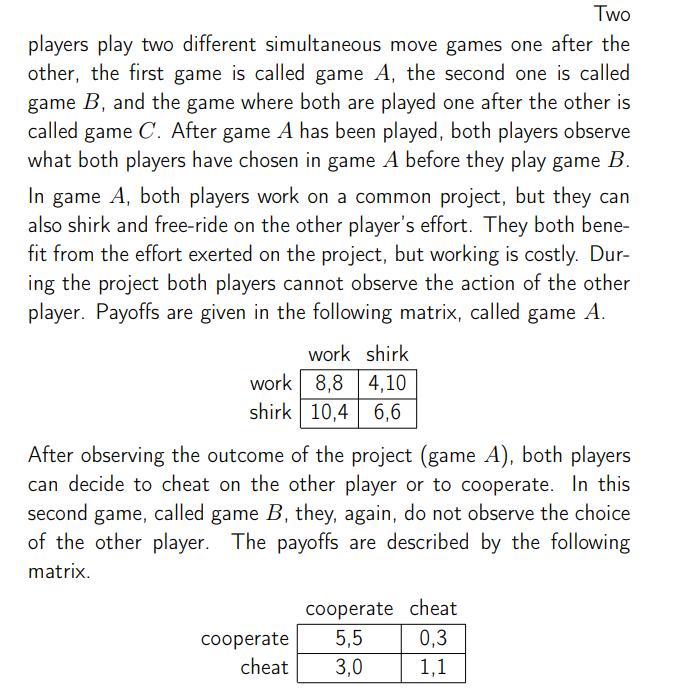
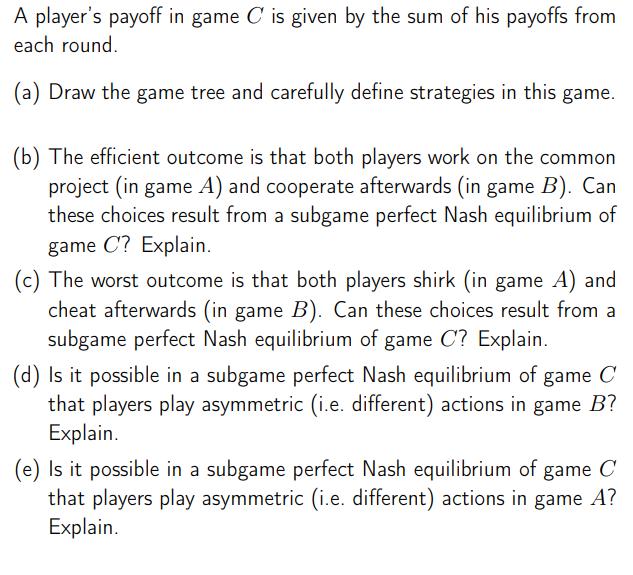
Two players play two different simultaneous move games one after the other, the first game is called game A, the second one is called game B, and the game where both are played one after the other is called game C. After game A has been played, both players observe what both players have chosen in game A before they play game B. In game A, both players work on a common project, but they can also shirk and free-ride on the other player's effort. They both bene- fit from the effort exerted on the project, but working is costly. Dur- ing the project both players cannot observe the action of the other player. Payoffs are given in the following matrix, called game A. work shirk work 8,8 4,10 shirk 10,4 6,6 After observing the outcome of the project (game A), both players can decide to cheat on the other player or to cooperate. In this second game, called game B, they, again, do not observe the choice of the other player. The payoffs are described by the following matrix. cooperate cheat cooperate cheat 5,5 0,3 3,0 1,1 A player's payoff in game C' is given by the sum of his payoffs from each round. (a) Draw the game tree and carefully define strategies in this game. (b) The efficient outcome is that both players work on the common project (in game A) and cooperate afterwards (in game B). Can these choices result from a subgame perfect Nash equilibrium of game C? Explain. (c) The worst outcome is that both players shirk (in game A) and cheat afterwards (in game B). Can these choices result from a subgame perfect Nash equilibrium of game C? Explain. (d) Is it possible in a subgame perfect Nash equilibrium of game C that players play asymmetric (i.e. different) actions in game B? Explain. (e) Is it possible in a subgame perfect Nash equilibrium of game C that players play asymmetric (i.e. different) actions in game A? Explain.
Step by Step Solution
There are 3 Steps involved in it
To answer these questions we need to analyze the strategic situation described by the payoff matrices for games A and B and then combine them into the overall game C Lets take each part one by one a D... View full answer

Get step-by-step solutions from verified subject matter experts
 Study Help