



Question: Two smooth disks A and B each have a mass of 0 . 5 kg . Both disks are moving with the velocities shown when
Two smooth disks A
and B
each have a mass of kg
Both disks are moving with the velocities shown when they collide. The coefficient of restitution is e
Suppose that vA
ms
vB
ms
Figure
Figure of
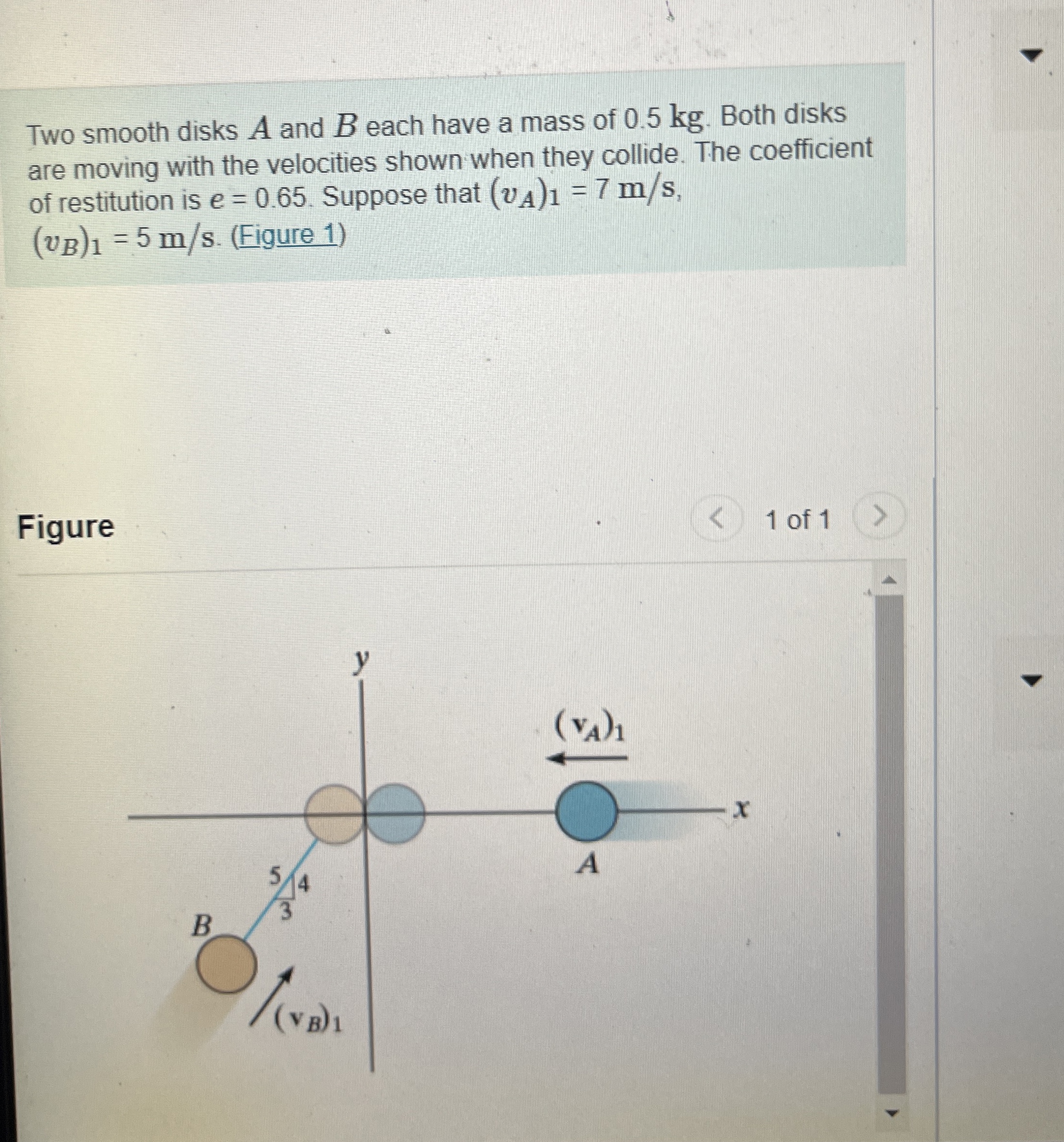
Two disks, A and B move towards the origin of the x y plane, where they collide. On collision, their common tangent lies on the vertical y axis. Disk A moves along the horizontal x axis in the negative x direction with velocity opening parenthesis v subscript A closing parenthesis subscript Block B moves from the third quadrant of the plane with velocity opening parenthesis v subscript B closing parenthesis subscript This velocity is directed along the hypotenuse of a right triangle with a horizontal leg of and a vertical leg of
Part A
Determine the magnitude of the final velocity of A
just after collision.
Express your answer to three significant figures and include the appropriate units.
Activate to select the appropriates template from the following choices. Operate up and down arrow for selection and press enter to choose the input value typeActivate to select the appropriates symbol from the following choices. Operate up and down arrow for selection and press enter to choose the input value type
vA
nothing
nothing
Request Answer
Part B
Determine the angle between the x
axis and the final velocity of A
just after the collision, measured counterclockwise from the positive x
axis.
Express your answer in degrees to three significant figures.
Activate to select the appropriates symbol from the following choices. Operate up and down arrow for selection and press enter to choose the input value type
theta
nothing
Request Answer
Part C
Determine the magnitude of the final velocity of B
just after collision.
Express your answer to three significant figures and include the appropriate units.
Activate to select the appropriates template from the following choices. Operate up and down arrow for selection and press enter to choose the input value typeActivate to select the appropriates symbol from the following choices. Operate up and down arrow for selection and press enter to choose the input value type
vB
nothing
nothing
Request Answer
Part D
Determine the angle between the x
axis and the final velocity of B
just after the collision, measured clockwise from the negative x
axis.
Express your answer using three significant figures.
Activate to select the appropriates symbol from the following choices. Operate up and down arrow for selection and press enter to choose the input value type
theta
nothing
Two smooth disks A and each have a mass of kg Both disks are moving with the velocities shown when they collide. The coefficient of restitution is Suppose that Figure
Figure
of
Determine the magnitude of the final velocity of A just after collision.
Express your answer to three significant figures and include the appropriate units.
Part B
Determine the angle between the axis and the final velocity of A just after the collision, measured counterclockwise from the positive axis
Express your answer in degrees to three significant figures.
Part C
Determine the magnitude of the final velocity of just after collision.
Express your answer to three significant figures and include the appropriate units.
Part D
Determine the angle between the axis and the final velocity of just after the collision, measured clockwise from the negative axis.
Express your answer using three significant figures.
Two smooth disks A and each have a mass of kg Both disks
are moving with the velocities shown when they collide. The coefficient
of restitution is Suppose that
Figure
Figure
Step by Step Solution
There are 3 Steps involved in it
1 Expert Approved Answer
Step: 1 Unlock

Question Has Been Solved by an Expert!
Get step-by-step solutions from verified subject matter experts
Step: 2 Unlock
Step: 3 Unlock