







Question: Two-Factor ANOVA Conspicuous consumption is when one buys fancy things to show off. It signals to potential mates that one can provide financially. It is
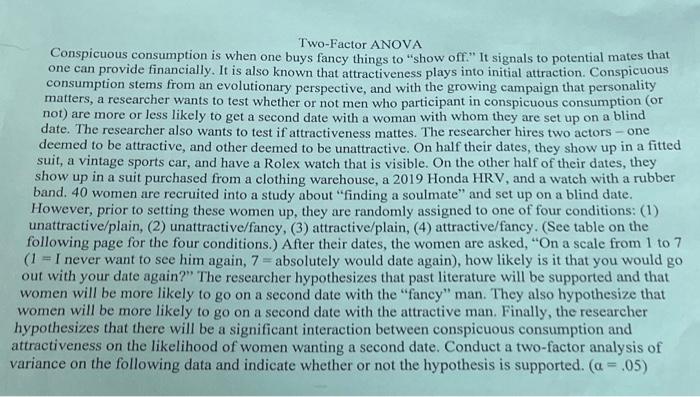
Two-Factor ANOVA Conspicuous consumption is when one buys fancy things to "show off." It signals to potential mates that one can provide financially. It is also known that attractiveness plays into initial attraction. Conspicuous consumption stems from an evolutionary perspective, and with the growing campaign that personality matters, a researcher wants to test whether or not men who participant in conspicuous consumption (or not) are more or less likely to get a second date with a woman with whom they are set up on a blind date. The researcher also wants to test if attractiveness mattes. The researcher hires two actors - one deemed to be attractive, and other deemed to be unattractive. On half their dates, they show up in a fitted suit, a vintage sports car, and have a Rolex watch that is visible. On the other half of their dates, they show up in a suit purchased from a clothing warehouse, a 2019 Honda HRV, and a watch with a rubber band. 40 women are recruited into a study about "finding a soulmate" and set up on a blind date. However, prior to setting these women up, they are randomly assigned to one of four conditions: (1) unattractive/plain, (2) unattractive/fancy, (3) attractive/plain, (4) attractive/fancy. (See table on the following page for the four conditions.) After their dates, the women are asked, "On a scale from 1 to 7 ( 1 = I never want to see him again, 7= absolutely would date again), how likely is it that you would go out with your date again?" The researcher hypothesizes that past literature will be supported and that women will be more likely to go on a second date with the "fancy" man. They also hypothesize that women will be more likely to go on a second date with the attractive man. Finally, the researcher typothesizes that there will be a significant interaction between conspicuous consumption and ttractiveness on the likelihood of women wanting a second date. Conduct a two-factor analysis of ariance on the following data and indicate whether or not the hypothesis is supported. (=.05) Two-Factor ANOVA Conspicuous consumption is when one buys fancy things to "show off." It signals to potential mates that one can provide financially. It is also known that attractiveness plays into initial attraction. Conspicuous consumption stems from an evolutionary perspective, and with the growing campaign that personality matters, a researcher wants to test whether or not men who participant in conspicuous consumption (or not) are more or less likely to get a second date with a woman with whom they are set up on a blind date. The researcher also wants to test if attractiveness mattes. The researcher hires two actors - one deemed to be attractive, and other deemed to be unattractive. On half their dates, they show up in a fitted suit, a vintage sports car, and have a Rolex watch that is visible. On the other half of their dates, they show up in a suit purchased from a clothing warehouse, a 2019 Honda HRV, and a watch with a rubber band. 40 women are recruited into a study about "finding a soulmate" and set up on a blind date. However, prior to setting these women up, they are randomly assigned to one of four conditions: (1) unattractive/plain, (2) unattractive/fancy, (3) attractive/plain, (4) attractive/fancy. (See table on the following page for the four conditions.) After their dates, the women are asked, "On a scale from 1 to 7 ( 1 = I never want to see him again, 7= absolutely would date again), how likely is it that you would go out with your date again?" The researcher hypothesizes that past literature will be supported and that women will be more likely to go on a second date with the "fancy" man. They also hypothesize that women will be more likely to go on a second date with the attractive man. Finally, the researcher typothesizes that there will be a significant interaction between conspicuous consumption and ttractiveness on the likelihood of women wanting a second date. Conduct a two-factor analysis of ariance on the following data and indicate whether or not the hypothesis is supported. (=.05)
Step by Step Solution
There are 3 Steps involved in it

Get step-by-step solutions from verified subject matter experts
 Study Help