







Question: Type a The data: Evaluating medical procedures ~ The following data refer to a study comparing treatments for kidney stones. Kidney stones are hard deposits

Type a The data: Evaluating medical procedures ~The following data refer to a study comparing treatments for kidney stones. Kidney stones are hard deposits of minerals and salts that accumulate over time as kidneys clean blood circulating throughout the body. As they increase in size, they can cause extreme pain, infection, and pose a serious health risk to the individual. In many cases, kidney stones are able to pass through the urinary system without medical assistance (although this does cause substantial pain!). Individuals diagnosed with larger kidney stones typically undergo an operation to remove them. Two of the treatments studied were Treatment A = open surgery,an invasive procedure that requires substantial patient recovery time and Treatment B = percutaneous nephrolithotomy, a less invasive procedure where a small scope is inserted through an incision in your back to remove the kidney stones. Treatments were deemed 'successful' if, after three months, the kidney stones were either eliminated or less than 2 mm. The goal of this study was to answer the following question:
The latter treatment (nephrolithotomy) is cheaper and less invasive, but is it as successful?
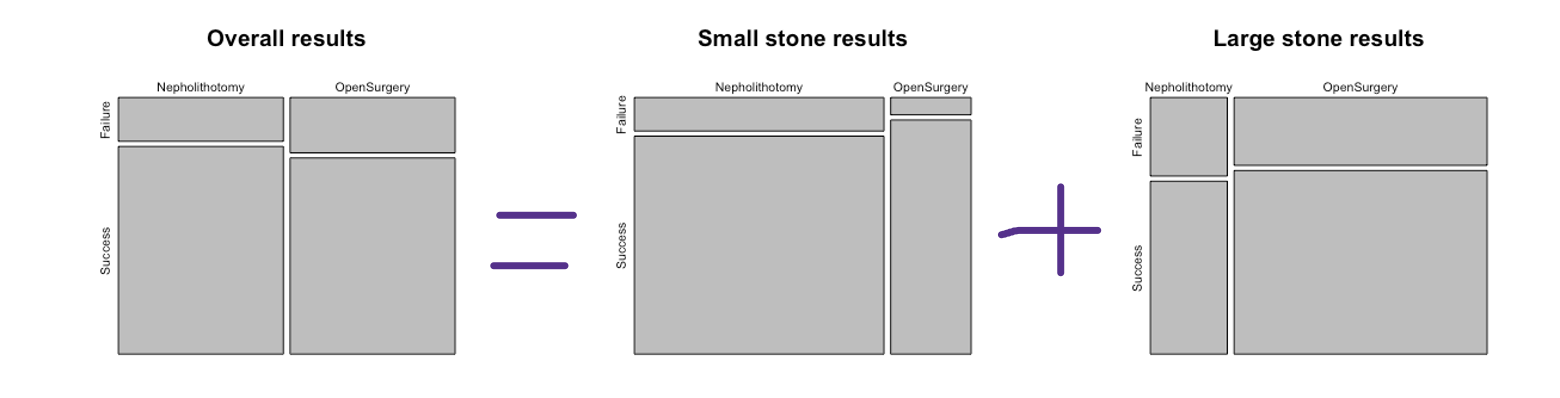
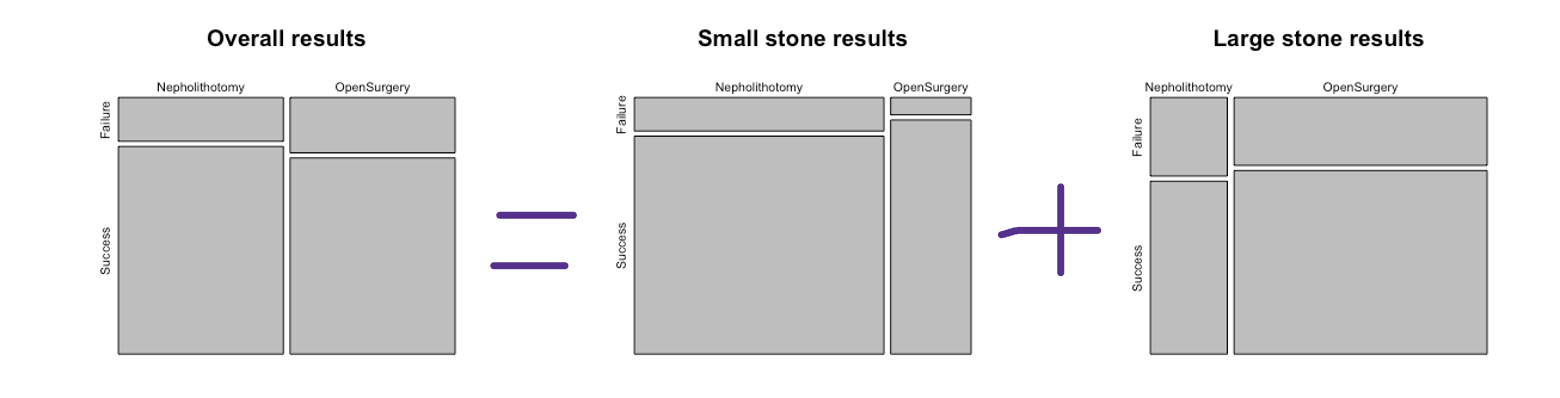
The tables below show the global results of the two treatment types along with the results of each treatment when the size of the kidney stones removed are taken into consideration. A kidney stone is considered large if it is initially more than 5 mm in diameter when detected and small if it is between 2 and 5 mm.
Overall results | Small stones (under 5mm) | Large stones (5 mm or greater) | |||||||||
Treatment | Success | Failure | Total | Success | Failure | Total | Success | Failure | Total | ||
Open surgery | 273 | 77 | 350 | 81 | 6 | 87 | 192 | 71 | 263 | ||
Nephrolithotomy | 289 | 61 | 350 | 234 | 36 | 270 | 55 | 25 | 80 | ||
Total | 562 | 138 | 700 | 315 | 42 | 357 | 247 | 96 | 343 |
Prompt for Peer Writing Assignment 2
Read through the brief statistical report on the following pages, provided to you in bold words under the heading The analysis. Draft a page response that offers constructive feedback for this group that they could use to edit and improve their work. The questions below offer possible topics you should address in your response.
- Do you agree with the authors' final conclusion regarding when to apply Treatment A and when to apply Treatment B? Explain why or why not, either referencing the original data directly or the arguments made by the authors.
- How did the authors address Simpson's Paradox in their response?
- Identify one passage (you may quote it) that is particularly striking to you as readers. This passage can be something you vigorously agree or disagree with, something you find surprising or confusing. Explain why this passage stands out to you and your teammates.
- Identify one or more elements of the authors' report (such as the formatting, the structure, the style of writing, etc.) that you think will influence your group's writing submissions in the future.
As always, remember to include in your submission your Group Number along with the names and NetIDs of all contributing group members.
The analysis
To whom it may concern:
This memo has been written to give guidance to our surgeons about when it is better to use Open Surgery (OS) and when it is better to use Nephrolithotomy (N) in treating kidney stones. Let's first give an overview of kidney stone removal procedures at our hospital, overall. We analyzed 700 procedures and for each one recorded the size of kidney stones removed (large or small) whether the procedure was successful (yes or no) and which procedure was applied (OS or N).

\fOverall results Small stone results Large stone results OpenSurgery OpenSurgery Nepholithotomy OpenSurgery Nepholithotomy Nepholithotomy Failure Failure Failure Success Success + Success
Step by Step Solution
There are 3 Steps involved in it

Get step-by-step solutions from verified subject matter experts
 Study Help