







Question: Type or paste question here ) Control Systems consist of preliminary controls, concurrent controls, rework controls, and damage controls. This case deals with what type(s)
Type or paste question here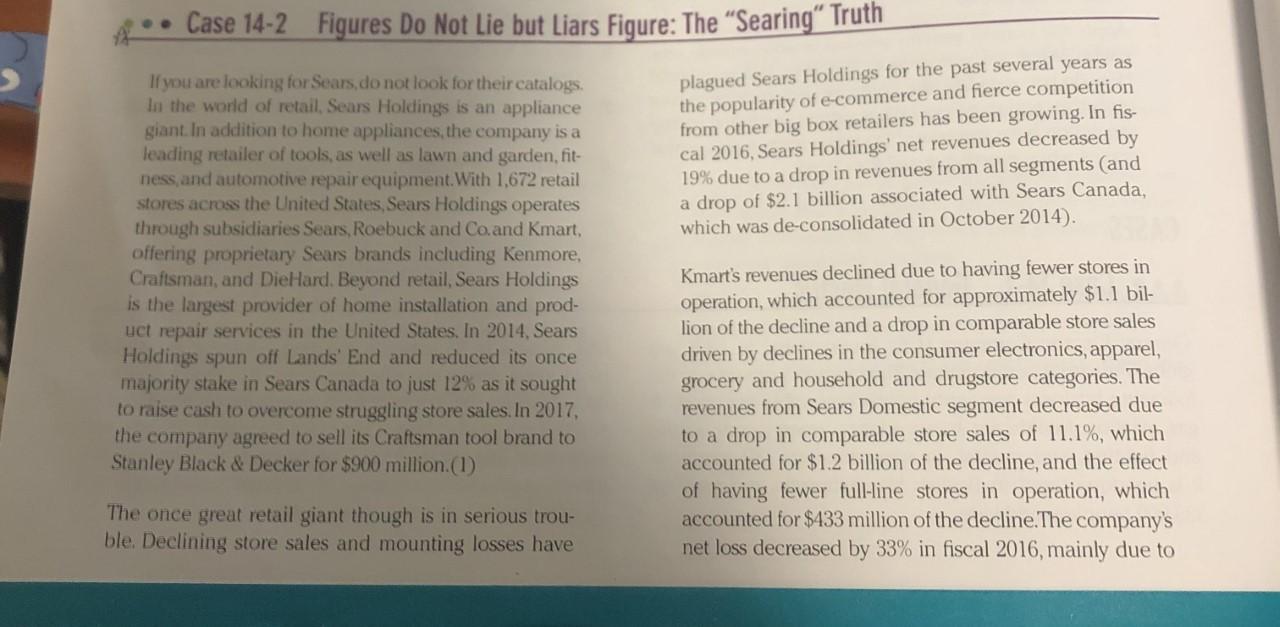
) Control Systems consist of preliminary controls, concurrent controls, rework controls, and damage controls. This case deals with what type(s) of control system?
) Which functional control system(s) are directly addressed in this case?
) The controls discussed in this case fall into which one of the three control frequencies?
) Most of the financial information described in this case can be found using which financial control tools?
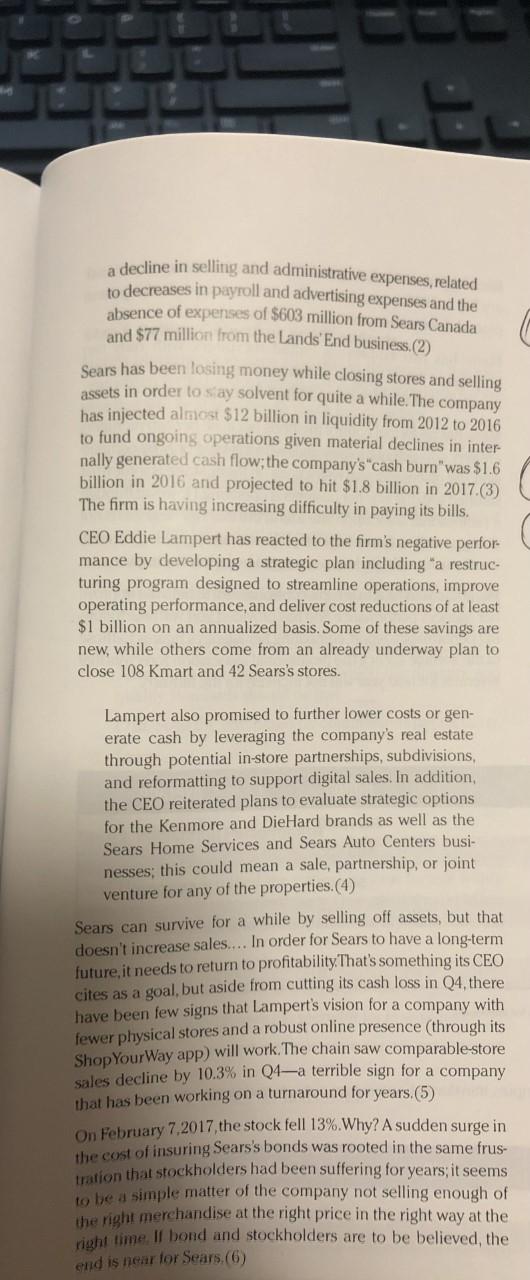
Case 14-2 Figures Do Not Lie but Liars Figure: The Searing Truth plagued Sears Holdings for the past several years as the popularity of e-commerce and fierce competition from other big box retailers has been growing. In fis- cal 2016, Sears Holdings' net revenues decreased by 19% due to a drop in revenues from all segments (and a drop of $2.1 billion associated with Sears Canada, which was de-consolidated in October 2014). If you are looking for Sears, do not look for their catalogs. In the world of retail, Sears Holdings is an appliance giant. In addition to home appliances, the company is a leading retailer of tools, as well as lawn and garden, fit- ness, and automotive repair equipment. With 1,672 retail stores across the United States, Sears Holdings operates through subsidiaries Sears, Roebuck and Co.and Kmart, offering proprietary Sears brands including Kenmore, Craftsman, and Die Hard Beyond retail, Sears Holdings is the largest provider of home installation and prod- uct repair services in the United States. In 2014, Sears Holdings spun off Lands' End and reduced its once majority stake in Sears Canada to just 12% as it sought to raise cash to overcome struggling store sales. In 2017, the company agreed to sell its Craftsman tool brand to Stanley Black & Decker for $900 million (1) Kmart's revenues declined due to having fewer stores in operation, which accounted for approximately $1.1 bil- lion of the decline and a drop in comparable store sales driven by declines in the consumer electronics, apparel, grocery and household and drugstore categories. The revenues from Sears Domestic segment decreased due to a drop in comparable store sales of 11.1%, which accounted for $1.2 billion of the decline, and the effect of having fewer full-line stores in operation, which accounted for $433 million of the decline.The company's net loss decreased by 33% in fiscal 2016, mainly due to The once great retail giant though is in serious trou- ble. Declining store sales and mounting losses have a decline in selling and administrative expenses, related to decreases in payroll and advertising expenses and the absence of expenses of $603 million from Sears Canada and $77 million from the Lands' End business. (2) Sears has been losing money while closing stores and selling assets in order to say solvent for quite a while. The company has injected almost $12 billion in liquidity from 2012 to 2016 to fund ongoing operations given material declines in inter- nally generated cash flow; the company's cash burn"was $1.6 billion in 2016 and projected to hit $1.8 billion in 2017.(3) The firm is having increasing difficulty in paying its bills. CEO Eddie Lampert has reacted to the firm's negative perfor mance by developing a strategic plan including "a restruc- turing program designed to streamline operations, improve operating performance, and deliver cost reductions of at least $1 billion on an annualized basis. Some of these savings are new, while others come from an already underway plan to close 108 Kmart and 42 Sears's stores. Lampert also promised to further lower costs or gen- erate cash by leveraging the company's real estate through potential in-store partnerships, subdivisions, and reformatting to support digital sales. In addition, the CEO reiterated plans to evaluate strategic options for the Kenmore and Die Hard brands as well as the Sears Home Services and Sears Auto Centers busi- nesses; this could mean a sale, partnership, or joint venture for any of the properties (4) Sears can survive for a while by selling off assets, but that doesn't increase sales... In order for Sears to have a long-term future, it needs to return to profitability. That's something its CEO cites as a goal, but aside from cutting its cash loss in Q4, there have been few signs that Lampert's vision for a company with fewer physical stores and a robust online presence through its ShopYourWay app) will work. The chain saw comparable-store sales decline by 10.3% in Q4a terrible sign for a company that has been working on a turnaround for years.(5) On February 7,2017, the stock fell 13%.Why? A sudden surge in the cost of insuring Sears's bonds was rooted in the same frus- tration that stockholders had been suffering for years, it seems to be a simple matter of the company not selling enough of the right merchandise at the right price in the right way at the right time. Il bond and stockholders are to be believed, the end is near for Sears.(6) Case 14-2 Figures Do Not Lie but Liars Figure: The Searing Truth plagued Sears Holdings for the past several years as the popularity of e-commerce and fierce competition from other big box retailers has been growing. In fis- cal 2016, Sears Holdings' net revenues decreased by 19% due to a drop in revenues from all segments (and a drop of $2.1 billion associated with Sears Canada, which was de-consolidated in October 2014). If you are looking for Sears, do not look for their catalogs. In the world of retail, Sears Holdings is an appliance giant. In addition to home appliances, the company is a leading retailer of tools, as well as lawn and garden, fit- ness, and automotive repair equipment. With 1,672 retail stores across the United States, Sears Holdings operates through subsidiaries Sears, Roebuck and Co.and Kmart, offering proprietary Sears brands including Kenmore, Craftsman, and Die Hard Beyond retail, Sears Holdings is the largest provider of home installation and prod- uct repair services in the United States. In 2014, Sears Holdings spun off Lands' End and reduced its once majority stake in Sears Canada to just 12% as it sought to raise cash to overcome struggling store sales. In 2017, the company agreed to sell its Craftsman tool brand to Stanley Black & Decker for $900 million (1) Kmart's revenues declined due to having fewer stores in operation, which accounted for approximately $1.1 bil- lion of the decline and a drop in comparable store sales driven by declines in the consumer electronics, apparel, grocery and household and drugstore categories. The revenues from Sears Domestic segment decreased due to a drop in comparable store sales of 11.1%, which accounted for $1.2 billion of the decline, and the effect of having fewer full-line stores in operation, which accounted for $433 million of the decline.The company's net loss decreased by 33% in fiscal 2016, mainly due to The once great retail giant though is in serious trou- ble. Declining store sales and mounting losses have a decline in selling and administrative expenses, related to decreases in payroll and advertising expenses and the absence of expenses of $603 million from Sears Canada and $77 million from the Lands' End business. (2) Sears has been losing money while closing stores and selling assets in order to say solvent for quite a while. The company has injected almost $12 billion in liquidity from 2012 to 2016 to fund ongoing operations given material declines in inter- nally generated cash flow; the company's cash burn"was $1.6 billion in 2016 and projected to hit $1.8 billion in 2017.(3) The firm is having increasing difficulty in paying its bills. CEO Eddie Lampert has reacted to the firm's negative perfor mance by developing a strategic plan including "a restruc- turing program designed to streamline operations, improve operating performance, and deliver cost reductions of at least $1 billion on an annualized basis. Some of these savings are new, while others come from an already underway plan to close 108 Kmart and 42 Sears's stores. Lampert also promised to further lower costs or gen- erate cash by leveraging the company's real estate through potential in-store partnerships, subdivisions, and reformatting to support digital sales. In addition, the CEO reiterated plans to evaluate strategic options for the Kenmore and Die Hard brands as well as the Sears Home Services and Sears Auto Centers busi- nesses; this could mean a sale, partnership, or joint venture for any of the properties (4) Sears can survive for a while by selling off assets, but that doesn't increase sales... In order for Sears to have a long-term future, it needs to return to profitability. That's something its CEO cites as a goal, but aside from cutting its cash loss in Q4, there have been few signs that Lampert's vision for a company with fewer physical stores and a robust online presence through its ShopYourWay app) will work. The chain saw comparable-store sales decline by 10.3% in Q4a terrible sign for a company that has been working on a turnaround for years.(5) On February 7,2017, the stock fell 13%.Why? A sudden surge in the cost of insuring Sears's bonds was rooted in the same frus- tration that stockholders had been suffering for years, it seems to be a simple matter of the company not selling enough of the right merchandise at the right price in the right way at the right time. Il bond and stockholders are to be believed, the end is near for Sears.(6)
Step by Step Solution
There are 3 Steps involved in it

Get step-by-step solutions from verified subject matter experts
 Study Help