







Question: Type or paste question here CST-305: Project 2 - Runge-Kutta-Fehlberg (RKF) for ODE Objective: Use RKF to assess the power of a computing system Description:
 Type or paste question here
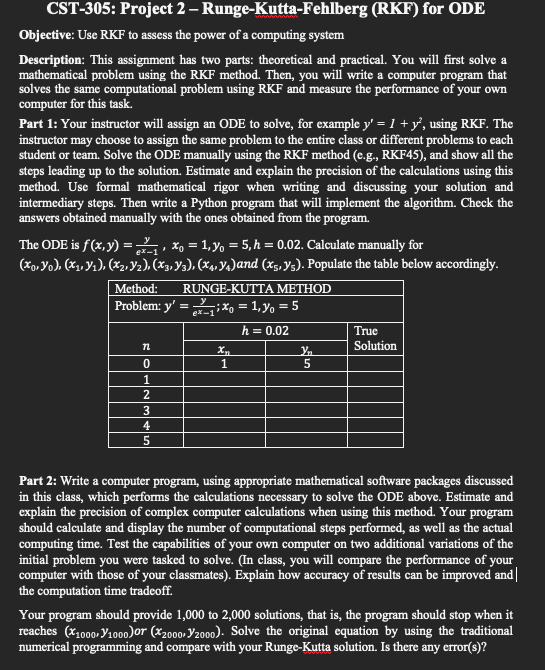
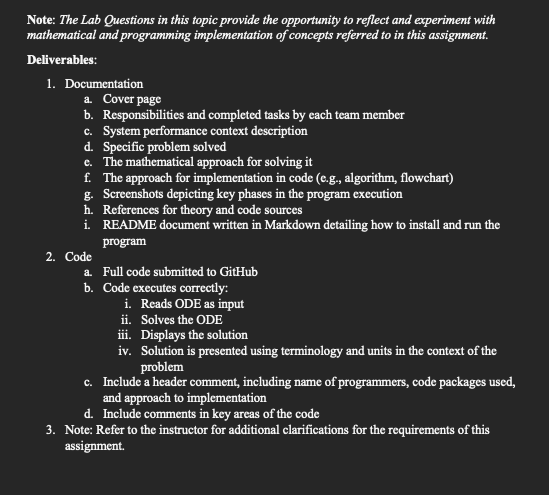
CST-305: Project 2 - Runge-Kutta-Fehlberg (RKF) for ODE Objective: Use RKF to assess the power of a computing system Description: This assignment has two parts: theoretical and practical. You will first solve a mathematical problem using the RKF method. Then, you will write a computer program that solves the same computational problem using RKF and measure the performance of your own computer for this task. Part 1: Your instructor will assign an ODE to solve, for example y' = 1 + y', using RKF. The instructor may choose to assign the same problem to the entire class or different problems to each student or team. Solve the ODE manually using the RKF method (e.g., RKF45), and show all the steps leading up to the solution. Estimate and explain the precision of the calculations using this method. Use formal mathematical rigor when writing and discussing your solution and intermediary steps. Then write a Python program that will implement the algorithm. Check the answers obtained manually with the ones obtained from the program. The ODE is f(x,y)= Xo = 1, y = 5, h = 0.02. Calculate manually for (x,y),(X,Y), (X2,42), (X3.93), (x...)and (X5,Ys). Populate the table below accordingly. RUNGE-KUTTA METHOD Problem: y' = -2; *0 = 1, y = 5 h = 0.02 True x Solution 1 5 ex-1 Method: = ex1 72 0 - 1 2 3 4 5 Part 2: Write a computer program, using appropriate mathematical software packages discussed in this class, which performs the calculations necessary to solve the ODE above. Estimate and explain the precision of complex computer calculations when using this method. Your program should calculate and display the number of computational steps performed, as well as the actual computing time. Test the capabilities of your own computer on two additional variations of the initial problem you were tasked to solve. (In class, you will compare the performance of your computer with those of your classmates). Explain how accuracy of results can be improved and the computation time tradeoff. Your program should provide 1,000 to 2,000 solutions, that is, the program should stop when it reaches (>1000,Y1000) or (X2000-Y2000). Solve the original equation by using the traditional numerical programming and compare with your Runge-Kutta solution. Is there any error(s)? Note: The Lab Questions in this topic provide the opportunity to reflect and experiment with mathematical and programming implementation of concepts referred to in this assignment. Deliverables: 1. Documentation a Cover page b. Responsibilities and completed tasks by each team member c. System performance context description d. Specific problem solved e. The mathematical approach for solving it f. The approach for implementation in code (e.g., algorithm, flowchart) g. Screenshots depicting key phases in the program execution h. References for theory and code sources i. README document written in Markdown detailing how to install and run the program 2. Code a. Full code submitted to GitHub b. Code executes correctly: i. Reads ODE as input ii. Solves the ODE iii. Displays the solution iv. Solution is presented using terminology and units in the context of the problem c. Include a header comment, including name of programmers, code packages used, and approach to implementation d. Include comments in key areas of the code 3. Note: Refer to the instructor for additional clarifications for the requirements of this assignment
Step by Step Solution
There are 3 Steps involved in it

Get step-by-step solutions from verified subject matter experts
 Study Help