



Question: Type or paste question here The Brick Company had cash sales of $223,500 for Year 1, its first year of operation. On April 2, the
 Type or paste question here
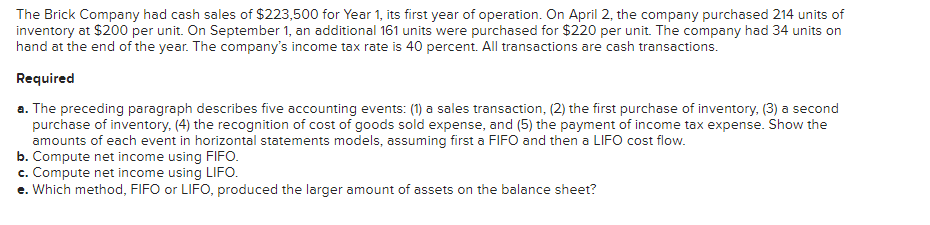
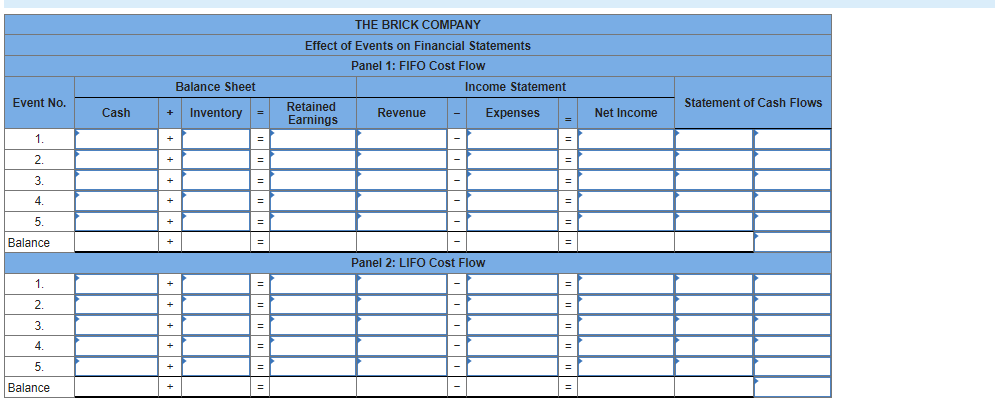
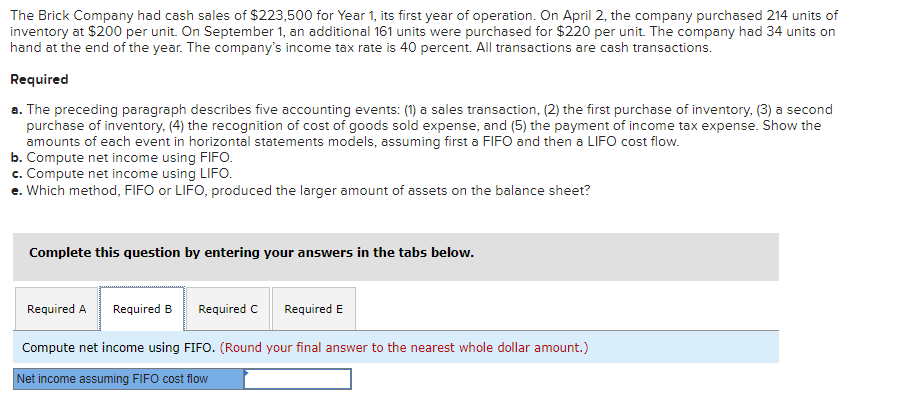
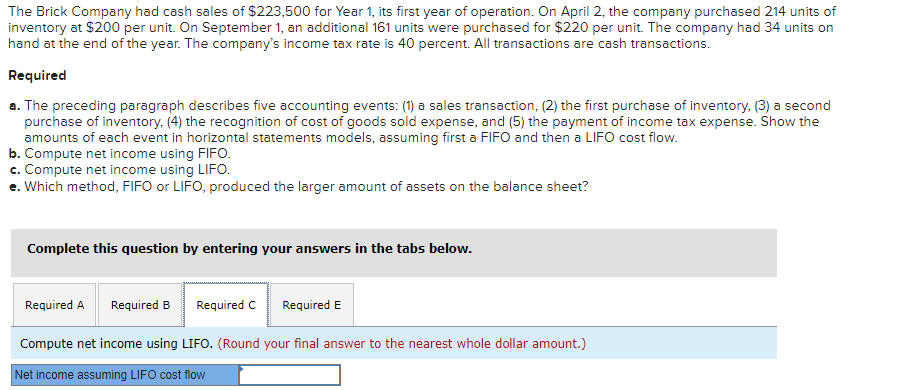
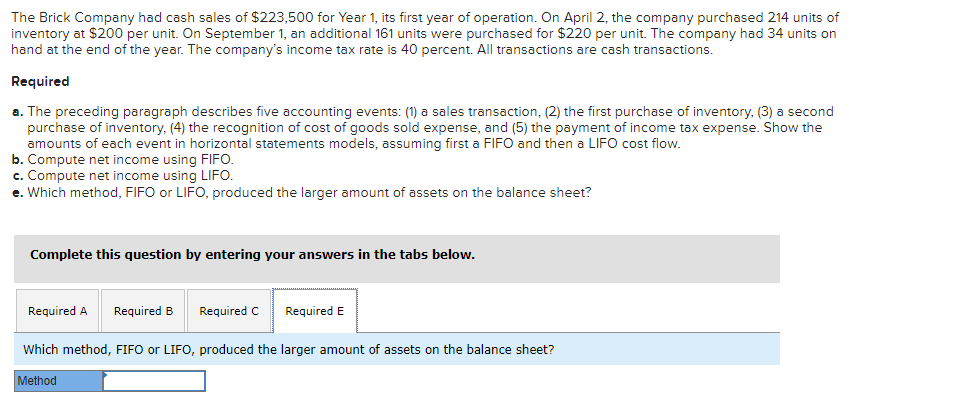
The Brick Company had cash sales of $223,500 for Year 1, its first year of operation. On April 2, the company purchased 214 units of inventory at $200 per unit. On September 1, an additional 161 units were purchased for $220 per unit. The company had 34 units on hand at the end of the year. The company's income tax rate is 40 percent. All transactions are cash transactions. Required a. The preceding paragraph describes five accounting events: (1) a sales transaction, (2) the first purchase of inventory, (3) a second purchase of inventory, (4) the recognition of cost of goods sold expense, and (5) the payment of income tax expense. Show the amounts of each event in horizontal statements models, assuming first a FIFO and then a LIFO cost flow. b. Compute net income using FIFO. c. Compute net income using LIFO. e. Which method, FIFO or LIFO, produced the larger amount of assets on the balance sheet? THE BRICK COMPANY Effect of Events on Financial Statements Panel 1: FIFO Cost Flow Income Statement Retained Revenue Expenses Earnings Balance Sheet Event No. Statement of Cash Flows Cash Inventory Net Income 1. 2. = = 3. 4. = = 5. + = Balance Panel 2: LIFO Cost Flow 1. = 2. = 3. = 4. 5. + = Balance = The Brick Company had cash sales of $223,500 for Year 1, its first year of operation. On April 2, the company purchased 214 units of inventory at $200 per unit. On September 1, an additional 161 units were purchased for $220 per unit. The company had 34 units on hand at the end of the year. The company's income tax rate is 40 percent. All transactions are cash transactions. Required a. The preceding paragraph describes five accounting events: (1) a sales transaction, (2) the first purchase of inventory, (3) a second purchase of inventory, (4) the recognition of cost of goods sold expense, and (5) the payment of income tax expense. Show the amounts of each event in horizontal statements models, assuming first a FIFO and then a LIFO cost flow. b. Compute net income using FIFO. c. Compute net income using LIFO. e. Which method, FIFO or LIFO, produced the larger amount of assets on the balance sheet? Complete this question by entering your answers in the tabs below. Required a Required B Required Required E Compute net income using FIFO. (Round your final answer to the nearest whole dollar amount.) Net income assuming FIFO cost flow The Brick Company had cash sales of $223,500 for Year 1, its first year of operation. On April 2, the company purchased 214 units of inventory at $200 per unit. On September 1, an additional 161 units were purchased for $220 per unit. The company had 34 units on hand at the end of the year. The company's income tax rate is 40 percent. All transactions are cash transactions. Required a. The preceding paragraph describes five accounting events: (1) a sales transaction, (2) the first purchase of inventory, (3) a second purchase of inventory, (4) the recognition of cost of goods sold expense, and (5) the payment of income tax expense. Show the amounts of each event in horizontal statements models, assuming first a FIFO and then a LIFO cost flow. b. Compute net income using FIFO. c. Compute net income using LIFO. e. Which method, FIFO or LIFO, produced the larger amount of assets on the balance sheet? Complete this question by entering your answers in the tabs below. Required A Required B Required C Required E Compute net income using LIFO. (Round your final answer to the nearest whole dollar amount.) Net income assuming LIFO cost flow The Brick Company had cash sales of $223,500 for Year 1, its first year of operation. On April 2, the company purchased 214 units of inventory at $200 per unit. On September 1, an additional 161 units were purchased for $220 per unit. The company had 34 units on hand at the end of the year. The company's income tax rate is 40 percent. All transactions are cash transactions. Required a. The preceding paragraph describes five accounting events: (1) a sales transaction, (2) the first purchase of inventory, (3) a second purchase of inventory, (4) the recognition of cost of goods sold expense, and (5) the payment of income tax expense. Show the amounts of each event in horizontal statements models, assuming first a FIFO and then a LIFO cost flow. b. Compute net income using FIFO. c. Compute net income using LIFO. e. Which method, FIFO or LIFO, produced the larger amount of assets on the balance sheet? Complete this question by entering your answers in the tabs below. Required A Required B Required c Required E Which method, FIFO or LIFO, produced the larger amount of assets on the balance sheet? Method
Step by Step Solution
There are 3 Steps involved in it

Get step-by-step solutions from verified subject matter experts