







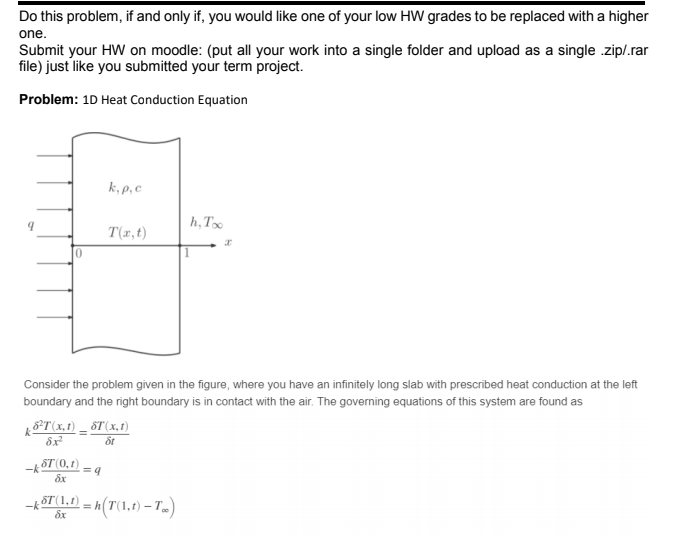
Question: U S E M A T L A B Take all parameters, h=k=p=c= 1, heat flux at the left boundary, g = 10, and the
U S E M A T L A B
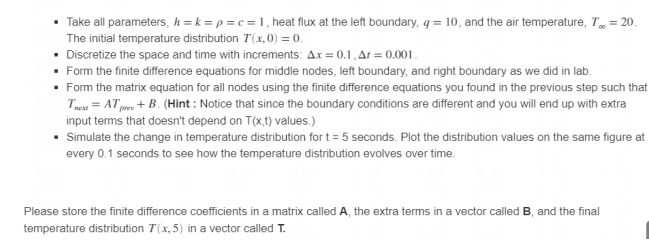
Take all parameters, h=k=p=c= 1, heat flux at the left boundary, g = 10, and the air temperature, Too = 20. The initial temperature distribution 7(x,0) = 0. Discretize the space and time with increments: Ax=0.1, At = 0.001. Form the finite difference equations for middle nodes, left boundary, and right boundary as we did in lab. Form the matrix equation for all nodes using the finite difference equations you found in the previous step such that Thex = AT pre +B. (Hint: Notice that since the boundary conditions are different and you will end up with extra input terms that doesn't depend on T(xt) values.) Simulate the change in temperature distribution for t = 5 seconds. Plot the distribution values on the same figure at every 0.1 seconds to see how the temperature distribution evolves over time. Please store the finite difference coefficients in a matrix called A, the extra terms in a vector called B, and the final temperature distribution 7(x,5) in a vector called T. Take all parameters, h=k=p=c= 1, heat flux at the left boundary, g = 10, and the air temperature, Too = 20. The initial temperature distribution 7(x,0) = 0. Discretize the space and time with increments: Ax=0.1, At = 0.001. Form the finite difference equations for middle nodes, left boundary, and right boundary as we did in lab. Form the matrix equation for all nodes using the finite difference equations you found in the previous step such that Thex = AT pre +B. (Hint: Notice that since the boundary conditions are different and you will end up with extra input terms that doesn't depend on T(xt) values.) Simulate the change in temperature distribution for t = 5 seconds. Plot the distribution values on the same figure at every 0.1 seconds to see how the temperature distribution evolves over time. Please store the finite difference coefficients in a matrix called A, the extra terms in a vector called B, and the final temperature distribution 7(x,5) in a vector called T
Step by Step Solution
There are 3 Steps involved in it

Get step-by-step solutions from verified subject matter experts
 Study Help