







Question: Uber, the mobile application that allows passengers to hail Uber cars to their location, has broken into a market that has long been dominated
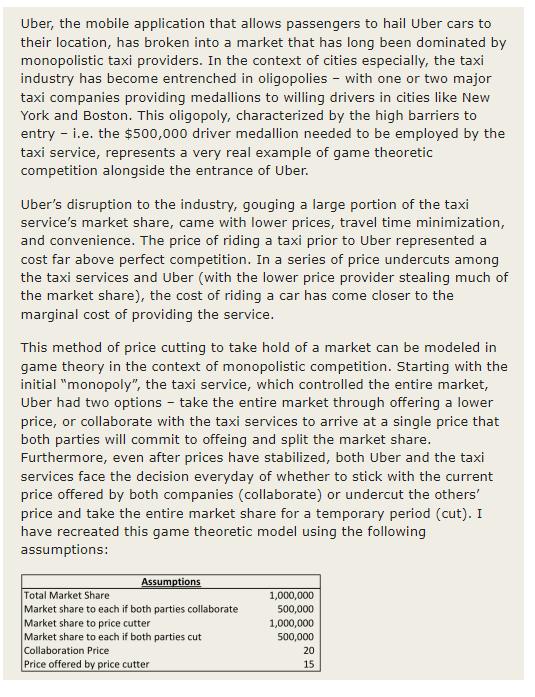
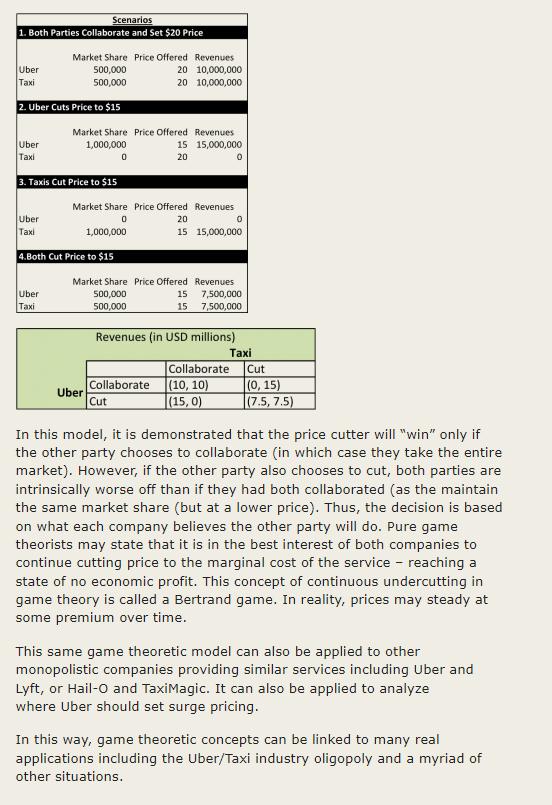
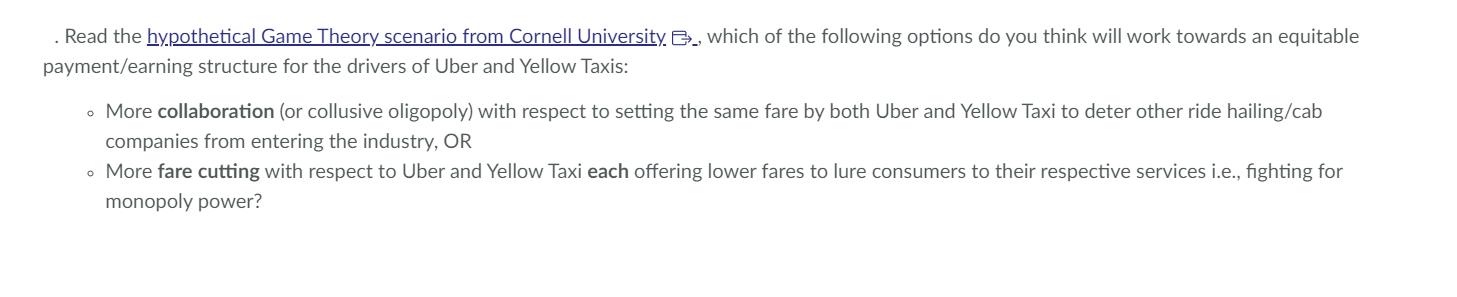
Uber, the mobile application that allows passengers to hail Uber cars to their location, has broken into a market that has long been dominated by monopolistic taxi providers. In the context of cities especially, the taxi industry has become entrenched in oligopolies with one or two major taxi companies providing medallions to willing drivers in cities like New York and Boston. This oligopoly, characterized by the high barriers to entry - i.e. the $500,000 driver medallion needed to be employed by the taxi service, represents a very real example of game theoretic competition alongside the entrance of Uber. Uber's disruption to the industry, gouging a large portion of the taxi service's market share, came with lower prices, travel time minimization, and convenience. The price of riding a taxi prior to Uber represented a cost far above perfect competition. In a series of price undercuts among the taxi services and Uber (with the lower price provider stealing much of the market share), the cost of riding a car has come closer to the marginal cost of providing the service. This method of price cutting to take hold of a market can be modeled in game theory in the context of monopolistic competition. Starting with the initial "monopoly", the taxi service, which controlled the entire market, Uber had two options take the entire market through offering a lower price, or collaborate with the taxi services to arrive at a single price that both parties will commit to offeing and split the market share. Furthermore, even after prices have stabilized, both Uber and the taxi services face the decision everyday of whether to stick with the current price offered by both companies (collaborate) or undercut the others' price and take the entire market share for a temporary period (cut). I have recreated this game theoretic model using the following assumptions: Assumptions Total Market Share Market share to each if both parties collaborate Market share to price cutter Market share to each if both parties cut Collaboration Price Price offered by price cutter 1,000,000 500,000 1,000,000 500,000 20 15 Scenarios 1. Both Parties Collaborate and Set $20 Price Market Share Price Offered Revenues 500,000 Uber 20 10,000,000 Taxi 500,000 20 10,000,000 2. Uber Cuts Price to $15 Uber Taxi 3. Taxis Cut Price to $15 Uber Market Share Price Offered 1,000,000 0 Uber Taxi Taxl 4.Both Cut Price to $15 Market Share Price Offered Revenues 0 1,000,000 Revenues 15 15,000,000 20 Uber Collaborate Cut 20 15 15,000,000 Market Share Price Offered Revenues 500,000 15 7,500,000 500,000 15 7,500,000 Revenues (in USD millions) 0 Collaborate (10, 10) (15, 0) 0 Taxi Cut (0, 15) (7.5, 7.5) In this model, it is demonstrated that the price cutter will "win" only if the other party chooses to collaborate (in which case they take the entire market). However, if the other party also chooses to cut, both parties are intrinsically worse off than if they had both collaborated (as the maintain the same market share (but at a lower price). Thus, the decision is based on what each company believes the other party will do. Pure game theorists may state that it is in the best interest of both companies to continue cutting price to the marginal cost of the service - reaching a state of no economic profit. This concept of continuous undercutting in game theory is called a Bertrand game. In reality, prices may steady at some premium over time. This same game theoretic model can also be applied to other monopolistic companies providing similar services including Uber and Lyft, or Hail-O and TaxiMagic. It can also be applied to analyze where Uber should set surge pricing. In this way, game theoretic concepts can be linked to many real applications including the Uber/Taxi industry oligopoly and a myriad of other situations. . Read the hypothetical Game Theory scenario from Cornell University, which of the following options do you think will work towards an equitable payment/earning structure for the drivers of Uber and Yellow Taxis: More collaboration (or collusive oligopoly) with respect to setting the same fare by both Uber and Yellow Taxi to deter other ride hailing/cab companies from entering the industry, OR More fare cutting with respect to Uber and Yellow Taxi each offering lower fares to lure consumers to their respective services i.e., fighting for monopoly power?
Step by Step Solution
3.42 Rating (161 Votes )
There are 3 Steps involved in it
1 More collaboration or collusive oligopoly with respect to setting the same fare by both Uber and Yellow Taxi to deter other ride hailingcab companie... View full answer

Get step-by-step solutions from verified subject matter experts
 Study Help