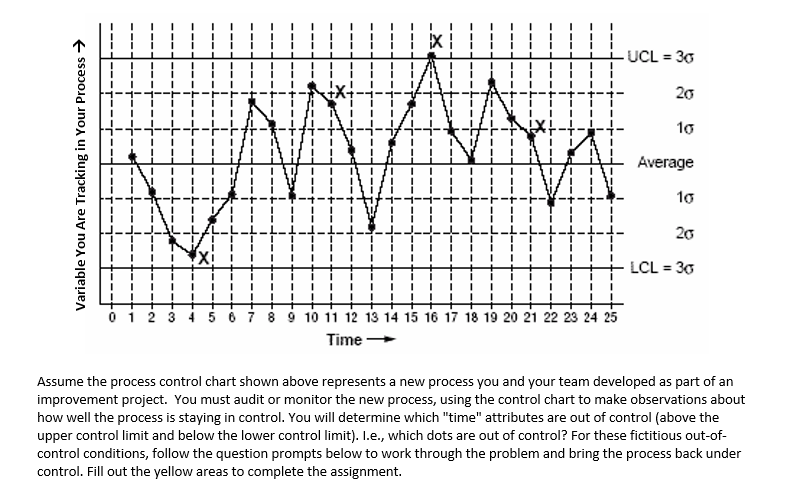
Question: UCL = 30 20 10 Average Variable You Are Tracking in Your Process 10 20 LCL = 30 9 10 11 12 13 14 15
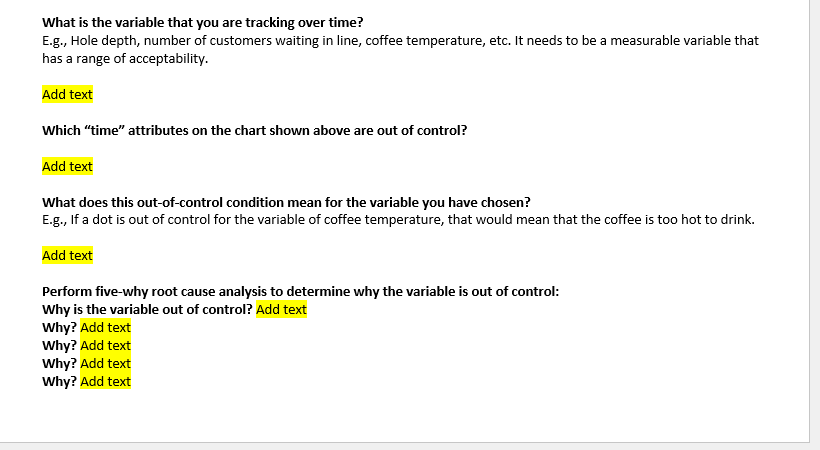
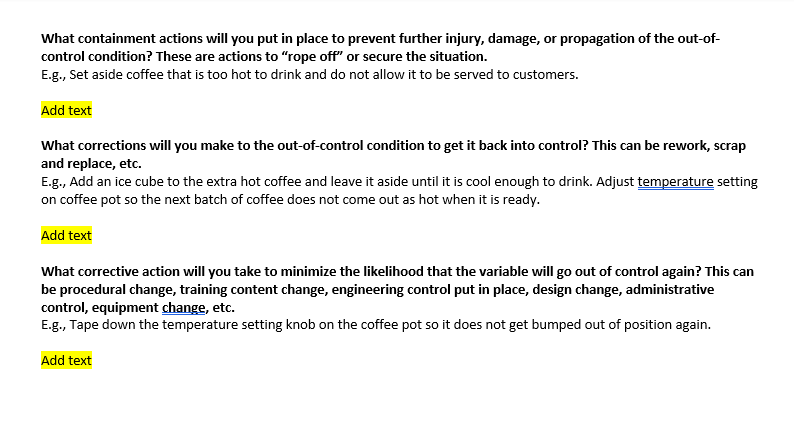
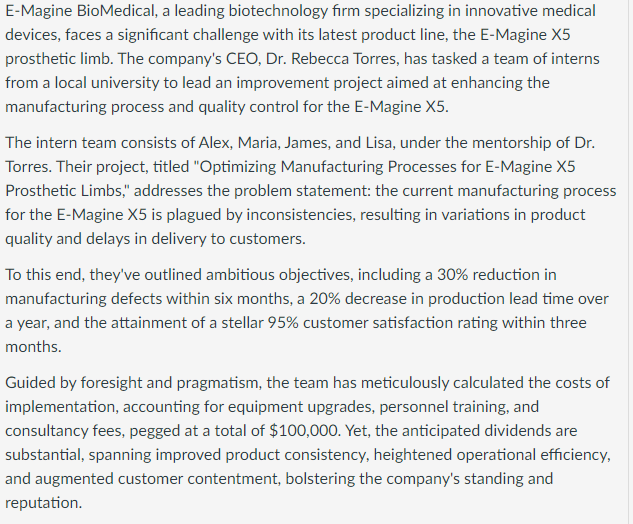
UCL = 30 20 10 Average Variable You Are Tracking in Your Process 10 20 LCL = 30 9 10 11 12 13 14 15 16 17 18 19 20 21 22 23 24 25 Time Assume the process control chart shown above represents a new process you and your team developed as part of an improvement project. You must audit or monitor the new process, using the control chart to make observations about how well the process is staying in control. You will determine which "time" attributes are out of control (above the upper control limit and below the lower control limit). L.e., which dots are out of control? For these fictitious out-of- control conditions, follow the question prompts below to work through the problem and bring the process back under control. Fill out the yellow areas to complete the assignment.What is the variable that you are tracking over time? E.g., Hole depth, number of customers waiting in line, coffes temperature, etc. It needs to be a measurable variable that has a range of acceptability. Add text Which \"time\" attributes on the chart shown above are out of control? Add text What does this out-of-control condition mean for the variable you have chosen? E.g., If a dot is out of control for the variable of coffee temperature, that would mean that the coffee is too hot to drink. Add text Perform five-why root cause analysis to determine why the variable is out of control: Why is the variable out of control? Add text Why? Add text Why? Add text Why? Add text Why? Add text What containment actions will you put in place to prevent further injury, damage, or propagation of the out-of- control condition? These are actions to \"rope off\" or secure the situation. E.g., Set aside coffee that is too hot to drink and do not allow it to be served to customers. Add text What corrections will you make to the out-of-contrel condition to get it back into control? This can be rework, scrap and replace, etc. E.g., Add an ice cube to the extra hot coffee and leave it aside until it is cool enough to drink. Adjust temperature setting on coffee pot so the next batch of coffee does not come out as hot when it is ready. Add text What corrective action will you take to minimize the likelihood that the variable will go out of control again? This can be procedural change, training content change, engineering control put in place, design change, administrative control, equipment change, etc. E.g., Tape down the temperature setting knob on the coffee pot so it does not get bumped out of position again. Add text E-Magine BioMedical, a leading biotechnology firm specializing in innovative medical devices, faces a significant challenge with its latest product line, the E-Magine X5 prosthetic limb. The company's CEO, Dr. Rebecca Torres, has tasked a team of interns from a local university to lead an improvement project aimed at enhancing the manufacturing process and quality control for the E-Magine X5. The intern team consists of Alex, Maria, James, and Lisa, under the mentorship of Dr. Torres. Their project, titled "Optimizing Manufacturing Processes for E-Magine X5 Prosthetic Limbs," addresses the problem statement: the current manufacturing process for the E-Magine X5 is plagued by inconsistencies, resulting in variations in product quality and delays in delivery to customers. To this end, they've outlined ambitious objectives, including a 30% reduction in manufacturing defects within six months, a 20% decrease in production lead time over a year, and the attainment of a stellar 95% customer satisfaction rating within three months. Guided by foresight and pragmatism, the team has meticulously calculated the costs of implementation, accounting for equipment upgrades, personnel training, and consultancy fees, pegged at a total of $100,000. Yet, the anticipated dividends are substantial, spanning improved product consistency, heightened operational efficiency, and augmented customer contentment, bolstering the company's standing and reputation. Undoubtedly, the journey toward process optimization is fraught with potential obstacles, ranging from resistance among incumbent staff to the specter of regulatory hurdles. Nonetheless, the team remains undaunted, primed to tackle any impediments that may arise with unwavering resolve. They are acutely aware of the looming specter of compliance obligations, which may introduce delays but are essential for upholding industry standards and customer trust. Moreover, amidst the technological zeitgeist, the team recognizes the dual-edged nature of integrating artificial intelligence (Al) into the manufacturing milieu. While Al holds the promise of revolutionizing production dynamics, enhancing predictive analytics, and ameliorating quality control, its adoption brings forth a slew of considerations, from data privacy concerns to algorithmic biases. However, through diligent risk assessment and strategic foresight, they aim to harness Al as a potent catalyst for innovation while safeguarding against potential pitfalls. As the project unfolds, the team remains steadfast in their commitment to excellence, employing a multifaceted approach to problem-solving. They vigilantly track key variables, swiftly identifying any out-of-control conditions through comprehensive analysis, employing the Five-Why Root Cause methodology to unearth underlying issues. In the event of deviations, containment actions are swiftly enacted to mitigate immediate risks, followed by corrective measures to restore equilibrium. Furthermore, they proactively implement corrective actions, fortifying the system against recurrence and paving the path toward sustained excellence and progress. Through their concerted efforts, they aspire to not only optimize manufacturing processes but also exemplify a paradigm of ethical and responsible innovation, driving transformative change within E- Magine BioMedical and beyond
Step by Step Solution
There are 3 Steps involved in it
1 Expert Approved Answer
Step: 1 Unlock
Question Has Been Solved by an Expert!
Get step-by-step solutions from verified subject matter experts
Step: 2 Unlock
Step: 3 Unlock
Students Have Also Explored These Related General Management Questions!









 Study Help