







Question: UID 5. (30 points) Consider a composite plane wall composed of two materials of equal thickness; Material A (LA = 20 mm, kA =
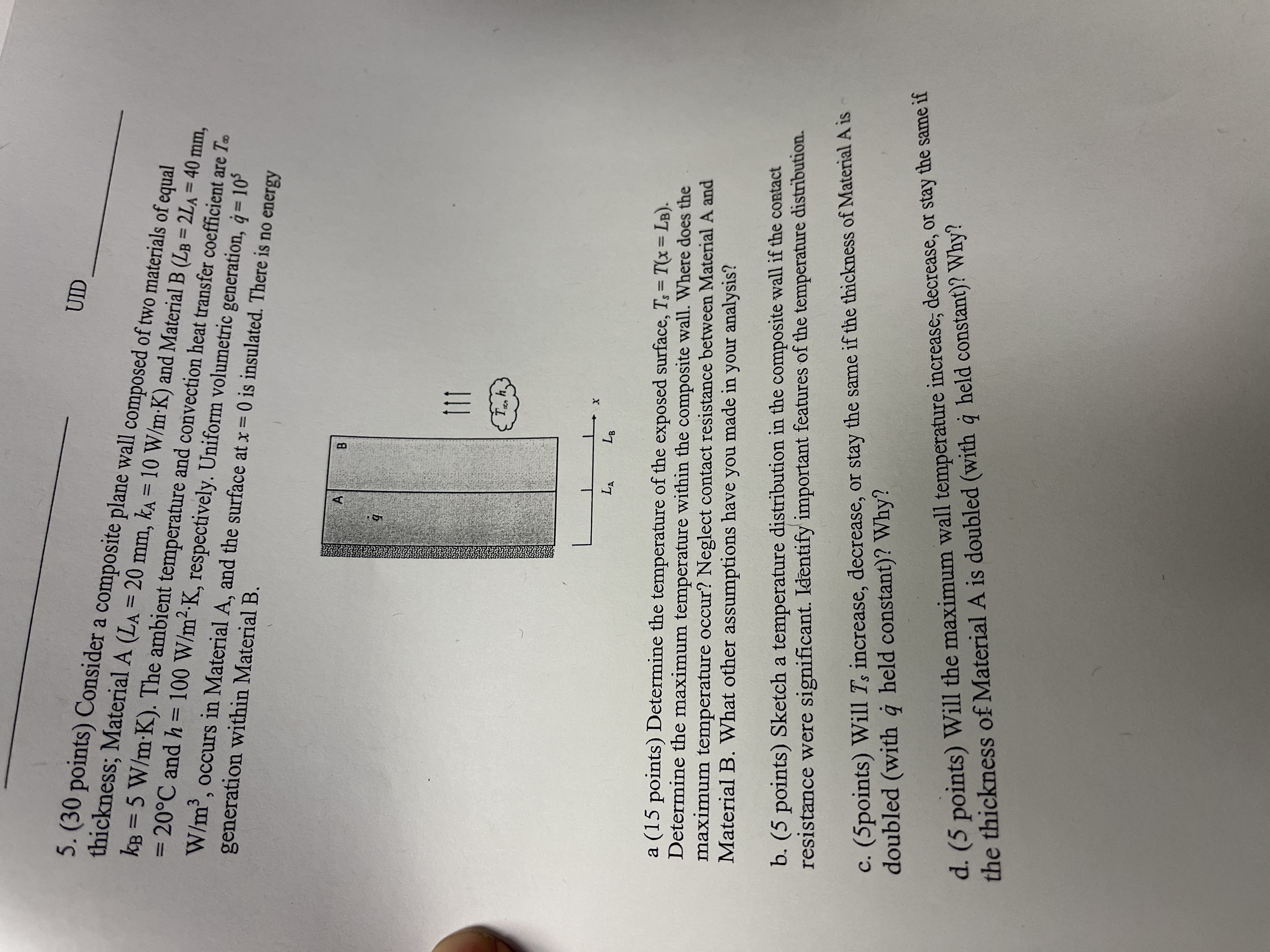
UID 5. (30 points) Consider a composite plane wall composed of two materials of equal thickness; Material A (LA = 20 mm, kA = 10 W/m K) and Material B (LB = 2LA = 40 mm, kB = 5 W/mK). The ambient temperature and convection heat transfer coefficient are To = generation within Material B. = 20C and h = 100 W/m K, respectively. Uniform volumetric generation, q = 10 W/m, occurs in Material A, and the surface at x = 0 is insulated. There is no energy 4 A B 111 X LA LB a (15 points) Determine the temperature of the exposed surface, T, = T(x = LB). Determine the maximum temperature within the composite wall. Where does the maximum temperature occur? Neglect contact resistance between Material A and Material B. What other assumptions have you made in your analysis? b. (5 points) Sketch a temperature distribution in the composite wall if the contact resistance were significant. Identify important features of the temperature distribution. c. (5points) Will T's increase, decrease, or stay the same if the thickness of Material A is doubled (with held constant)? Why? d. (5 points) Will the maximum wall temperature increase; decrease, or stay the same if the thickness of Material A is doubled (with held constant)? Why? 9
Step by Step Solution
There are 3 Steps involved in it

Get step-by-step solutions from verified subject matter experts
 Study Help