







Question: undefined 1 Adverse Selection (50%) There are a continuum types of people in the society, whose health status can be represented by x, which lies
 undefined
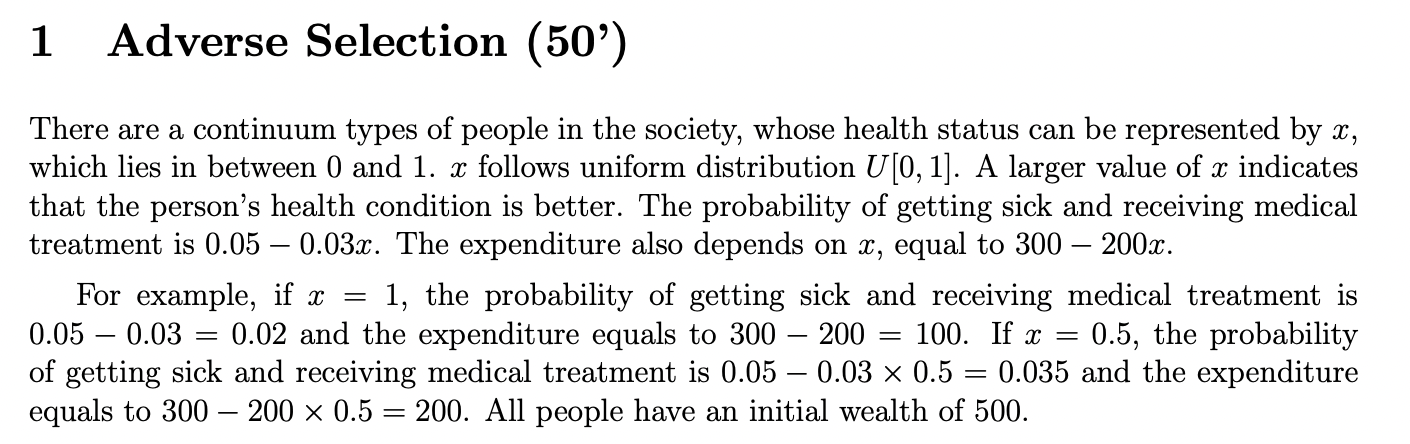
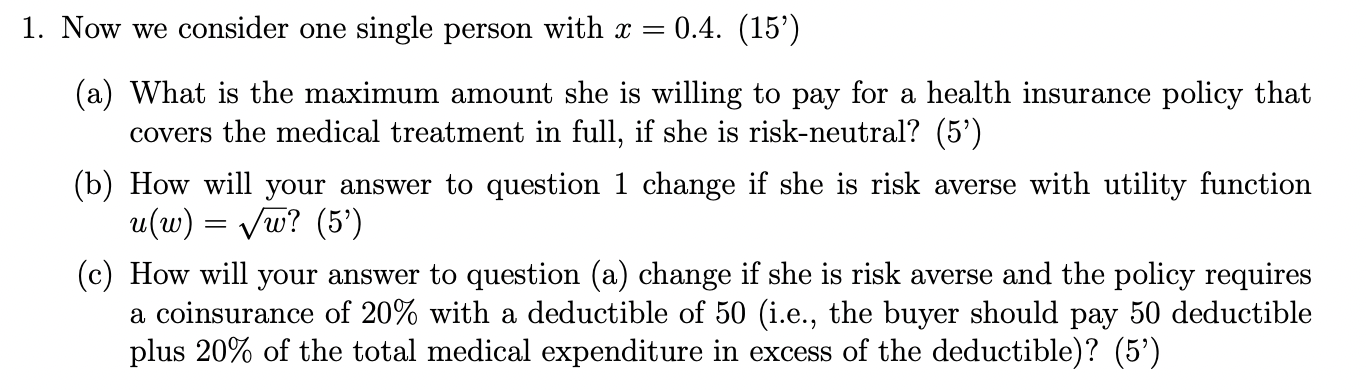
1 Adverse Selection (50%) There are a continuum types of people in the society, whose health status can be represented by x, which lies in between 0 and 1. x follows uniform distribution U[0, 1]. A larger value of x indicates that the person's health condition is better. The probability of getting sick and receiving medical treatment is 0.05 0.03x. The expenditure also depends on x, equal to 300 200x. For example, if x 1, the probability of getting sick and receiving medical treatment is 0.05 0.03 : 0.02 and the expenditure equals to 300 200 = 100. If x 0.5, the probability of getting sick and receiving medical treatment is 0.05 0.03 x 0.5 = 0.035 and the expenditure equals to 300 200 x 0.5 = 200. All people have an initial wealth of 500. = = 1. Now we consider one single person with x = 0.4. (15') (a) What is the maximum amount she is willing to pay for a health insurance policy that covers the medical treatment in full, if she is risk-neutral? (5) (b) How will your answer to question 1 change if she is risk averse with utility function u(w) = vw? (5) (c) How will your answer to question (a) change if she is risk averse and the policy requires a coinsurance of 20% with a deductible of 50 (i.e., the buyer should pay 50 deductible plus 20% of the total medical expenditure in excess of the deductible)? (5') 1 Adverse Selection (50%) There are a continuum types of people in the society, whose health status can be represented by x, which lies in between 0 and 1. x follows uniform distribution U[0, 1]. A larger value of x indicates that the person's health condition is better. The probability of getting sick and receiving medical treatment is 0.05 0.03x. The expenditure also depends on x, equal to 300 200x. For example, if x 1, the probability of getting sick and receiving medical treatment is 0.05 0.03 : 0.02 and the expenditure equals to 300 200 = 100. If x 0.5, the probability of getting sick and receiving medical treatment is 0.05 0.03 x 0.5 = 0.035 and the expenditure equals to 300 200 x 0.5 = 200. All people have an initial wealth of 500. = = 1. Now we consider one single person with x = 0.4. (15') (a) What is the maximum amount she is willing to pay for a health insurance policy that covers the medical treatment in full, if she is risk-neutral? (5) (b) How will your answer to question 1 change if she is risk averse with utility function u(w) = vw? (5) (c) How will your answer to question (a) change if she is risk averse and the policy requires a coinsurance of 20% with a deductible of 50 (i.e., the buyer should pay 50 deductible plus 20% of the total medical expenditure in excess of the deductible)? (5')
Step by Step Solution
There are 3 Steps involved in it

Get step-by-step solutions from verified subject matter experts
 Study Help