







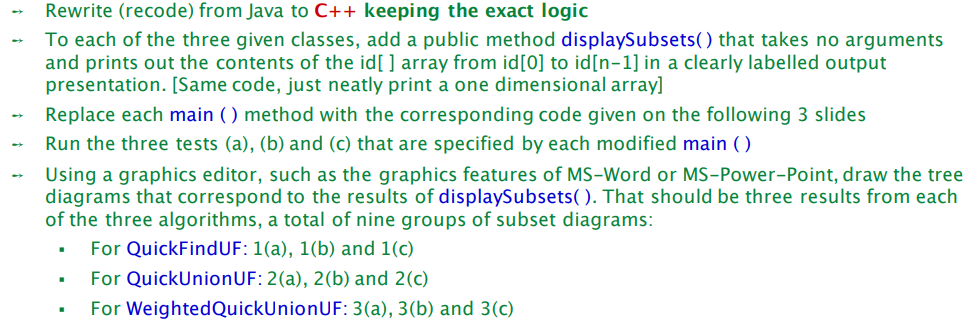
Question: undefined Rewrite (recode) from Java to C++ keeping the exact logic To each of the three given classes, add a public method displaySubsets() that takes
![takes no arguments and prints out the contents of the id[ ]](https://dsd5zvtm8ll6.cloudfront.net/si.experts.images/questions/2024/09/66f4f1748ea20_62866f4f1741212b.jpg)
![array from id[0] to id[n-1] in a clearly labelled output presentation. [Same](https://dsd5zvtm8ll6.cloudfront.net/si.experts.images/questions/2024/09/66f4f1758afc0_62866f4f174e6650.jpg) undefined
undefined
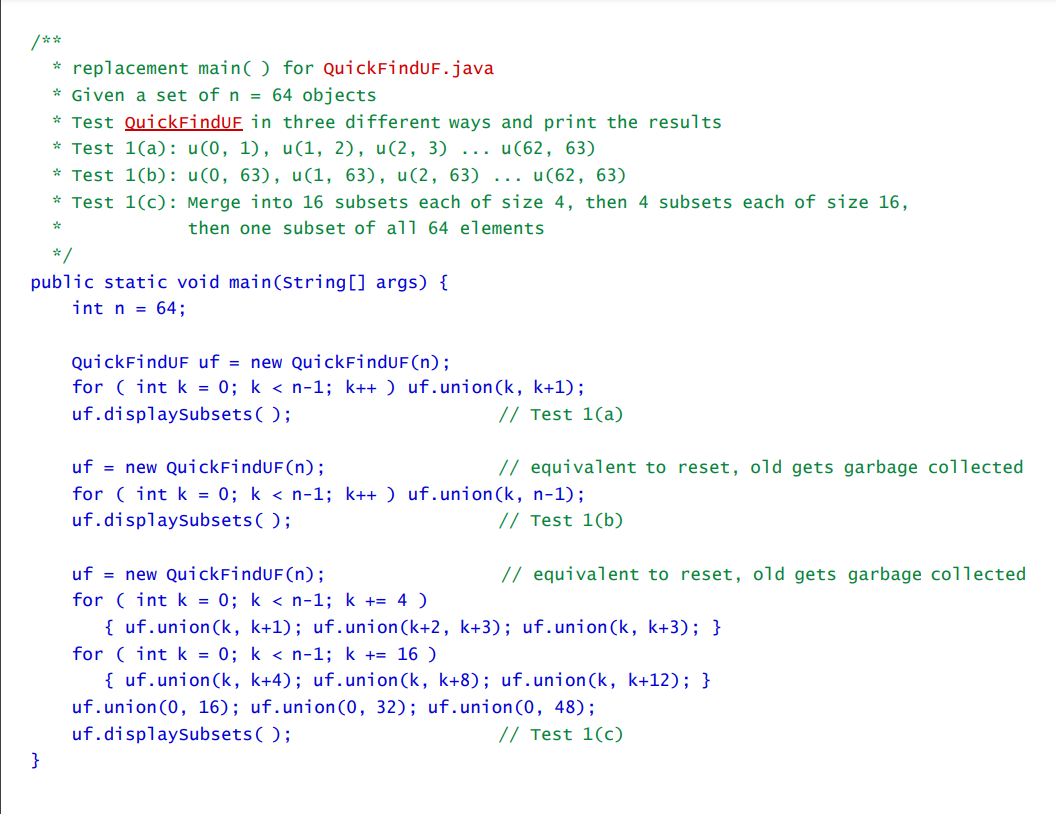
Rewrite (recode) from Java to C++ keeping the exact logic To each of the three given classes, add a public method displaySubsets() that takes no arguments and prints out the contents of the id[ ] array from id[0] to id[n-1] in a clearly labelled output presentation. [Same code, just neatly print a one dimensional array] Replace each main () method with the corresponding code given on the following 3 slides Run the three tests (a), (b) and (c) that are specified by each modified main() Using a graphics editor, such as the graphics features of MS-Word or MS-Power-Point, draw the tree diagrams that correspond to the results of displaySubsets(). That should be three results from each of the three algorithms, a total of nine groups of subset diagrams: For QuickFind UF: 1(a), 1(b) and 1(c) For QuickUnionUF: 2(a), 2(b) and 2(c) For WeightedQuickUnionUF: 3(a), 3(b) and 3(c) . /** * replacement mainfor QuickFindur.java * Given a set of n = 64 objects * Test Quickfindup in three different ways and print the results * Test 1(a): u(0, 1), u(1, 2), u(2, 3) ... (62, 63) * Test 1(b): u(0, 63), (1, 63), u(2, 63) ... (62, 63) * Test 1(c): Merge into 16 subsets each of size 4, then 4 subsets each of size 16, then one subset of all 64 elements */ public static void main(String[] args) { int n = 64; QuickFindur uf = new QuickFinduf(n); for (int k = 0; k
Step by Step Solution
There are 3 Steps involved in it

Get step-by-step solutions from verified subject matter experts
 Study Help