



Question: Under our usual assumptions (state what these are) consider a sealed-bid all-pay auction in which every buyer submits a non-negative bid, the highest bidder receives
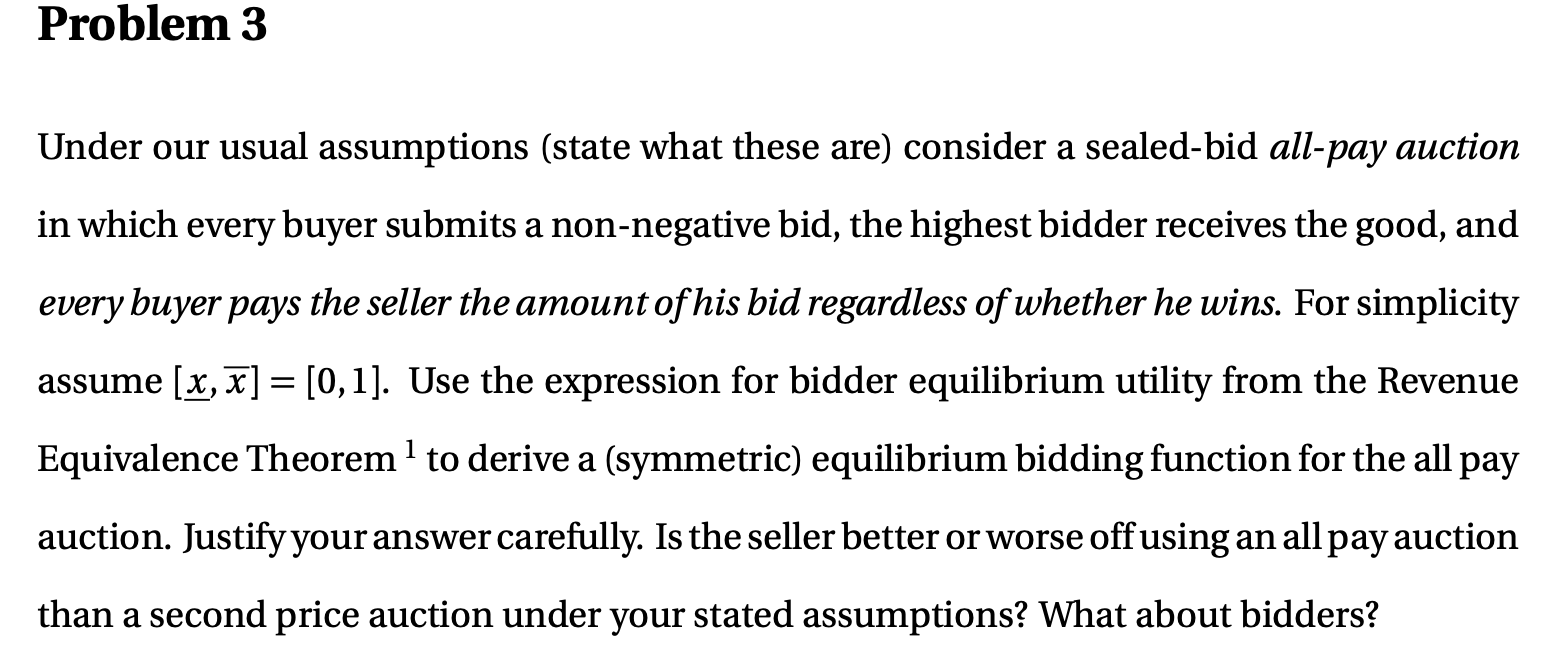
Under our usual assumptions (state what these are) consider a sealed-bid all-pay auction in which every buyer submits a non-negative bid, the highest bidder receives the good, and every buyer pays the seller the amount of his bid regardless of whether he wins. For simplicity assume [x,x]=[0,1]. Use the expression for bidder equilibrium utility from the Revenue Equivalence Theorem 1 to derive a (symmetric) equilibrium bidding function for the all pay auction. Justify your answer carefully. Is the seller better or worse off using an all pay auction than a second price auction under your stated assumptions? What about bidders? Under our usual assumptions (state what these are) consider a sealed-bid all-pay auction in which every buyer submits a non-negative bid, the highest bidder receives the good, and every buyer pays the seller the amount of his bid regardless of whether he wins. For simplicity assume [x,x]=[0,1]. Use the expression for bidder equilibrium utility from the Revenue Equivalence Theorem 1 to derive a (symmetric) equilibrium bidding function for the all pay auction. Justify your answer carefully. Is the seller better or worse off using an all pay auction than a second price auction under your stated assumptions? What about bidders
Step by Step Solution
There are 3 Steps involved in it

Get step-by-step solutions from verified subject matter experts