







Question: Under steady state, a compressor is used to increase the pressure of an ideal gas air from 1 0 0 kPa to 1 MPa .
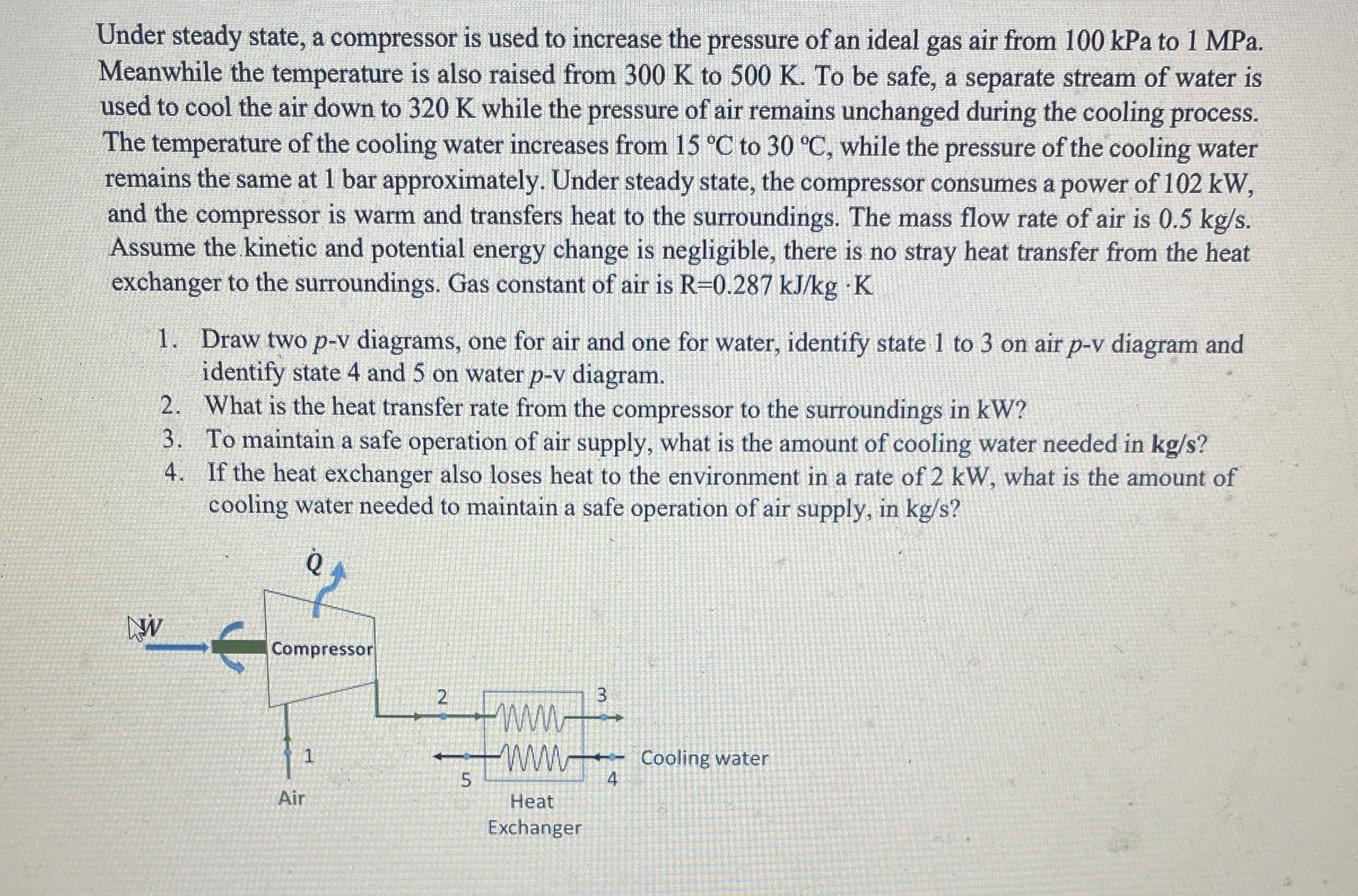
Under steady state, a compressor is used to increase the pressure of an ideal gas air from kPa to MPa Meanwhile the temperature is also raised from K to K To be safe, a separate stream of water is used to cool the air down to K while the pressure of air remains unchanged during the cooling process. The temperature of the cooling water increases from to while the pressure of the cooling water remains the same at bar approximately. Under steady state, the compressor consumes a power of kW and the compressor is warm and transfers heat to the surroundings. The mass flow rate of air is Assume the kinetic and potential energy change is negligible, there is no stray heat transfer from the heat exchanger to the surroundings. Gas constant of air is
Draw two v diagrams, one for air and one for water, identify state to on air v diagram and identify state and on water v diagram.
What is the heat transfer rate from the compressor to the surroundings in kW
To maintain a safe operation of air supply, what is the amount of cooling water needed in
If the heat exchanger also loses heat to the environment in a rate of kW what is the amount of cooling water needed to maintain a safe operation of air supply, in
Step by Step Solution
There are 3 Steps involved in it
1 Expert Approved Answer
Step: 1 Unlock

Question Has Been Solved by an Expert!
Get step-by-step solutions from verified subject matter experts
Step: 2 Unlock
Step: 3 Unlock
 Study Help