







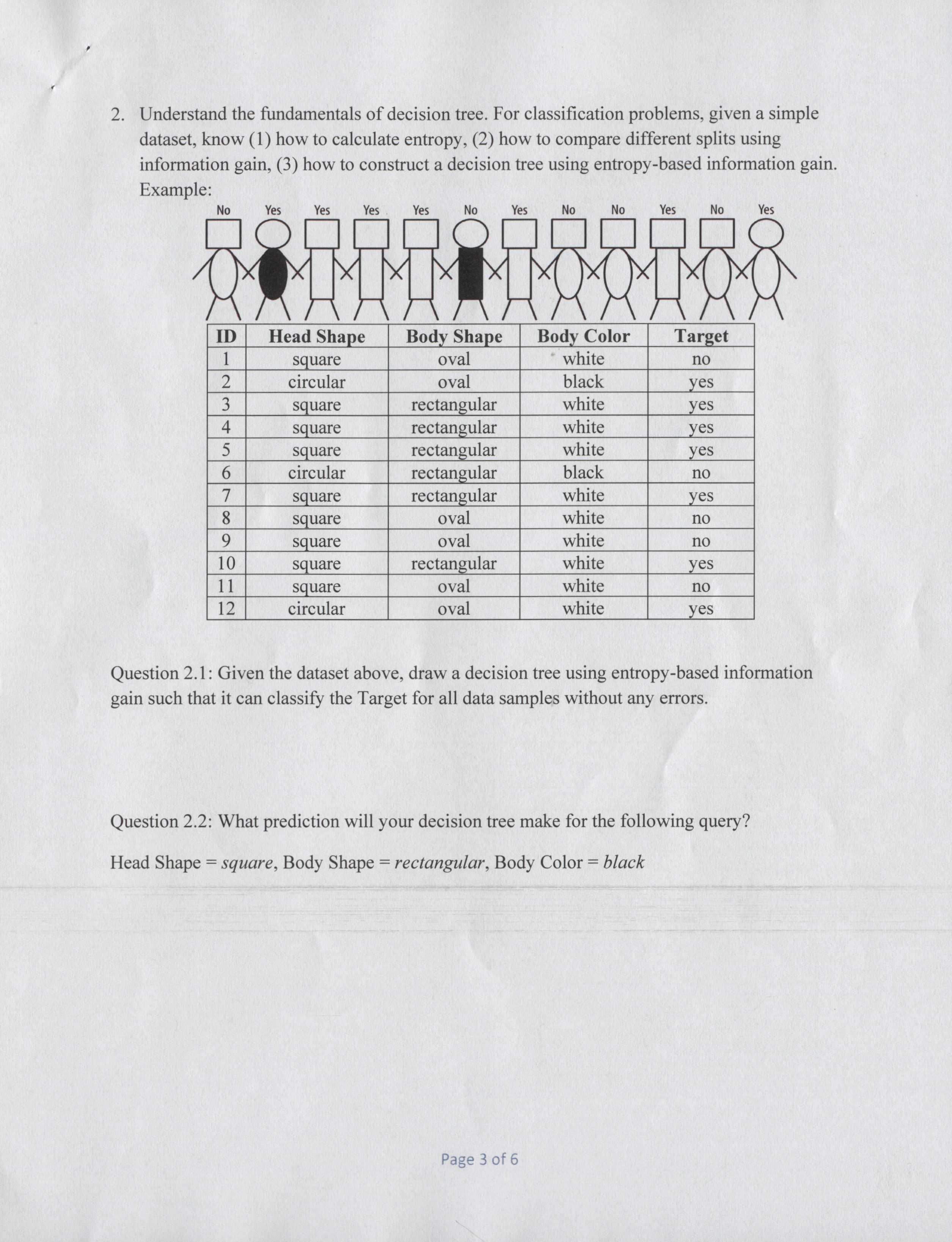
Question: Understand the fundamentals of decision tree. For classification problems, given a simple dataset, know ( 1 ) how to calculate entropy, ( 2 ) how
Understand the fundamentals of decision tree. For classification problems, given a simple
dataset, know how to calculate entropy, how to compare different splits using
information gain, how to construct a decision tree using entropybased information gain.
Example:
Question : Given the dataset above, draw a decision tree using entropybased information
gain such that it can classify the Target for all data samples without any errors.
Question : What prediction will your decision tree make for the following query?
Head Shape square, Body Shape rectangular, Body Color black Understand the concept of bootstrappingbagging and how ensemble learning work. Given a
simple dataset, know how to construct a random forest model.
Practice question: consider the task of predicting whether a postoperative patient should be sent
to an intensive care unit ICU or to a general ward for recovery. The dataset below contains the
details of six patients in a study. CORE describes the core temperature of the patient which can
be low or high and STABLE describes whether the patient's current temperature is stable true
or false The target feature in this domain, DECISION, records the decision of whether the
patient is sent to the icu or to a general ward gen for recovery. The goal is to build a random
forest model for this postoperative patient routing task.
Question : the three tables below list three bootstrap samples that have been generated from
the above dataset. Using these bootstrap samples create the decision trees that will be in the
random forest model use entropybased information gain as the feature selection criterion
Bootstrap Sample A:
Bootstrap Sample B:
Step by Step Solution
There are 3 Steps involved in it
1 Expert Approved Answer
Step: 1 Unlock

Question Has Been Solved by an Expert!
Get step-by-step solutions from verified subject matter experts
Step: 2 Unlock
Step: 3 Unlock
 Study Help