







Question: Understanding different policy options to correct for negative externalities Carbon dioxide emissions have been linked to worsening climate conditions. The following table lists some possible
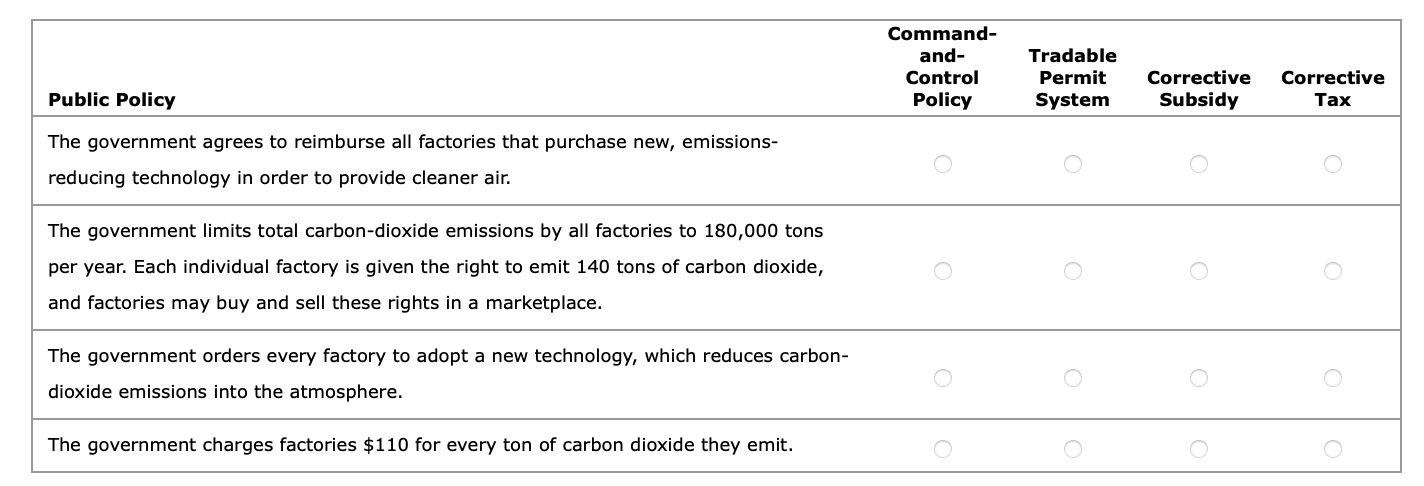
Understanding different policy options to correct for negative externalities
Carbon dioxide emissions have been linked to worsening climate conditions. The following table lists some possible public policies aimed at reducing the amount of carbon dioxide in the air.
For each policy listed, identify whether it is a:
- Command-and-control policy (regulation),
- Tradable permit system,
- Corrective subsidy (subsidies given to deal with the effects of a positive externality),
- or Corrective tax (taxes enacted to deal with the effects of a negative externality).
1. SELECT ONE FOR EACH POLICY:
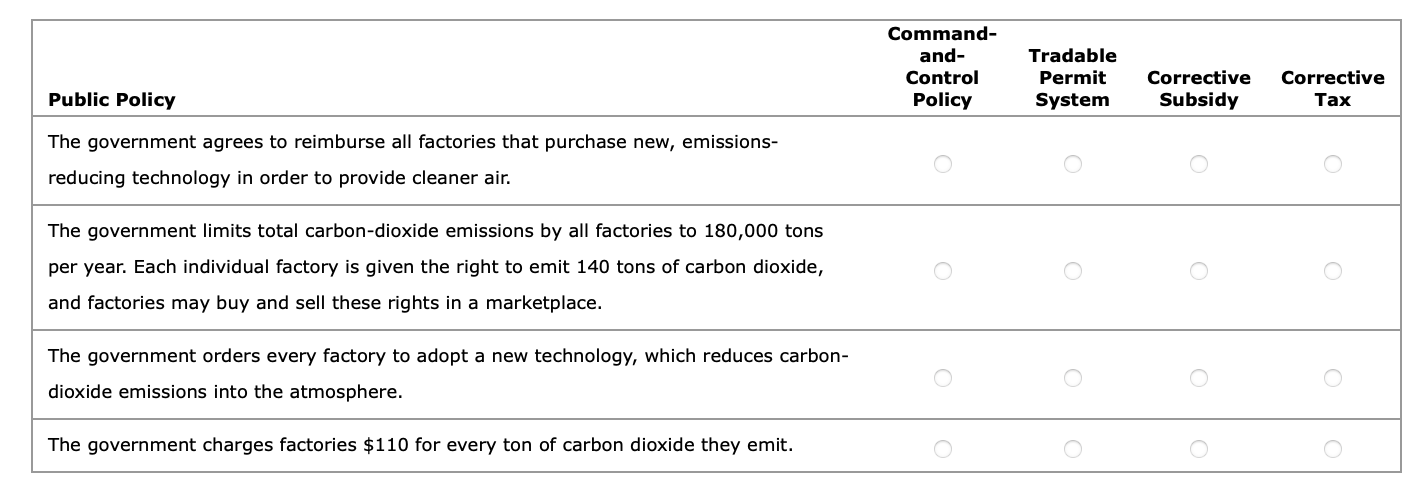
Command- and- Tradable Control Permit Corrective Corrective Public Policy Policy System Subsidy Tax The government agrees to reimburse all factories that purchase new, emissions- reducing technology in order to provide cleaner air. The government limits total carbon-dioxide emissions by all factories to 180,000 tons per year. Each individual factory is given the right to emit 140 tons of carbon dioxide, and factories may buy and sell these rights in a marketplace. The government orders every factory to adopt a new technology, which reduces carbon- dioxide emissions into the atmosphere. The government charges factories $110 for every ton of carbon dioxide they emit
Step by Step Solution
There are 3 Steps involved in it

Get step-by-step solutions from verified subject matter experts
 Study Help