



Question: understanding the IRR and NPV The net present value (NPV) and internal rate of return (IRR) methods of investment analysis are interrelated and are sometimes
understanding the IRR and NPV
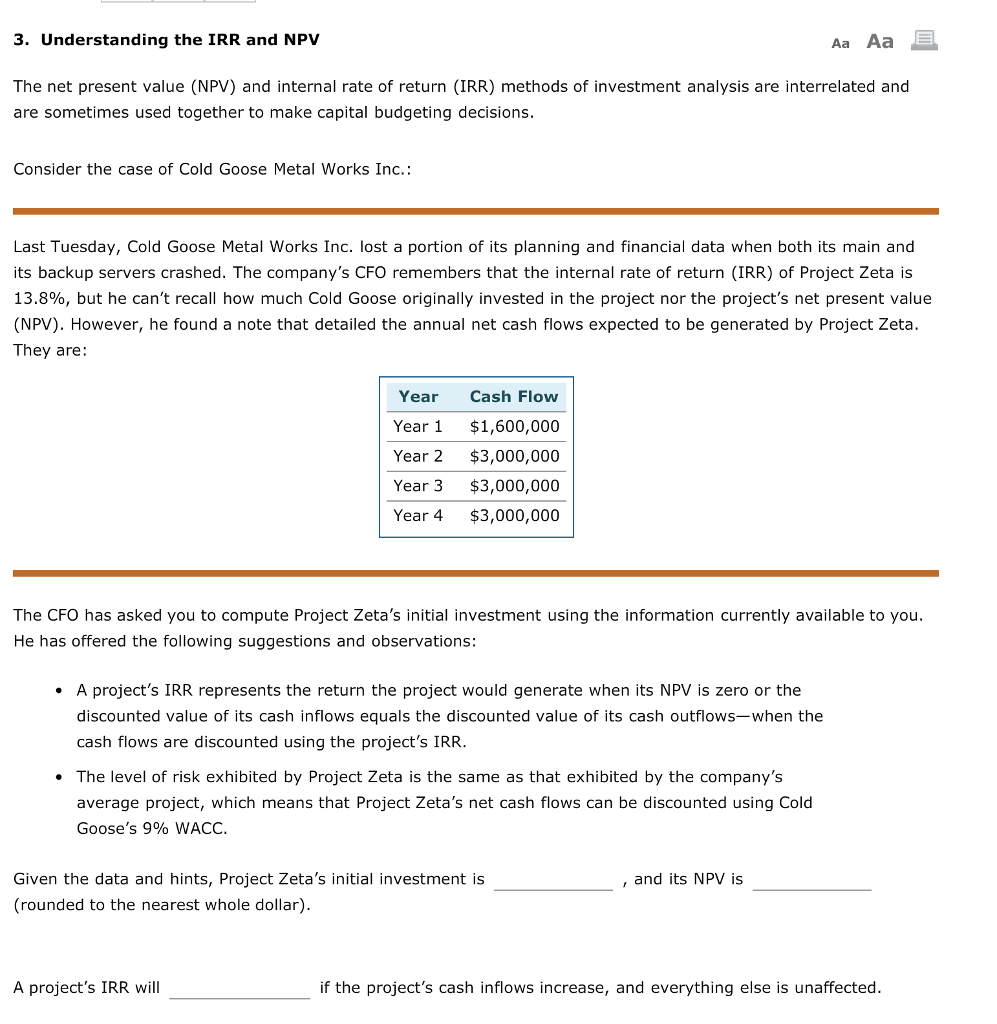
The net present value (NPV) and internal rate of return (IRR) methods of investment analysis are interrelated and are sometimes used together to make capital budgeting decisions. Consider the case of Cold Goose Metal Works Inc.: Last Tuesday, Cold Goose Metal Works Inc. lost a portion of its planning and financial data when both its main and its backup servers crashed. The company's CFO remembers that the internal rate of return (IRR) of Project Zeta is 13.8%, but he can't recall how much Cold Goose originally invested in the project nor the project's net present value (NPV). However, he found a note that detailed the annual net cash flows expected to be generated by Project Zeta. They are: The CFO has asked you to compute Project Zeta's initial investment using the information currently available to you. He has offered the following suggestions and observations: A project's IRR represents the return the project would generate when its NPV is zero or the discounted value of its cash inflows equals the discounted value of its cash outflows-when the cash flows are discounted using the project's IRR. The level of risk exhibited by Project Zeta is the same as that exhibited by the company's average project, which means that Project Zeta's net cash flows can be discounted using Cold Goose's 9% WACC. Given the data and hints, Project Zeta's initial investment is _____, and its NPV is _____ (rounded to the nearest whole dollar). A project's IRR will ______ if the project's cash inflows increase, and everything else is unaffected
Step by Step Solution
There are 3 Steps involved in it

Get step-by-step solutions from verified subject matter experts