







Question: UndirectedGraph class ( do NOT use an existing Graph class, you must write your own! ) Undirected graphs can be stored in a data structure
UndirectedGraph class do NOT use an existing Graph class, you must write your own!
Undirected graphs can be stored in a data structure called an adjacency matrix, where a nonzero value
stored at row x and column y in the matrix means there exists an edge connecting vertices x and y
Note that when storing an undirected graph in a matrix, you can either:
Make sure that both row x column y and row y column x are always set to the same value, or:
Use only half the matrix, the "upper triangle," by ensuring that the column number y is always
greater than or equal to the row number x when storing a value for an edge connecting x and y
You may use either approach when storing the graph. For example, in a graph with five vertices, both of
these matrices store the same graph:
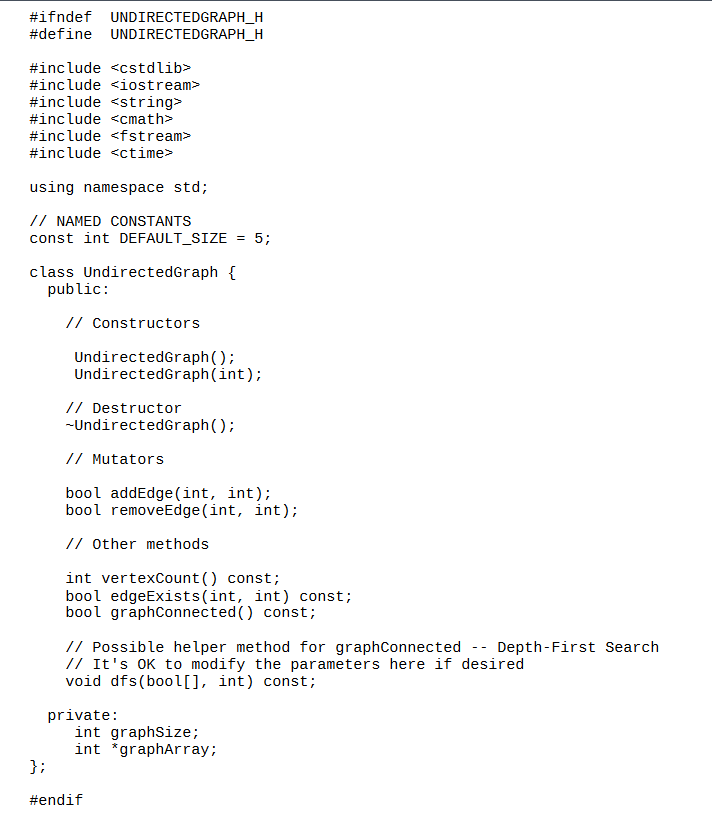
First, write methods appropriate to support an UndirectedGraph class:
Constructors to create an edgeless graph with a given number of vertices passed as an argument. Set a
default number of vertices for a zeroargument constructor. Each constructor will dynamically allocate the
array or vector the contains the matrix. NOTE that dynamic allocation of D arrays isn't something that
C supports! If using arrarys, consider using a "flat" singledimensional array, and use a formula to
convert an edge from vertex i to vertex j on a graph with v vertices where i and j range from to v to
map to arrayiv j in a onedimensional array. If using an uppertriangle approach to store edges, just
make sure that j i when performing the calculation. There'll be "wasted" space in the array, but that's of
no concern here.
An accessor method int vertexCount that returns the number of vertices in the graph.
A method bool edgeExistsint int that returns true if an edge exists between the two specified vertex
numbers.
Cal Poly Humboldt CS Fall Assignment # p of
You are not required to allow users to change the number of vertices once the graph is created.
bool addEdgeint int and bool removeEdgeint int methods for adding and removing edges from the
graph. An edge is defined by the two vertices it connects, so each method should expect two int values,
each representing a vertex. Each method should return true if the action was performed and false if it
wasn't for example, the edge already exists, or there was no edge to be removed Your addEdge method
should also check to make sure you are NOT adding a "loop" edge that connects a vertex to itself!
A method bool graphConnected that does the following:
Allocates a a bool array of size equal to the number of vertices, used to indicate whether a vertex
has been "marked" during traversal. Initialize all values to false.
Starting from any vertex, performs a "walk" using the edges, marking visited vertices along the way.
A recursive search using a helper function is best here, but be sure to pay attention to which
vertices have already been visited when doing your recursion so you don't infinitely recurse!
Check your markedvertex array, and return true if all vertices were marked during the search ie
the graph is connected and false otherwise.
There are several ways to determine whether a graph is connected that is whether it's possible to get
from any vertex to any other vertex via a path You can consult the text for possible methods.
Here is a description of a method for determining connectivity, from the Wikipedia page on "Connectivity
graph theory with some minor edits:
Begin at any arbitrary vertex in the graph, and "mark" itYou can use the bool array or
vector of size V the number of vertices in the graph, to record vertices are being
marked.
Proceed from that vertex using the edges in either a depthfirst or a breadthfirst search,
marking all vertices reached. Marking can be useful so that you know which vertices you've
already visited to avoid excessive recursion, or even infinite recursion!
Once the graph has been traversed, if all vertices are marked, then the graph is connected.
Step by Step Solution
There are 3 Steps involved in it
1 Expert Approved Answer
Step: 1 Unlock

Question Has Been Solved by an Expert!
Get step-by-step solutions from verified subject matter experts
Step: 2 Unlock
Step: 3 Unlock
 Study Help