







Question: Unit 2 Assignment: Socit De Transport De Montral Case Study Attached Files: CIS415 Unit 2 Assignment.pdfCIS415 Unit 2 Assignment.pdf - Alternative Formats(134.696 KB) Please read
Unit 2 Assignment: Socit De Transport De Montral Case Study
Attached Files:
- CIS415 Unit 2 Assignment.pdfCIS415 Unit 2 Assignment.pdf - Alternative Formats(134.696 KB)
Please read the case study at the end of Chapter 2, give a brief synopsis of the case, and answer the questions at the end.
See the attached document for complete instructions and grading rubric.
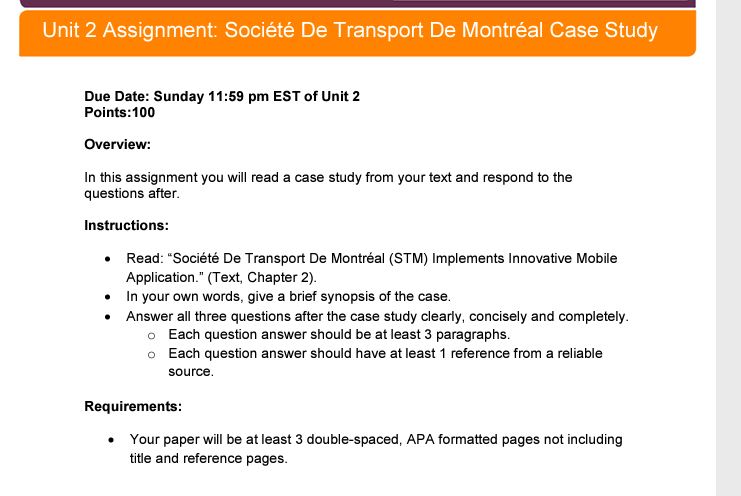
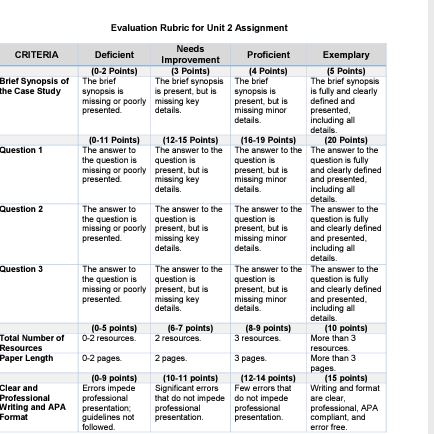
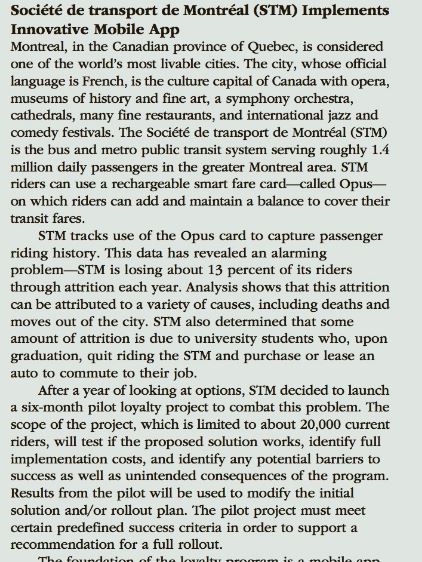
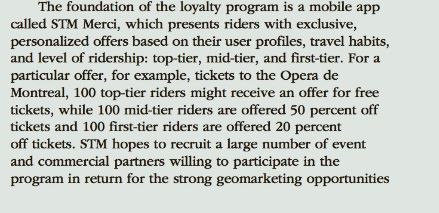
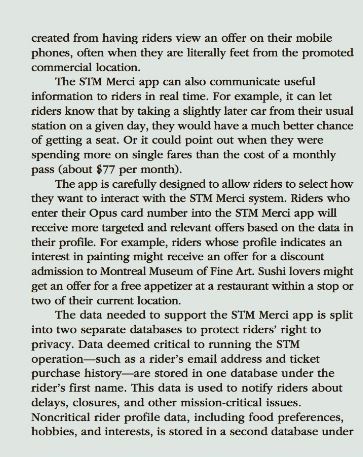
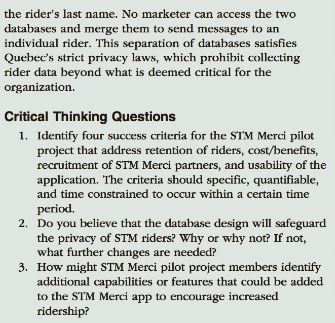
Unit 2 Assignment: Societe De Transport De Montreal Case Study Due Date: Sunday 11:59 pm EST of Unit 2 Points: 100 Overview: In this assignment you will read a case study from your text and respond to the questions after. Instructions: . Read: "Societe De Transport De Montreal (STM) Implements Innovative Mobile Application." (Text, Chapter 2). In your own words, give a brief synopsis of the case. . Answer all three questions after the case study clearly, concisely and completely. o Each question answer should be at least 3 paragraphs. o Each question answer should have at least 1 reference from a reliable source. Requirements: Your paper will be at least 3 double-spaced, APA formatted pages not including title and reference pages.\f\f\fcreated from having riders view an offer on their mobile phones, often when they are literally feet from the promoted commercial location. The SIM Merci app can also communicate useful Information to riders in real time. For example, it can let riders know that by taking a slightly later car from their usual station on a given day, they would have a much better chance of getting a seat. Or it could point out when they were spending more on single fares than the cost of a monthly pass (about $77 per month). The app is carefully designed to allow riders to select how they want to interact with the STM Merci system. Riders who enter their Opus card number into the STM Merci app will receive more targeted and relevant offers based on the data in their profile. For example, riders whose profile indicates an interest in painting might receive an offer for a discount admission to Montreal Museum of Fine Art. Sushi lovers might get an offer for a free appetizer at a restaurant within a stop or two of their current location. The data needed to support the STM Merci app is split into two separate databases to protect riders' right to privacy. Data deemed critical to running the STM operation-such as a rider's email address and ticket purchase history-are stored in one database under the rider's first name. This data is used to notify riders about delays, closures, and other mission-critical issues. Noncritical rider profile data, including food preferences, hobbies, and interests, is stored in a second database underthe rider's last name. No marketer can access the two databases and merge them to send messages to an individual rider. This separation of databases satisfies Quebec's strict privacy laws, which prohibit collecting rider data beyond what is deemed critical for the organization. Critical Thinking Questions 1. Identify four success criteria for the STM Merci pilot project that address retention of riders, cost/benefits, recruitment of STM Merci partners, and usability of the application. The criteria should specific, quantifiable, and time constrained to occur within a certain time period, 2. Do you believe that the database design will safeguard the privacy of STM riders? Why or why not? If not, what further changes are needed? 3. How might STM Merci pilot project members identify additional capabilities or features that could be added to the STM Merci app to encourage increased ridership
Step by Step Solution
There are 3 Steps involved in it

Get step-by-step solutions from verified subject matter experts
 Study Help