







Question: Unit 2: Instructions and Process Description Purpose Much of what we do in our lives requires us to explain something to either another person or
Unit 2: Instructions and Process Description Purpose Much of what we do in our lives requires us to explain something to either another person or a group of people, often at the same time. In this unit, we will turn our attention to determining the best way to explain something a broad "novice" audience (readers who lack knowledge of the task or the topic) using two expository genres common in technical communication: instructions and process description. The particular challenge of this unit is to use the fewest words possible in communicating essential knowledge while adopting a voice that is both as straight-forward as possible and uniquely your own. Tasks In this unit, you will construct a set of instructions and a process description. Your instructions are limited to one page (maximum) and must provide a step-by-step guide describing how to complete the chosen task. Your instructions should cover a task that you already know how to complete. The process description must be 750-850-words and describe how something works. The process description is not merely a recitation of the instructions in paragraph form. Instead, the process description explains how a process works from start to finish, clarifying each stage or part of the process. Your set of instructions and process description can be about any topic of your choosing, but the topic giving rise to the task should also give rise to the process (i.e. they should be connected; see example below) and must be appropriate to professional writing and a professional setting. Remember, instructions tell readers how to complete a task, while process descriptions tell readers how something works. Instructions and Process Description Example As an example, your instructions could describe step-by-step how to complete a set of yoga insanas (moves), while the process description could describe what happens to the body as one completes a set of yoga insanas. Alternatively, your instructions could describe step-by-step how to rebuild a carburetor, while the process description could describe how the carburetor works, from start to finish, in an engine. Rhetorical Situation of the Instructions and Process Description Instructions Audience Your audience is broad but united by the fact that these diverse readers want expert yet easy-to-follow guidance in how to complete a specialized task. In other words, the audience lacks knowledge about the task and needs straightforward steps and definitions to accomplish the task successfully. Purpose The aim of instructions is to communicate essential information briefly and directly. One page maximum. Expect a word count of 250-500 words. Genre Instructions take an objective tone and do not use first person pronouns (I, we, us, our) to refer to the writer or second person pronouns (you, your) to directly address the reader. Instead, instructions use imperative sentences to direct readers in a task (like, "stop the vacuum"), a sentence type of direct address that omits the use of second person pronouns.
2 Instructions begin with a title that clearly states the purpose and topic of the task. This can be achieved with the phrase "How to..." or a gerund phrase (ex. "How to Install a Printer" or "Installing a Printer"). Instructions also provide an introduction that informs readers of the task they will complete, a list of materials or conditions needed to complete the task, and safety information. Following the introduction, numbered steps describe how to complete the task in the correct sequence of action. Each step must begin with an active, present tense verb. If the instructions incorporate graphics, they must be clearly labeled and cited in APA format. Instructions end with a conclusion that signals the task's completion or offers troubleshooting information. You should not (need to) borrow from outside sources to help you craft the written contents of your instructions. Process Description Audience Again, your audience is broad but united by the fact that these diverse readers want to understand, through language that is accessible to them, how a complex process works. In other words, the audience lacks basic knowledge about the process and needs clear and easy-to-digest descriptions of elements, definitions of terms and concepts, and explanations of relationships of parts and movements. Purpose The aim of a process description is to communicate essential information briefly, thoroughly, and directly. Word count: 750-850-words. Genre Process descriptions do not include first person pronouns (I, we, us, our) to refer to the writer or second person pronouns (you, your) to directly address the reader. Instead, process descriptions describe what things are and what they do, typically using active verbs in straightforward subject + verb grammatical constructions (like, "the crank shaft rotates counterclockwise..."), in order to cumulatively convey how a process works. A process description begins with a specific and precise title that conveys exactly what process is being described (example: "How a Printer Works). Following the title, an introduction summarizes the overall process and describes the features or stages of the process. In addition, the process description includes technical definitions for any terms likely to be unfamiliar to readers. Finally, the process description concludes with a description of the process in motion. You will likely need to consult and borrow from (paraphrase only) outside sources to help you craft your process description, which means you will need to include citations and references for these sources, formatted according to APA style. Assessment Criteria: To earn the minimum passing grade of a C, your instructions and process description unit must 1) Use Standard Edited American/Academic English (SEAE) 2) Demonstrate an understanding of APA style documentation practices for research 3) Demonstrate topic-selection appropriate to a professional context 4) Maintain appropriate voice, tone, and level of formality 5) Demonstrate logical organization, at the levels of both document and genre, and attention to detail 6) Communicate effectively to a broad but diverse audience using a variety of genres 7) Communicate purposes?task and process?effectively by integrating one's own ideas with those of others
This is an example of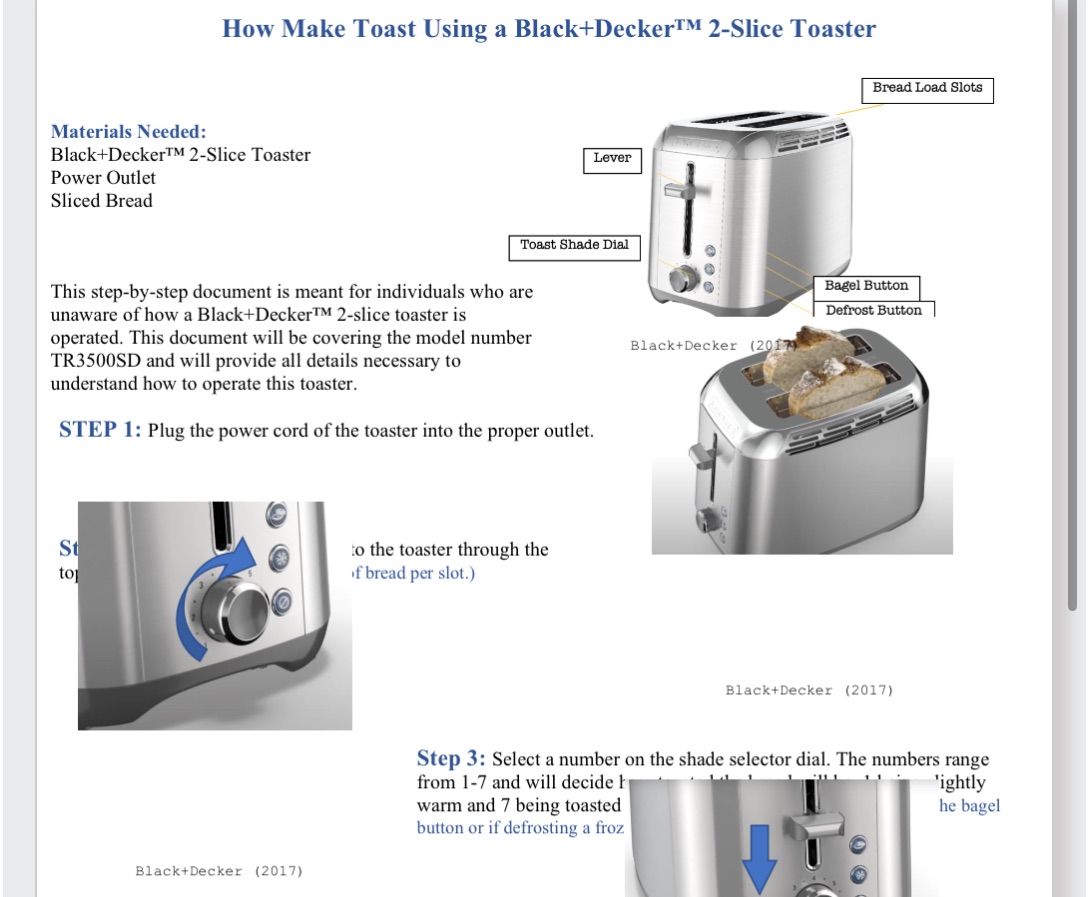
Step by Step Solution
There are 3 Steps involved in it

Get step-by-step solutions from verified subject matter experts
 Study Help