Question: UNIT 2 - MILESTONE 2 120 SUBMIT MILESTONE Question 1 O Mark this question Here are all the tutorials from Unit 2. Use them as
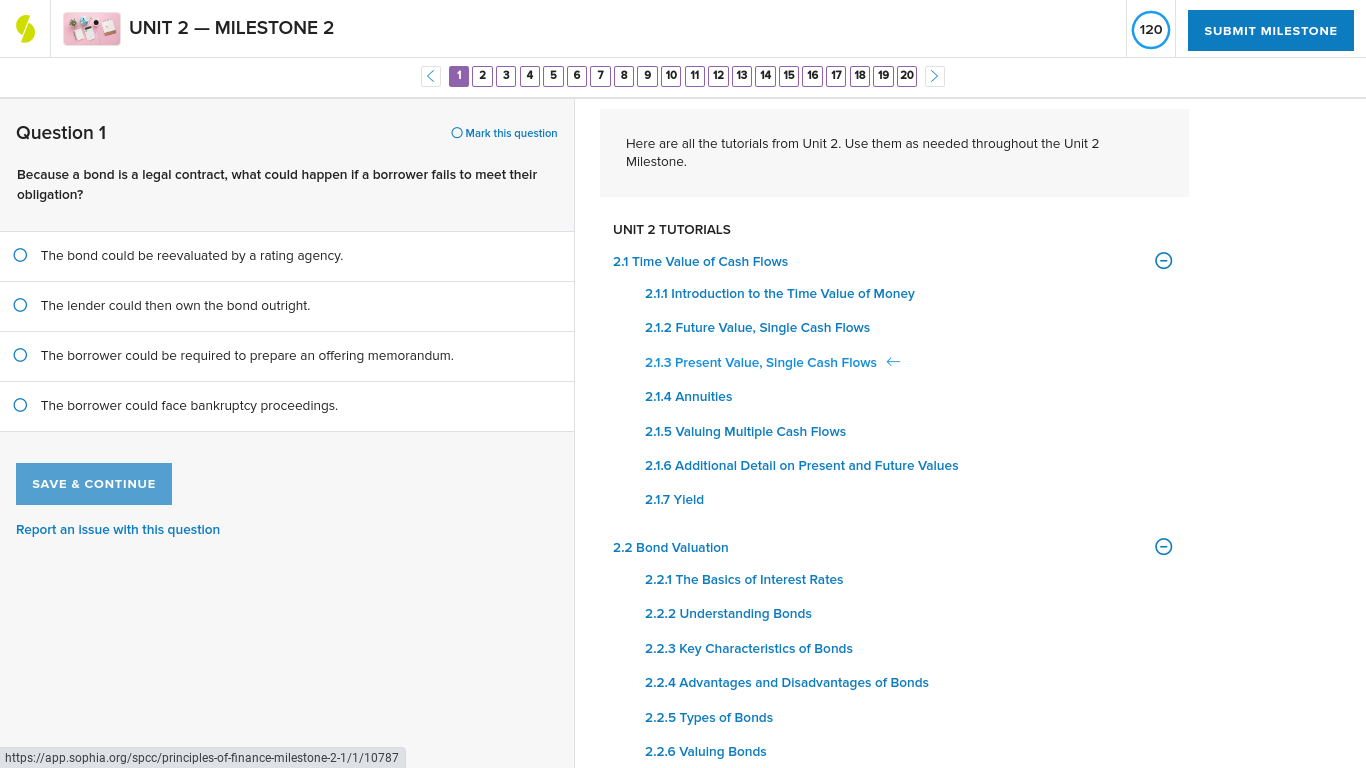
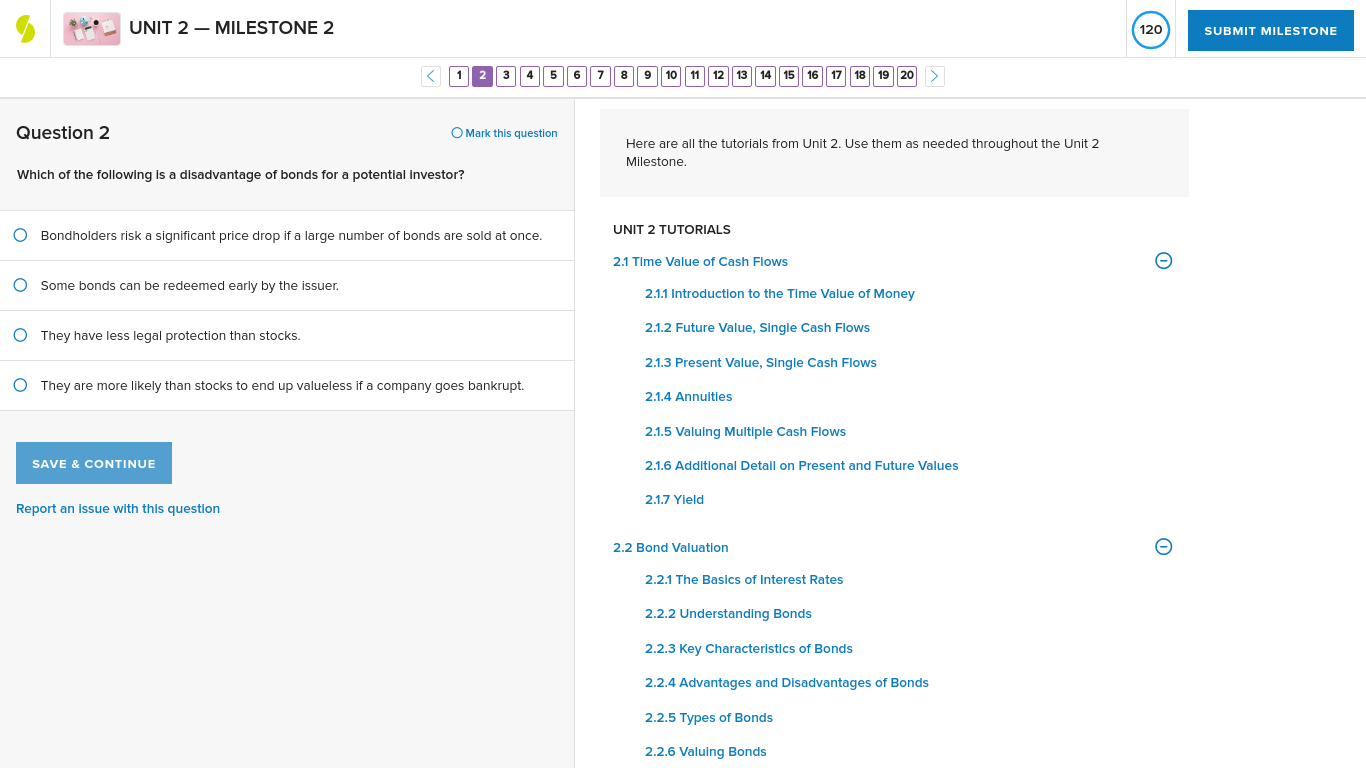
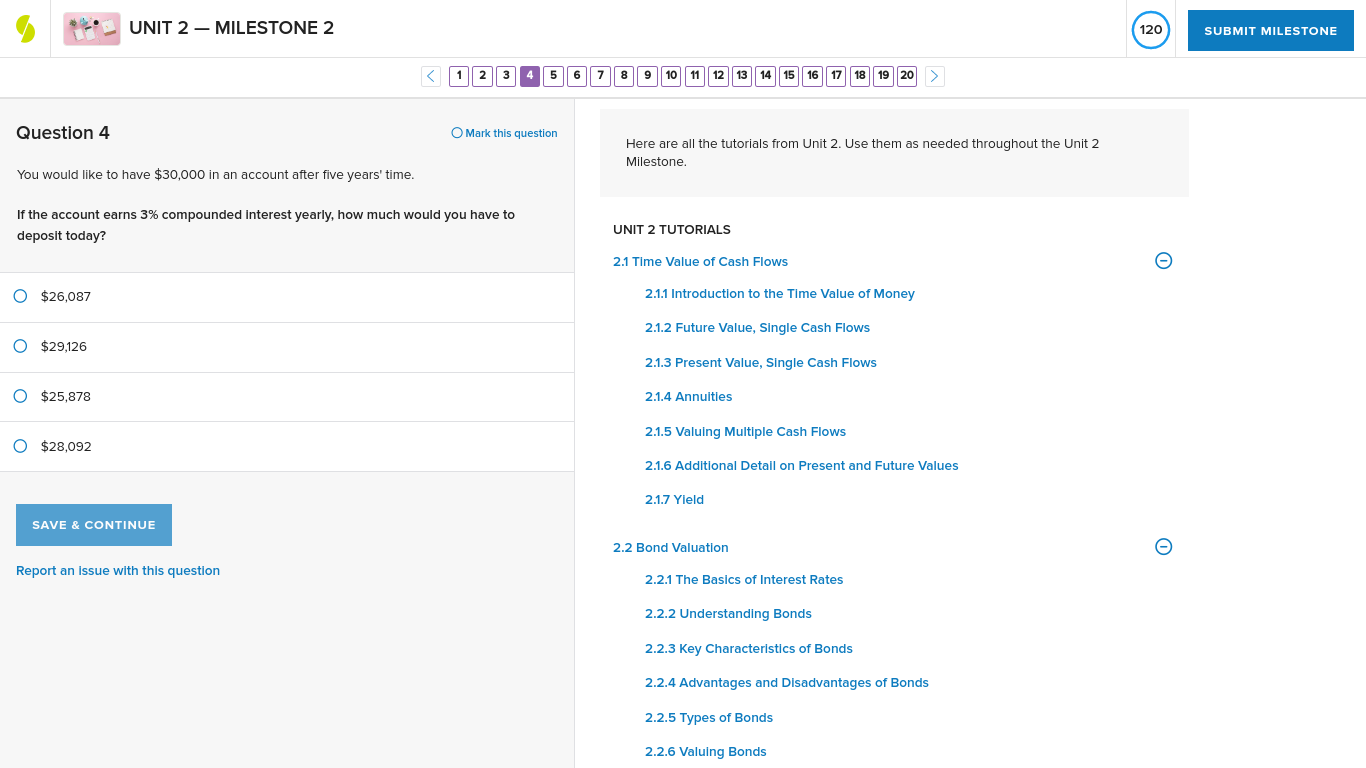
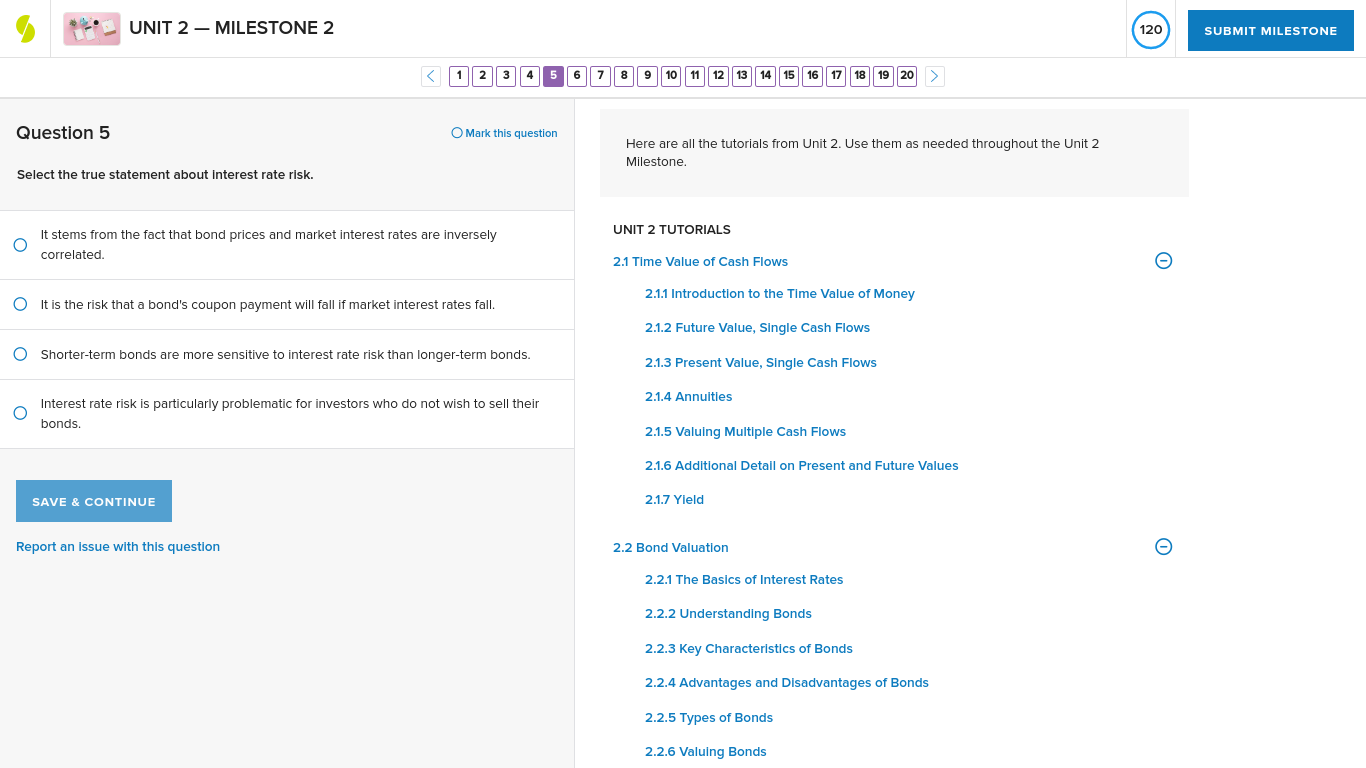
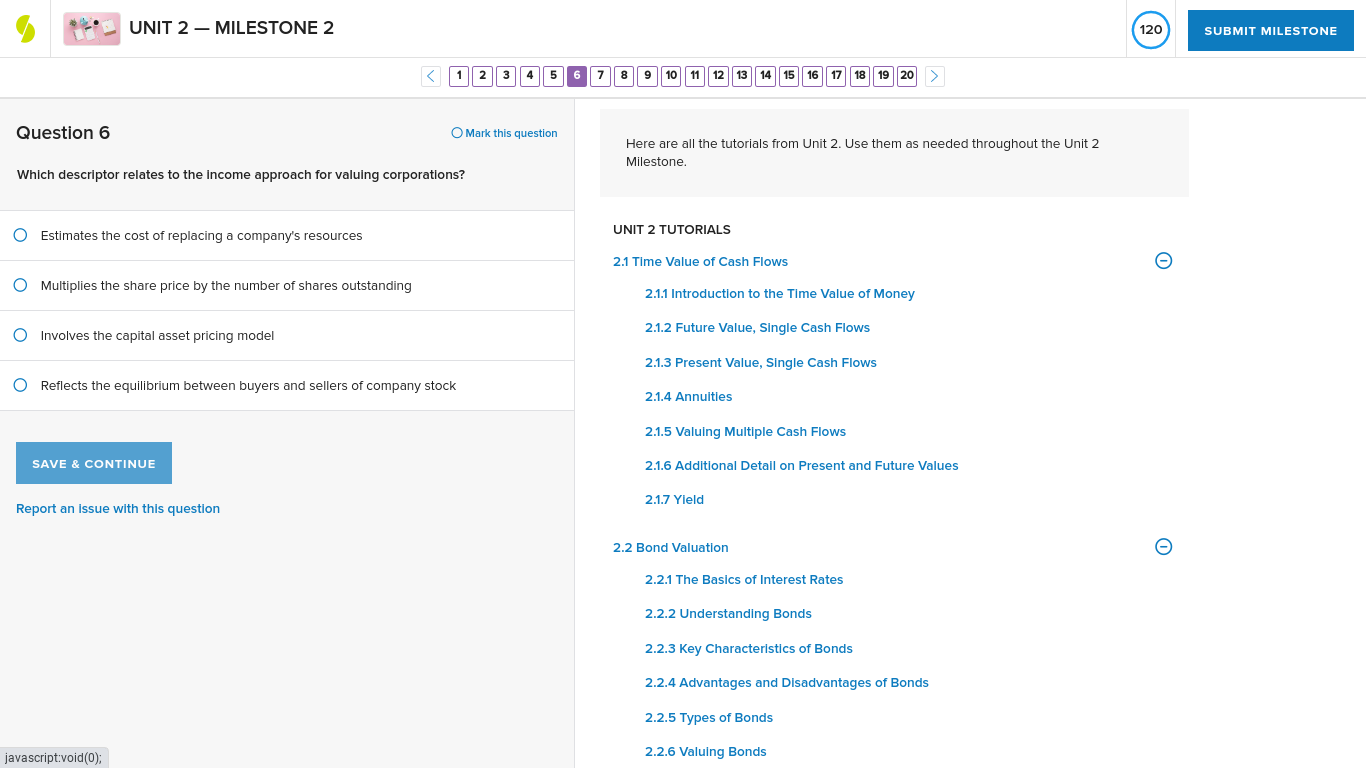
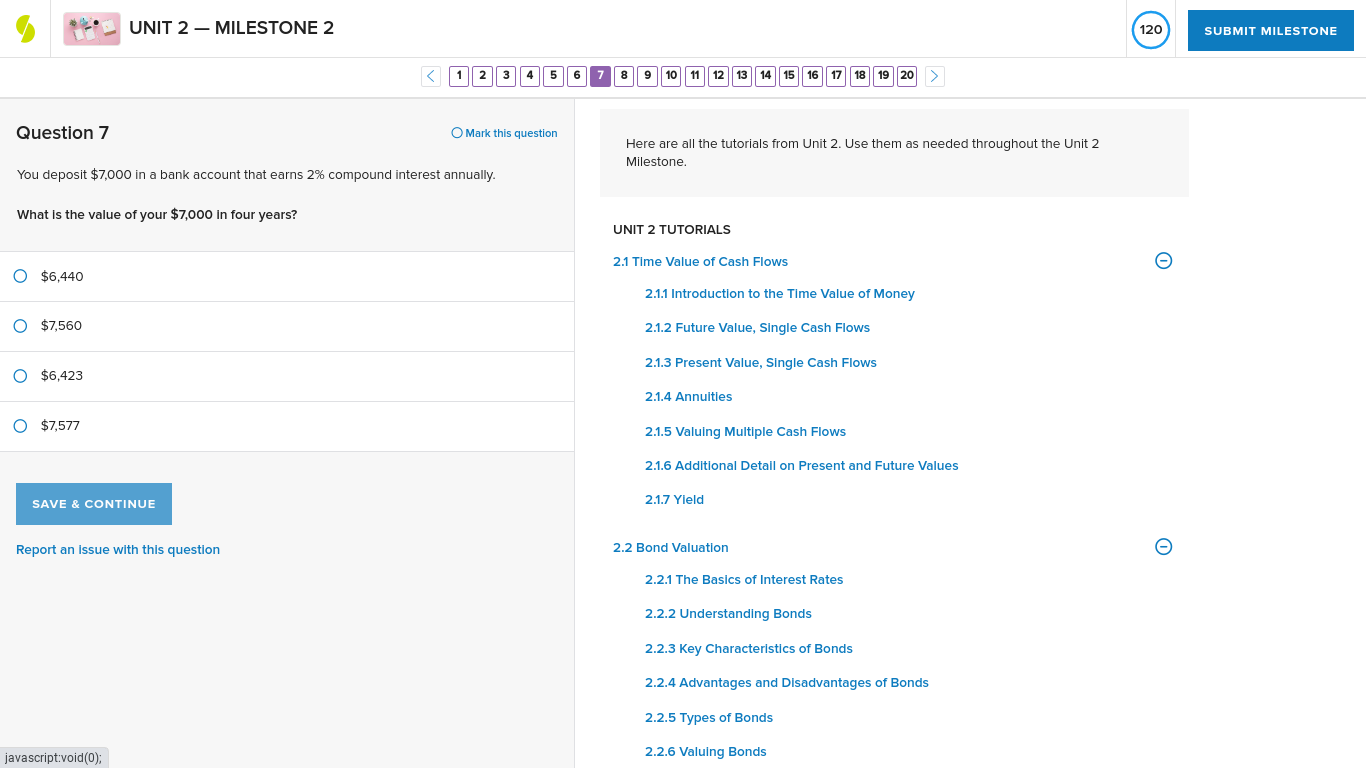
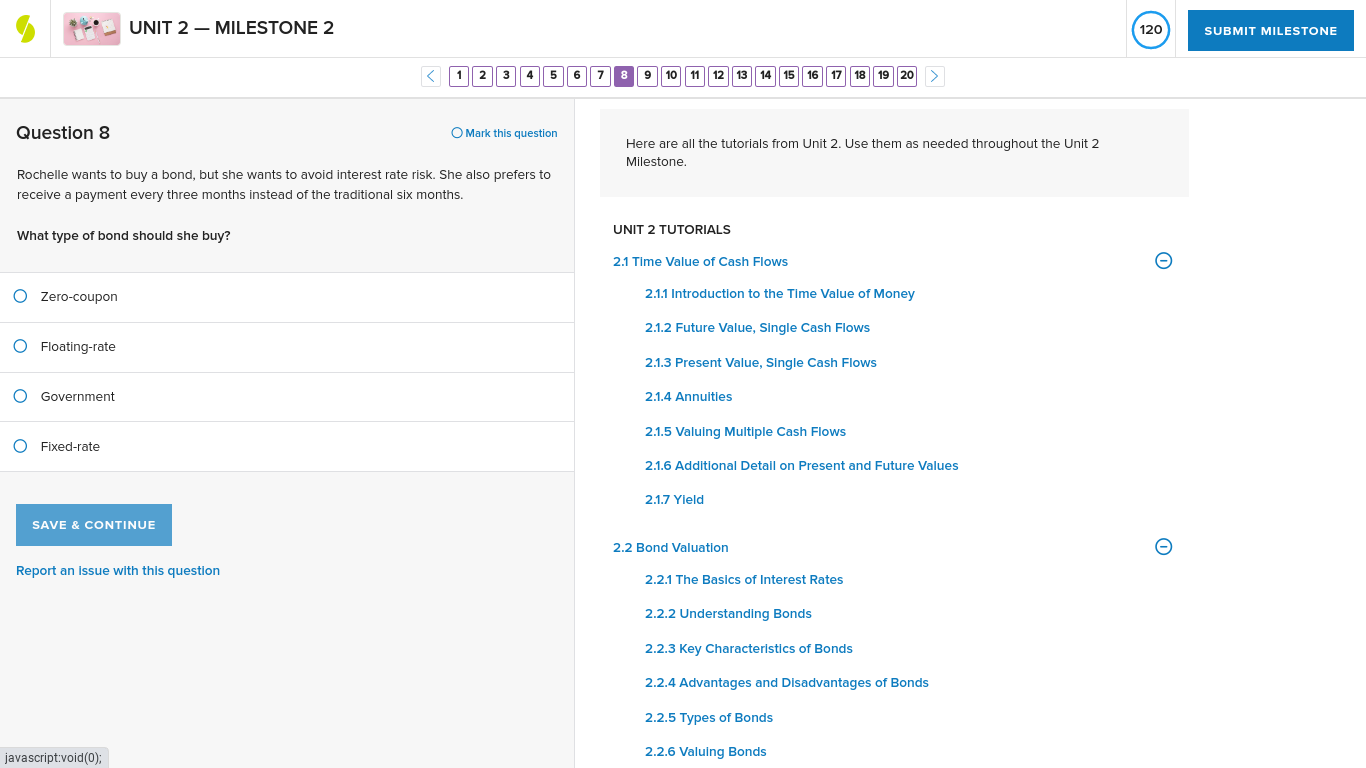
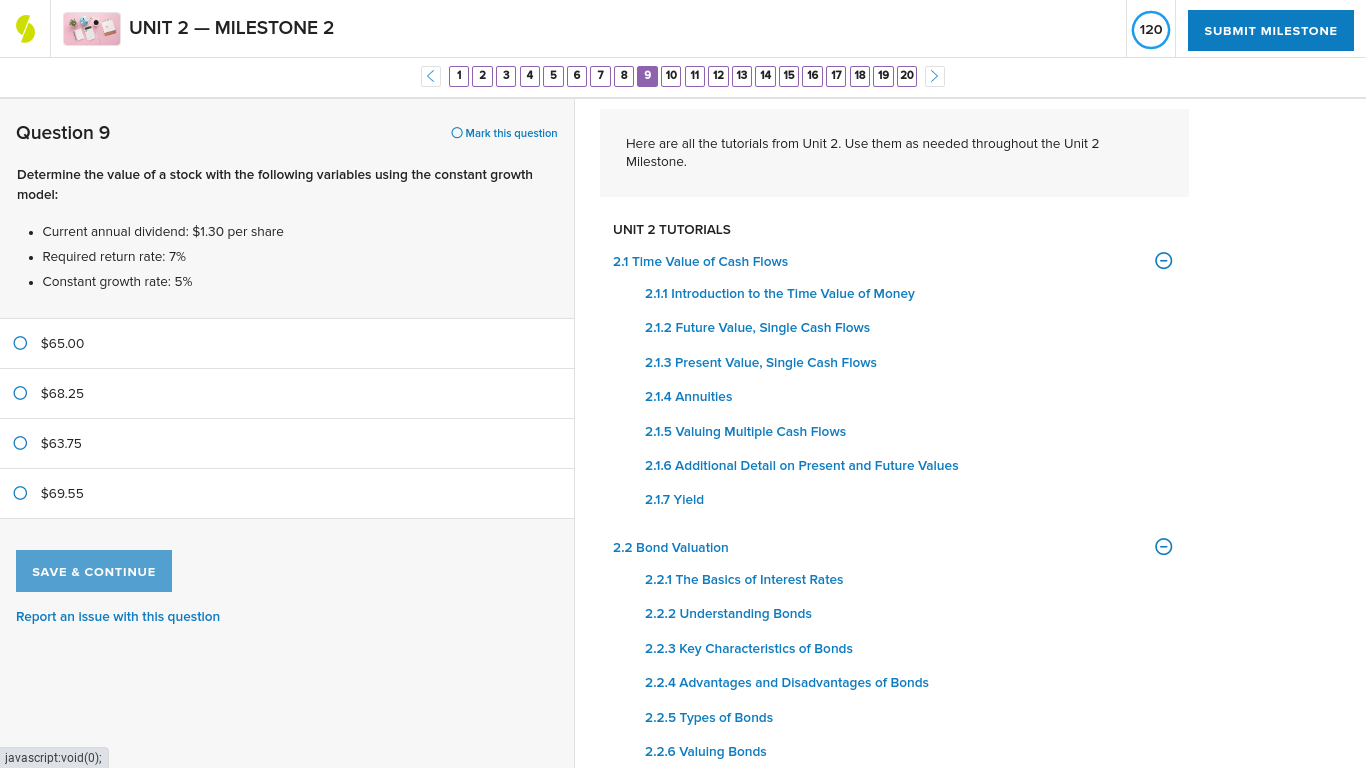
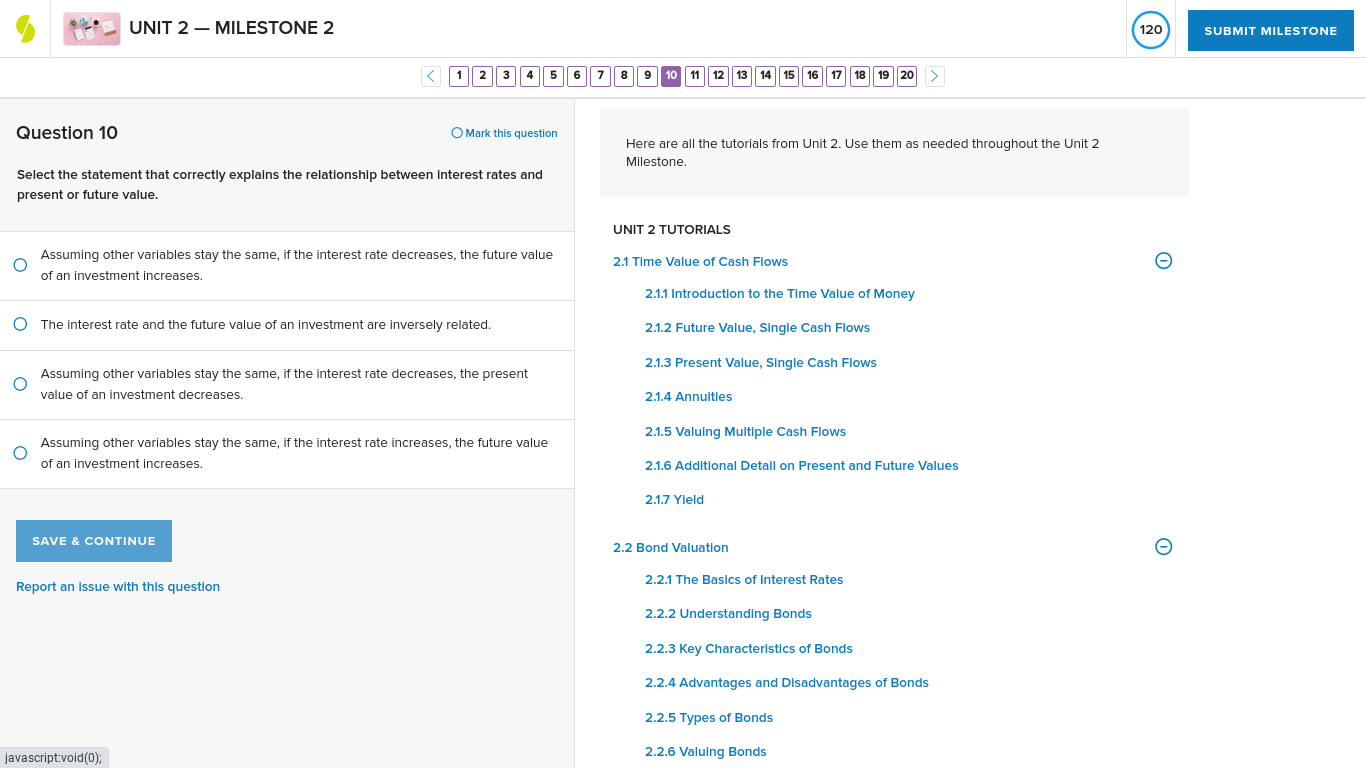
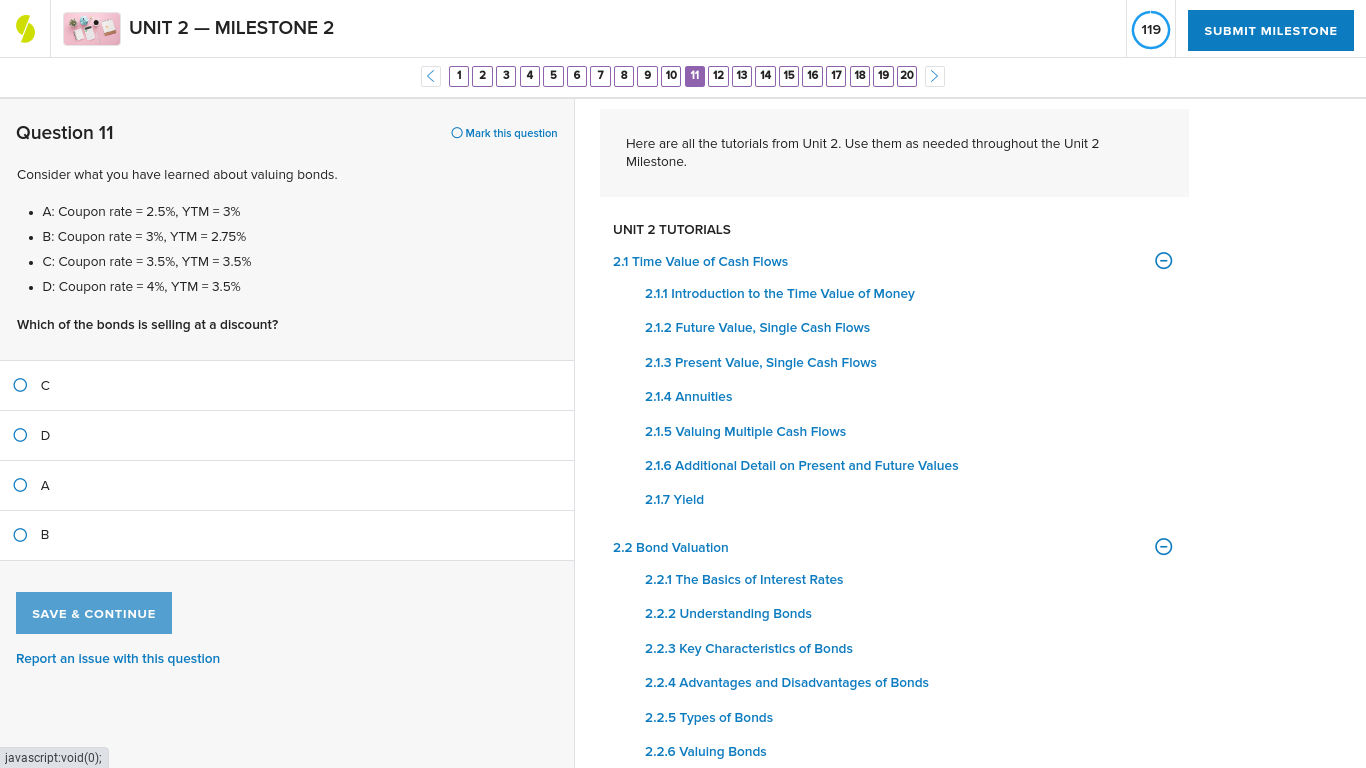
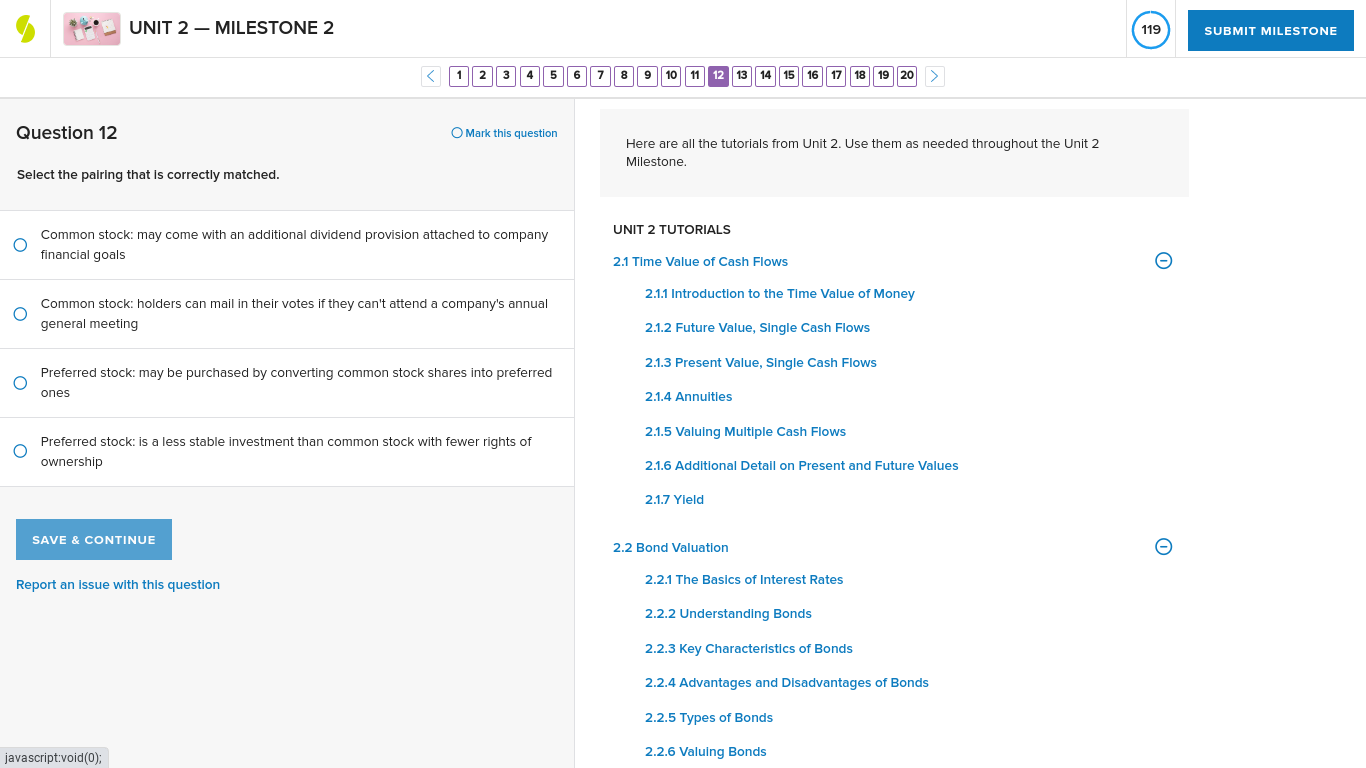
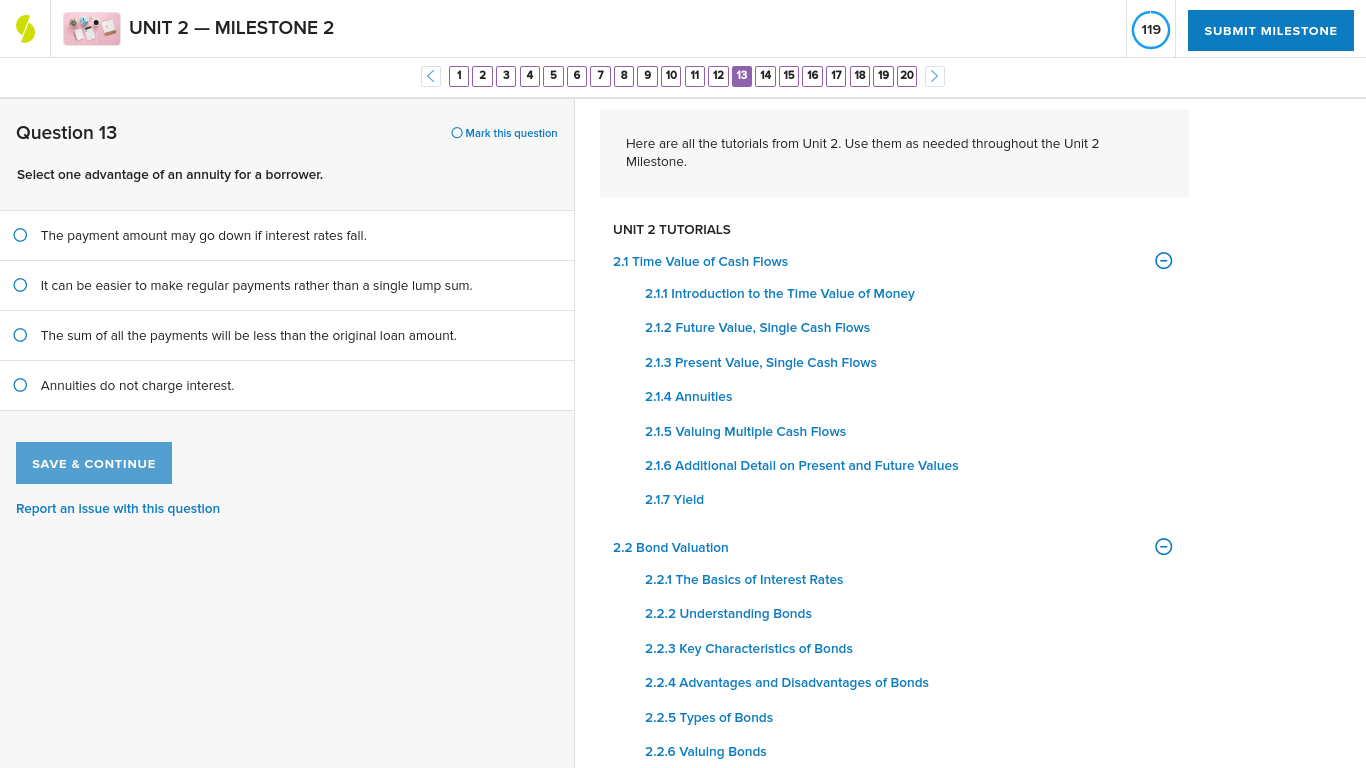
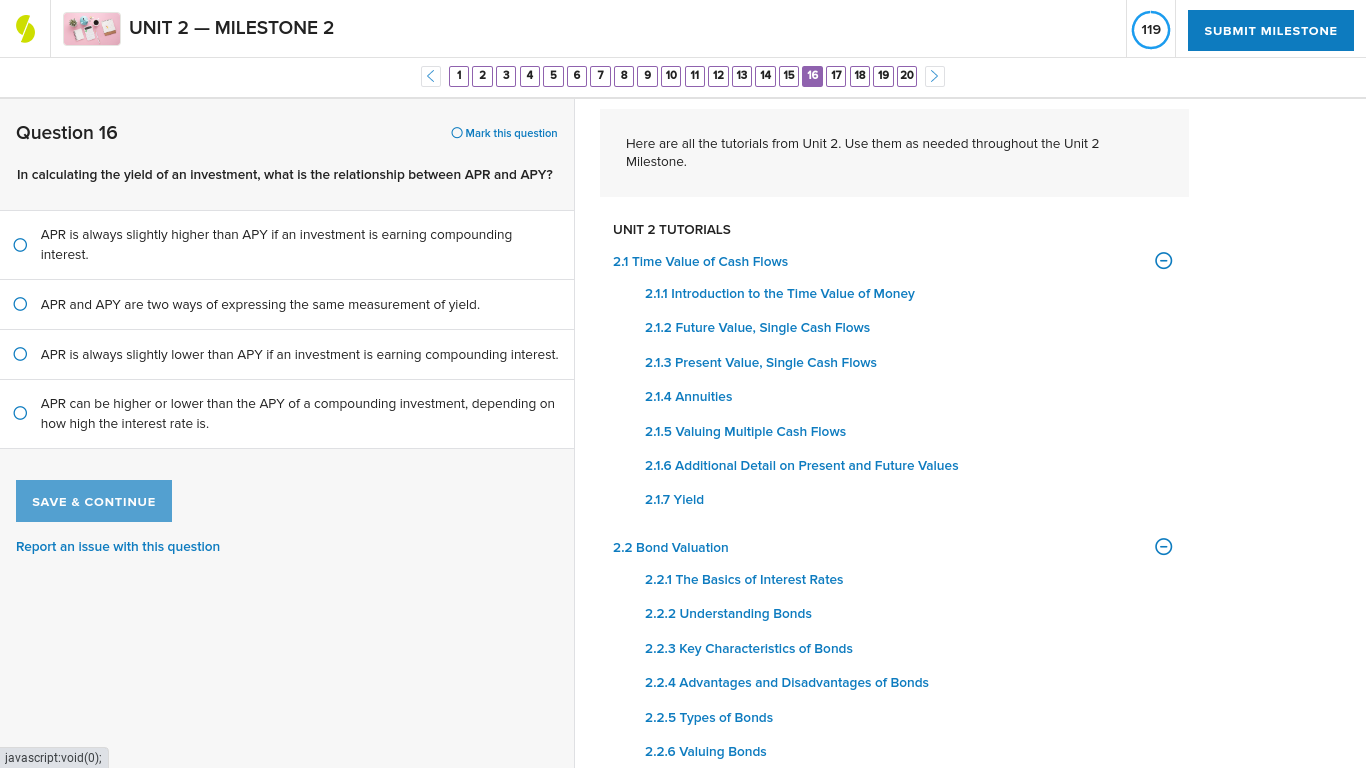
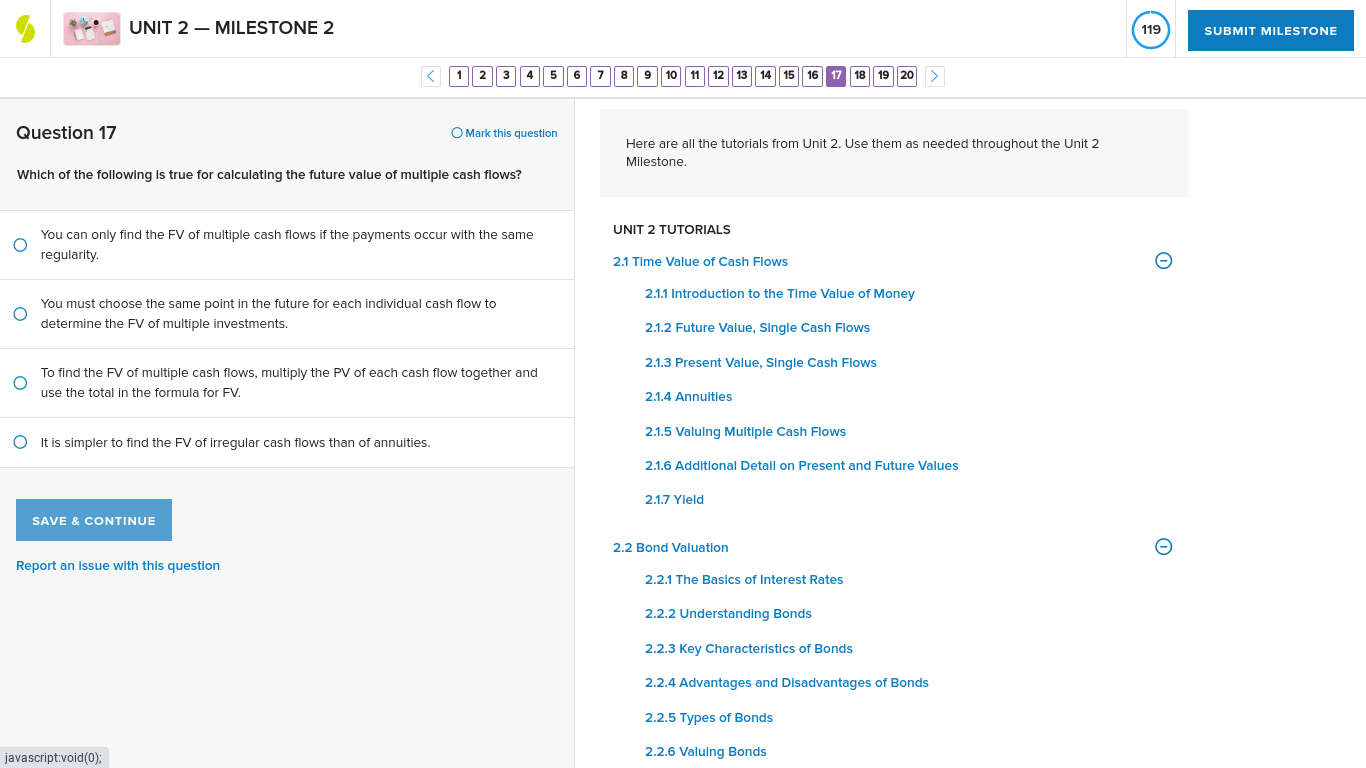
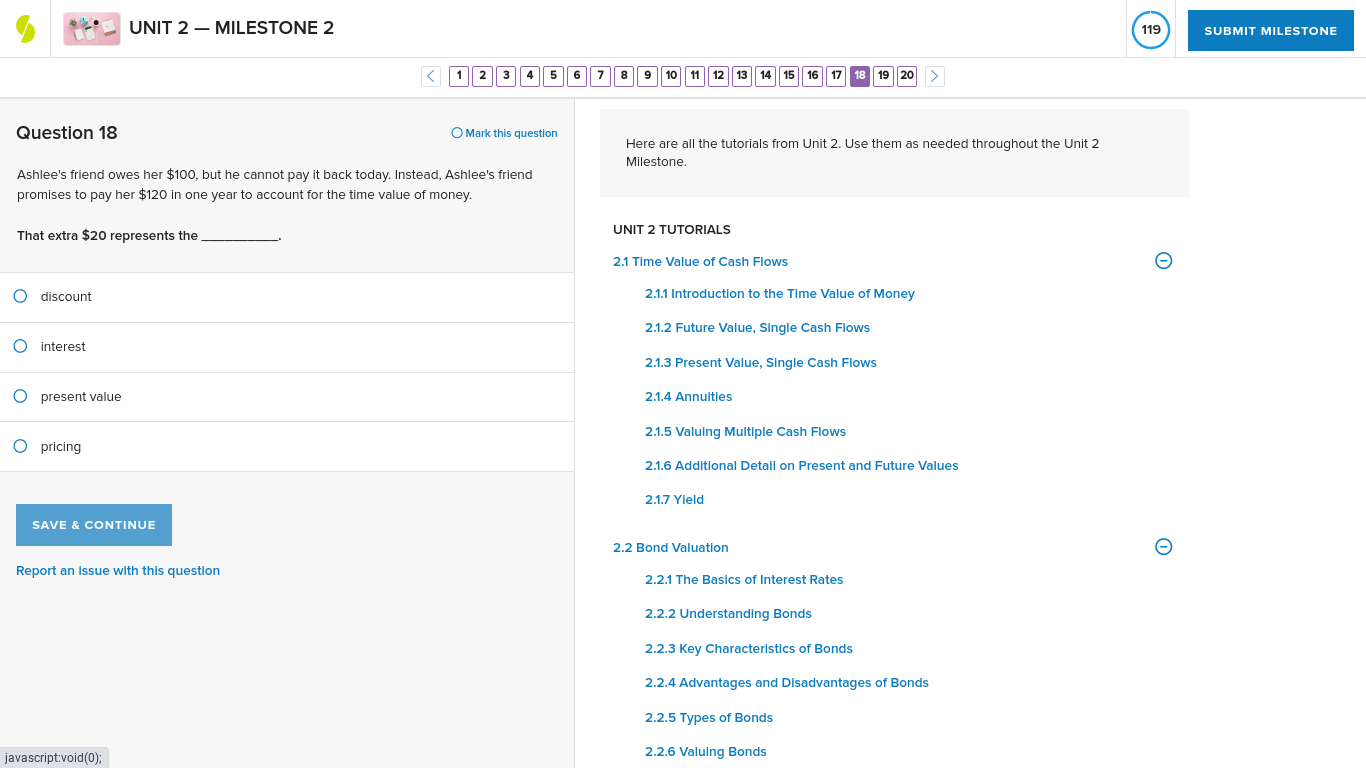
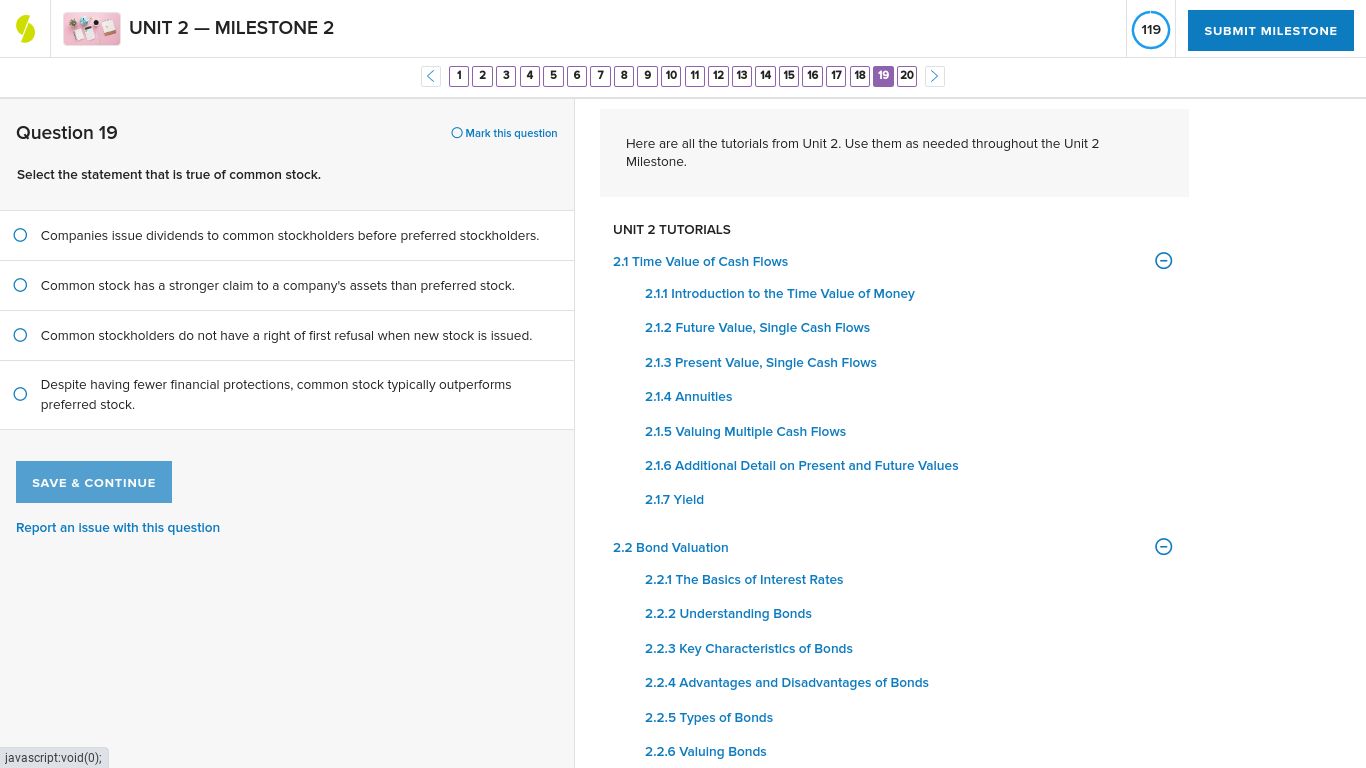
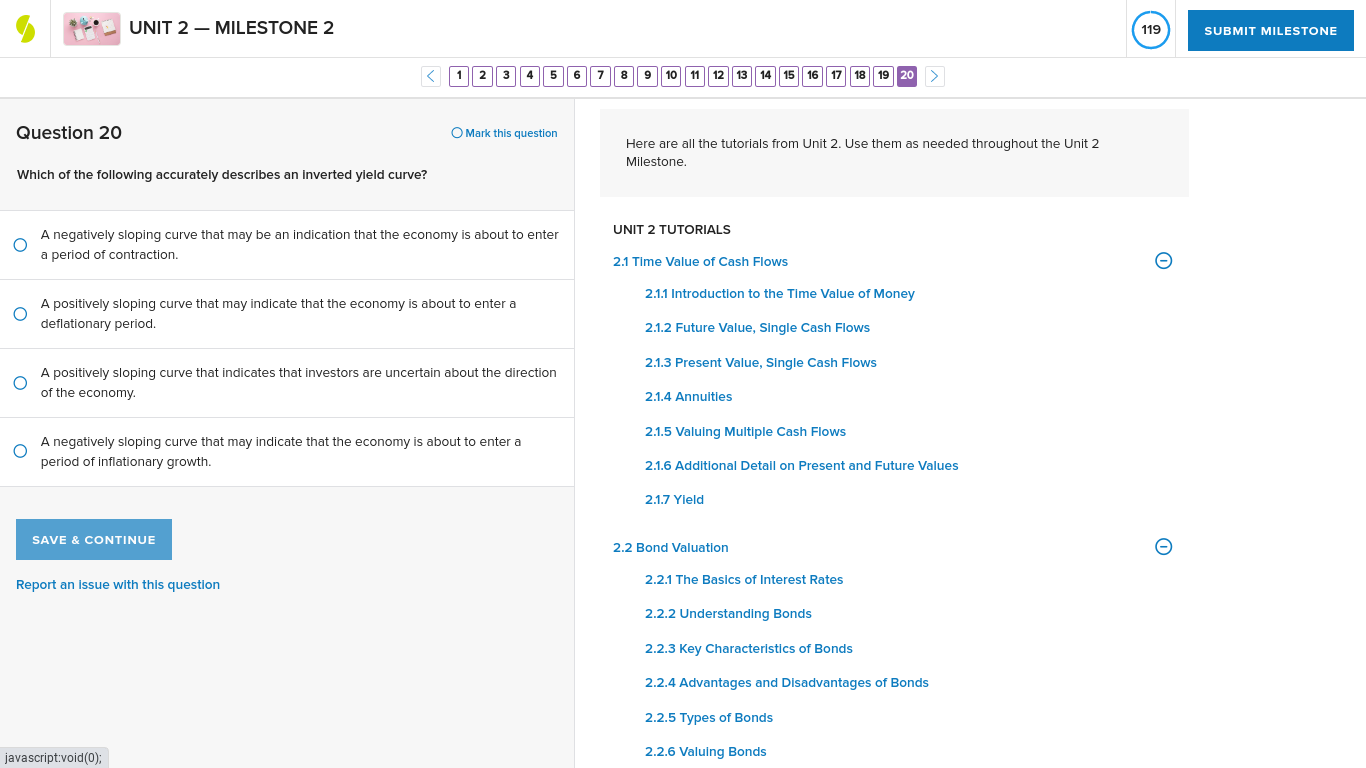
UNIT 2 - MILESTONE 2 120 SUBMIT MILESTONE Question 1 O Mark this question Here are all the tutorials from Unit 2. Use them as needed throughout the Unit 2 Milestone. Because a bond is a legal contract, what could happen If a borrower falls to meet their obligation? UNIT 2 TUTORIALS O The bond could be reevaluated by a rating agency. 2.1 Time Value of Cash Flows O 2.1.1 Introduction to the Time Value of Money O The lender could then own the bond outright. 2.1.2 Future Value, Single Cash Flows O The borrower could be required to prepare an offering memorandum. 2.1.3 Present Value, Single Cash Flows O 2.1.4 Annulties The borrower could face bankruptcy proceedings. 2.1.5 Valuing Multiple Cash Flows 2.1.6 Additional Detail on Present and Future Values SAVE & CONTINUE 2.1.7 Yield Report an Issue with this question 2.2 Bond Valuation O 2.2.1 The Basics of Interest Rates 2.2.2 Understanding Bonds 2.2.3 Key Characteristics of Bonds 2.2.4 Advantages and Disadvantages of Bonds 2.2.5 Types of Bonds https://app.sophia.org/spcc/principles-of-finance-milestone-2-1/1/10787 2.2.6 Valuing BondsUNIT 2 - MILESTONE 2 120 SUBMIT MILESTONE Question 2 O Mark this question Here are all the tutorials from Unit 2. Use them as needed throughout the Unit 2 Milestone. Which of the following is a disadvantage of bonds for a potential investor? O Bondholders risk a significant price drop if a large number of bonds are sold at once. UNIT 2 TUTORIALS 2.1 Time Value of Cash Flows O Some bonds can be redeemed early by the issuer. 2.1.1 Introduction to the Time Value of Money O They have less legal protection than stocks. 2.1.2 Future Value, Single Cash Flows 2.1.3 Present Value, Single Cash Flows O They are more likely than stocks to end up valueless if a company goes bankrupt. 2.1.4 Annuities 2.1.5 Valuing Multiple Cash Flows SAVE & CONTINUE 2.1.6 Additional Detail on Present and Future Values 2.1.7 Yield Report an Issue with this question 2.2 Bond Valuation O 2.2.1 The Basics of Interest Rates 2.2.2 Understanding Bonds 2.2.3 Key Characteristics of Bonds 2.2.4 Advantages and Disadvantages of Bonds 2.2.5 Types of Bonds 2.2.6 Valuing BondsUNIT 2 - MILESTONE 2 120 SUBMIT MILESTONE Question 3 O Mark this question Here are all the tutorials from Unit 2. Use them as needed throughout the Unit 2 Milestone. In the case of liquidation, shareholders have a right to company assets after UNIT 2 TUTORIALS O debt-holders 2.1 Time Value of Cash Flows O 2.1.1 Introduction to the Time Value of Money O directors 2.1.2 Future Value, Single Cash Flows O founders 2.1.3 Present Value, Single Cash Flows O 2.1.4 Annuities owners 2.1.5 Valuing Multiple Cash Flows 2.1.6 Additional Detail on Present and Future Values SAVE & CONTINUE 2.1.7 Yield Report an Issue with this question 2.2 Bond Valuation O 2.2.1 The Basics of Interest Rates 2.2.2 Understanding Bonds 2.2.3 Key Characteristics of Bonds 2.2.4 Advantages and Disadvantages of Bonds 2.2.5 Types of Bonds javascript:void(0); 2.2.6 Valuing BondsUNIT 2 - MILESTONE 2 120 SUBMIT MILESTONE Question 4 O Mark this question Here are all the tutorials from Unit 2. Use them as needed throughout the Unit 2 Milestone. You would like to have $30,000 in an account after five years' time. If the account earns 3% compounded Interest yearly, how much would you have to deposit today? UNIT 2 TUTORIALS 2.1 Time Value of Cash Flows O O $26,087 2.1.1 Introduction to the Time Value of Money 2.1.2 Future Value, Single Cash Flows O $29,126 2.1.3 Present Value, Single Cash Flows O $25,878 2.1.4 Annulties 2.1.5 Valuing Multiple Cash Flows O $28,092 2.1.6 Additional Detail on Present and Future Values 2.1.7 Yield SAVE & CONTINUE 2.2 Bond Valuation O Report an issue with this question 2.2.1 The Basics of Interest Rates 2.2.2 Understanding Bonds 2.2.3 Key Characteristics of Bonds 2.2.4 Advantages and Disadvantages of Bonds 2.2.5 Types of Bonds 2.2.6 Valuing BondsUNIT 2 - MILESTONE 2 120 SUBMIT MILESTONE Question 5 O Mark this question Here are all the tutorials from Unit 2. Use them as needed throughout the Unit 2 Milestone. Select the true statement about Interest rate risk. O It stems from the fact that bond prices and market interest rates are inversely UNIT 2 TUTORIALS correlated. 2.1 Time Value of Cash Flows O 2.1.1 Introduction to the Time Value of Money O It is the risk that a bond's coupon payment will fall if market interest rates fall. 2.1.2 Future Value, Single Cash Flows O Shorter-term bonds are more sensitive to interest rate risk than longer-term bonds. 2.1.3 Present Value, Single Cash Flows 2.1.4 Annulties O Interest rate risk is particularly problematic for investors who do not wish to sell their bonds. 2.1.5 Valuing Multiple Cash Flows 2.1.6 Additional Detail on Present and Future Values SAVE & CONTINUE 2.1.7 Yield Report an issue with this question 2.2 Bond Valuation O 2.2.1 The Basics of Interest Rates 2.2.2 Understanding Bonds 2.2.3 Key Characteristics of Bonds 2.2.4 Advantages and Disadvantages of Bonds 2.2.5 Types of Bonds 2.2.6 Valuing BondsUNIT 2 - MILESTONE 2 120 SUBMIT MILESTONE Question 6 O Mark this question Here are all the tutorials from Unit 2. Use them as needed throughout the Unit 2 Milestone. Which descriptor relates to the income approach for valuing corporations? O Estimates the cost of replacing a company's resources UNIT 2 TUTORIALS 2.1 Time Value of Cash Flows O O Multiplies the share price by the number of shares outstanding 2.1.1 Introduction to the Time Value of Money O Involves the capital asset pricing model 2.1.2 Future Value, Single Cash Flows 2.1.3 Present Value, Single Cash Flows O Reflects the equilibrium between buyers and sellers of company stock 2.1.4 Annulties 2.1.5 Valuing Multiple Cash Flows SAVE & CONTINUE 2.1.6 Additional Detail on Present and Future Values 2.1.7 Yield Report an issue with this question 2.2 Bond Valuation O 2.2.1 The Basics of Interest Rates 2.2.2 Understanding Bonds 2.2.3 Key Characteristics of Bonds 2.2.4 Advantages and Disadvantages of Bonds 2.2.5 Types of Bonds javascript:void(0); 2.2.6 Valuing BondsUNIT 2 - MILESTONE 2 120 SUBMIT MILESTONE Question 7 O Mark this question Here are all the tutorials from Unit 2. Use them as needed throughout the Unit 2 Milestone. You deposit $7,000 in a bank account that earns 2% compound interest annually. What is the value of your $7,000 In four years? UNIT 2 TUTORIALS 2.1 Time Value of Cash Flows O O $6,440 2.1.1 Introduction to the Time Value of Money O $7,560 2.1.2 Future Value, Single Cash Flows 2.1.3 Present Value, Single Cash Flows O $6,423 2.1.4 Annulties O $7,577 2.1.5 Valuing Multiple Cash Flows 2.1.6 Additional Detail on Present and Future Values SAVE & CONTINUE 2.1.7 Yield Report an Issue with this question 2.2 Bond Valuation O 2.2.1 The Basics of Interest Rates 2.2.2 Understanding Bonds 2.2.3 Key Characteristics of Bonds 2.2.4 Advantages and Disadvantages of Bonds 2.2.5 Types of Bonds javascript:void(0); 2.2.6 Valuing BondsUNIT 2 - MILESTONE 2 120 SUBMIT MILESTONE Question 8 O Mark this question Here are all the tutorials from Unit 2. Use them as needed throughout the Unit 2 Milestone. Rochelle wants to buy a bond, but she wants to avoid interest rate risk. She also prefers to receive a payment every three months instead of the traditional six months. What type of bond should she buy? UNIT 2 TUTORIALS 2.1 Time Value of Cash Flows O O Zero-coupon 2.1.1 Introduction to the Time Value of Money 2.1.2 Future Value, Single Cash Flows O Floating-rate 2.1.3 Present Value, Single Cash Flows Government 2.1.4 Annulties 2.1.5 Valuing Multiple Cash Flows O Fixed-rate 2.1.6 Additional Detail on Present and Future Values 2.1.7 Yield SAVE & CONTINUE 2.2 Bond Valuation O Report an issue with this question 2.2.1 The Basics of Interest Rates 2.2.2 Understanding Bonds 2.2.3 Key Characteristics of Bonds 2.2.4 Advantages and Disadvantages of Bonds 2.2.5 Types of Bonds javascript:void(0); 2.2.6 Valuing BondsUNIT 2 - MILESTONE 2 120 SUBMIT MILESTONE Question 9 O Mark this question Here are all the tutorials from Unit 2. Use them as needed throughout the Unit 2 Milestone. Determine the value of a stock with the following variables using the constant growth model: . Current annual dividend: $1.30 per share UNIT 2 TUTORIALS . Required return rate: 7% 2.1 Time Value of Cash Flows O . Constant growth rate: 5% 2.1.1 Introduction to the Time Value of Money 2.1.2 Future Value, Single Cash Flows O $65.00 2.1.3 Present Value, Single Cash Flows O $68.25 2.1.4 Annulties 2.1.5 Valuing Multiple Cash Flows O $63.75 2.1.6 Additional Detail on Present and Future Values O $69.55 2.1.7 Yield 2.2 Bond Valuation O SAVE & CONTINUE 2.2.1 The Basics of Interest Rates Report an issue with this question 2.2.2 Understanding Bonds 2.2.3 Key Characteristics of Bonds 2.2.4 Advantages and Disadvantages of Bonds 2.2.5 Types of Bonds javascript:void(0); 2.2.6 Valuing BondsUNIT 2 - MILESTONE 2 120 SUBMIT MILESTONE Question 10 O Mark this question Here are all the tutorials from Unit 2. Use them as needed throughout the Unit 2 Milestone. Select the statement that correctly explains the relationship between Interest rates and present or future value. UNIT 2 TUTORIALS Assuming other variables stay the same, if the interest rate decreases, the future value O 2.1 Time Value of Cash Flows O of an investment increases. 2.1.1 Introduction to the Time Value of Money O The interest rate and the future value of an investment are inversely related. 2.1.2 Future Value, Single Cash Flows 2.1.3 Present Value, Single Cash Flows Assuming other variables stay the same, if the interest rate decreases, the present value of an investment decreases. 2.1.4 Annulties 2.1.5 Valuing Multiple Cash Flows Assuming other variables stay the same, if the interest rate increases, the future value O of an investment increases. 2.1.6 Additional Detail on Present and Future Values 2.1.7 Yield SAVE & CONTINUE 2.2 Bond Valuation O Report an issue with this question 2.2.1 The Basics of Interest Rates 2.2.2 Understanding Bonds 2.2.3 Key Characteristics of Bonds 2.2.4 Advantages and Disadvantages of Bonds 2.2.5 Types of Bonds javascript:void(0); 2.2.6 Valuing BondsUNIT 2 - MILESTONE 2 119 SUBMIT MILESTONE Question 11 Mark this question Here are all the tutorials from Unit 2. Use them as needed throughout the Unit 2 Milestone. Consider what you have learned about valuing bonds. . A: Coupon rate = 2.5%, YTM = 3% . B: Coupon rate = 3%, YTM = 2.75% UNIT 2 TUTORIALS C: Coupon rate = 3.5%, YTM = 3.5% 2.1 Time Value of Cash Flows O . D: Coupon rate = 4%, YTM = 3.5% 2.1.1 Introduction to the Time Value of Money Which of the bonds is selling at a discount? 2.1.2 Future Value, Single Cash Flows 2.1.3 Present Value, Single Cash Flows O C 2.1.4 Annulties O D 2.1.5 Valuing Multiple Cash Flows 2.1.6 Additional Detail on Present and Future Values O A 2.1.7 Yield O B 2.2 Bond Valuation O 2.2.1 The Basics of Interest Rates SAVE & CONTINUE 2.2.2 Understanding Bonds 2.2.3 Key Characteristics of Bonds Report an issue with this question 2.2.4 Advantages and Disadvantages of Bonds 2.2.5 Types of Bonds javascript:void(0); 2.2.6 Valuing BondsUNIT 2 - MILESTONE 2 119 SUBMIT MILESTONE Question 12 O Mark this question Here are all the tutorials from Unit 2. Use them as needed throughout the Unit 2 Milestone. Select the pairing that is correctly matched. O Common stock: may come with an additional dividend provision attached to company UNIT 2 TUTORIALS financial goals 2.1 Time Value of Cash Flows O 2.1.1 Introduction to the Time Value of Money O Common stock: holders can mail in their votes if they can't attend a company's annual general meeting 2.1.2 Future Value, Single Cash Flows 2.1.3 Present Value, Single Cash Flows O Preferred stock: may be purchased by converting common stock shares into preferred ones 2.1.4 Annulties 2.1.5 Valuing Multiple Cash Flows Preferred stock: is a less stable investment than common stock with fewer rights of O ownership 2.1.6 Additional Detail on Present and Future Values 2.1.7 Yield SAVE & CONTINUE 2.2 Bond Valuation O Report an Issue with this question 2.2.1 The Basics of Interest Rates 2.2.2 Understanding Bonds 2.2.3 Key Characteristics of Bonds 2.2.4 Advantages and Disadvantages of Bonds 2.2.5 Types of Bonds javascript:void(0); 2.2.6 Valuing BondsUNIT 2 - MILESTONE 2 119 SUBMIT MILESTONE Question 13 Mark this question Here are all the tutorials from Unit 2. Use them as needed throughout the Unit 2 Milestone. Select one advantage of an annuity for a borrower. O The payment amount may go down if interest rates fall. UNIT 2 TUTORIALS 2.1 Time Value of Cash Flows O O It can be easier to make regular payments rather than a single lump sum. 2.1.1 Introduction to the Time Value of Money O The sum of all the payments will be less than the original loan amount. 2.1.2 Future Value, Single Cash Flows 2.1.3 Present Value, Single Cash Flows O Annuities do not charge interest. 2.1.4 Annuities 2.1.5 Valuing Multiple Cash Flows SAVE & CONTINUE 2.1.6 Additional Detail on Present and Future Values 2.1.7 Yield Report an Issue with this question 2.2 Bond Valuation O 2.2.1 The Basics of Interest Rates 2.2.2 Understanding Bonds 2.2.3 Key Characteristics of Bonds 2.2.4 Advantages and Disadvantages of Bonds 2.2.5 Types of Bonds 2.2.6 Valuing BondsUNIT 2 - MILESTONE 2 119 SUBMIT MILESTONE Question 14 O Mark this question Here are all the tutorials from Unit 2. Use them as needed throughout the Unit 2 Milestone. Hans purchased a 20-year corporate bond in 2015 that promised to pay him 3% interest semi-annually for the life of the loan. The corporation reserved the right to redeem the bond in 2022. UNIT 2 TUTORIALS Which of those numbers is the bond's maturity? 2.1 Time Value of Cash Flows O 2.1.1 Introduction to the Time Value of Money O 20 2.1.2 Future Value, Single Cash Flows 0 3 2.1.3 Present Value, Single Cash Flows 2.1.4 Annulties O 2015 2.1.5 Valuing Multiple Cash Flows O 2022 2.1.6 Additional Detail on Present and Future Values 2.1.7 Yield SAVE & CONTINUE 2.2 Bond Valuation O 2.2.1 The Basics of Interest Rates Report an Issue with this question 2.2.2 Understanding Bonds 2.2.3 Key Characteristics of Bonds 2.2.4 Advantages and Disadvantages of Bonds 2.2.5 Types of Bonds javascript:void(0); 2.2.6 Valuing BondsUNIT 2 - MILESTONE 2 119 SUBMIT MILESTONE Question 15 O Mark this question Here are all the tutorials from Unit 2. Use them as needed throughout the Unit 2 Milestone. A corporation that makes shares of stock available for the public to purchase is an example of an UNIT 2 TUTORIALS O investment trust 2.1 Time Value of Cash Flows O 2.1.1 Introduction to the Time Value of Money O investor 2.1.2 Future Value, Single Cash Flows O intermediary 2.1.3 Present Value, Single Cash Flows 2.1.4 Annuities O issuer 2.1.5 Valuing Multiple Cash Flows 2.1.6 Additional Detail on Present and Future Values SAVE & CONTINUE 2.1.7 Yield Report an Issue with this question 2.2 Bond Valuation O 2.2.1 The Basics of Interest Rates 2.2.2 Understanding Bonds 2.2.3 Key Characteristics of Bonds 2.2.4 Advantages and Disadvantages of Bonds 2.2.5 Types of Bonds javascript:void(0); 2.2.6 Valuing BondsUNIT 2 - MILESTONE 2 119 SUBMIT MILESTONE Question 16 O Mark this question Here are all the tutorials from Unit 2. Use them as needed throughout the Unit 2 Milestone. In calculating the yield of an Investment, what is the relationship between APR and APY? APR is always slightly higher than APY if an investment is earning compounding UNIT 2 TUTORIALS O interest. 2.1 Time Value of Cash Flows O 2.1.1 Introduction to the Time Value of Money O APR and APY are two ways of expressing the same measurement of yield. 2.1.2 Future Value, Single Cash Flows O APR is always slightly lower than APY if an investment is earning compounding interest. 2.1.3 Present Value, Single Cash Flows APR can be higher or lower than the APY of a compounding investment, depending on 2.1.4 Annuities how high the interest rate is. 2.1.5 Valuing Multiple Cash Flows 2.1.6 Additional Detail on Present and Future Values SAVE & CONTINUE 2.1.7 Yield Report an issue with this question 2.2 Bond Valuation O 2.2.1 The Basics of Interest Rates 2.2.2 Understanding Bonds 2.2.3 Key Characteristics of Bonds 2.2.4 Advantages and Disadvantages of Bonds 2.2.5 Types of Bonds javascript:void(0); 2.2.6 Valuing BondsUNIT 2 - MILESTONE 2 119 SUBMIT MILESTONE Question 17 O Mark this question Here are all the tutorials from Unit 2. Use them as needed throughout the Unit 2 Milestone. Which of the following is true for calculating the future value of multiple cash flows? UNIT 2 TUTORIALS O You can only find the FV of multiple cash flows if the payments occur with the same regularity. 2.1 Time Value of Cash Flows O 2.1.1 Introduction to the Time Value of Money You must choose the same point in the future for each individual cash flow to determine the FV of multiple investments. 2.1.2 Future Value, Single Cash Flows 2.1.3 Present Value, Single Cash Flows To find the FV of multiple cash flows, multiply the PV of each cash flow together and use the total in the formula for FV. 2.1.4 Annuities 2.1.5 Valuing Multiple Cash Flows It is simpler to find the FV of irregular cash flows than of annuities. 2.1.6 Additional Detail on Present and Future Values 2.1.7 Yield SAVE & CONTINUE 2.2 Bond Valuation O Report an issue with this question 2.2.1 The Basics of Interest Rates 2.2.2 Understanding Bonds 2.2.3 Key Characteristics of Bonds 2.2.4 Advantages and Disadvantages of Bonds 2.2.5 Types of Bonds javascript:void(0); 2.2.6 Valuing BondsUNIT 2 - MILESTONE 2 119 SUBMIT MILESTONE Question 18 O Mark this question Here are all the tutorials from Unit 2. Use them as needed throughout the Unit 2 Milestone. Ashlee's friend owes her $100, but he cannot pay it back today. Instead, Ashlee's friend promises to pay her $120 in one year to account for the time value of money. That extra $20 represents the UNIT 2 TUTORIALS 2.1 Time Value of Cash Flows O O discount 2.1.1 Introduction to the Time Value of Money 2.1.2 Future Value, Single Cash Flows O interest 2.1.3 Present Value, Single Cash Flows O present value 2.1.4 Annulties 2.1.5 Valuing Multiple Cash Flows O pricing 2.1.6 Additional Detail on Present and Future Values 2.1.7 Yield SAVE & CONTINUE 2.2 Bond Valuation O Report an issue with this question 2.2.1 The Basics of Interest Rates 2.2.2 Understanding Bonds 2.2.3 Key Characteristics of Bonds 2.2.4 Advantages and Disadvantages of Bonds 2.2.5 Types of Bonds javascript:void(0); 2.2.6 Valuing BondsUNIT 2 - MILESTONE 2 119 SUBMIT MILESTONE Question 20 O Mark this question Here are all the tutorials from Unit 2. Use them as needed throughout the Unit 2 Milestone. Which of the following accurately describes an inverted yield curve? O A negatively sloping curve that may be an indication that the economy is about to enter UNIT 2 TUTORIALS a period of contraction. 2.1 Time Value of Cash Flows O 2.1.1 Introduction to the Time Value of Money O A positively sloping curve that may indicate that the economy is about to enter a deflationary period. 2.1.2 Future Value, Single Cash Flows 2.1.3 Present Value, Single Cash Flows O A positively sloping curve that indicates that investors are uncertain about the direction of the economy. 2.1.4 Annulties 2.1.5 Valuing Multiple Cash Flows O A negatively sloping curve that may indicate that the economy is about to enter a period of inflationary growth. 2.1.6 Additional Detail on Present and Future Values 2.1.7 Yield SAVE & CONTINUE 2.2 Bond Valuation O Report an Issue with this question 2.2.1 The Basics of Interest Rates 2.2.2 Understanding Bonds 2.2.3 Key Characteristics of Bonds 2.2.4 Advantages and Disadvantages of Bonds 2.2.5 Types of Bonds javascript:void(0); 2.2.6 Valuing Bonds
Step by Step Solution
There are 3 Steps involved in it
1 Expert Approved Answer
Step: 1 Unlock
Question Has Been Solved by an Expert!
Get step-by-step solutions from verified subject matter experts
Step: 2 Unlock
Step: 3 Unlock
Students Have Also Explored These Related Finance Questions!












 Study Help