Question: unit 6 case study answer 1-4 asap New answers only please, dont copy others What judgment would you make about the scenario presented in the
unit 6 case study
answer 1-4 asap
New answers only please, dont copy others
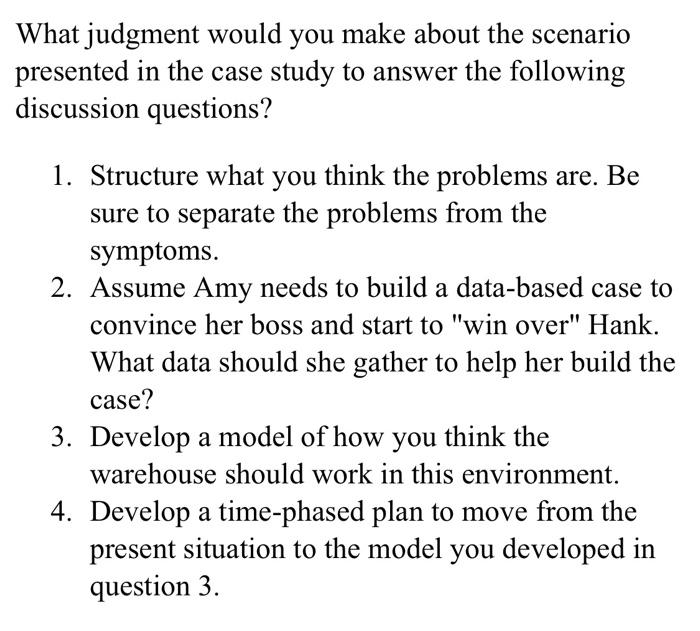
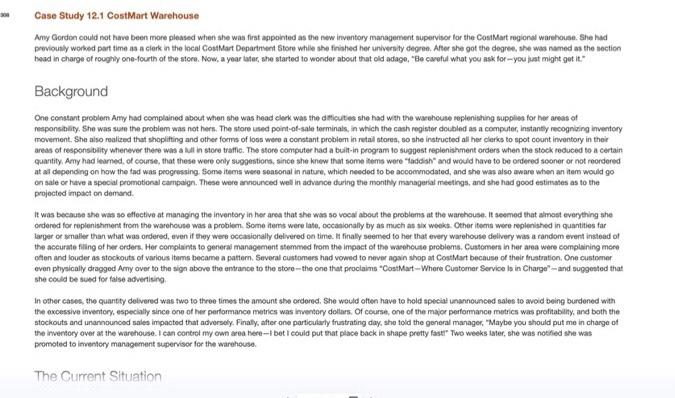
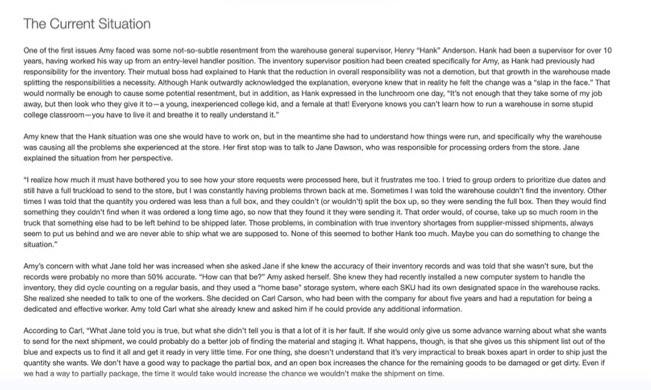
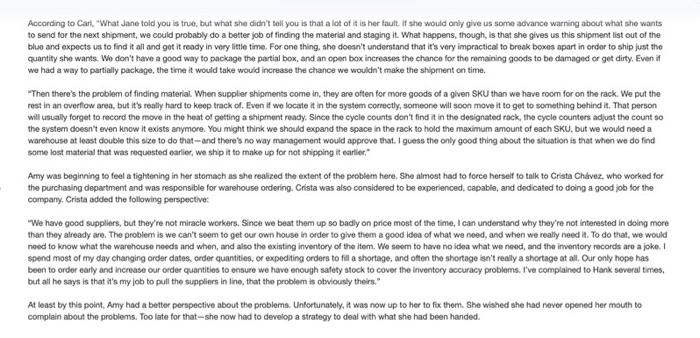
What judgment would you make about the scenario presented in the case study to answer the following discussion questions? 1. Structure what you think the problems are. Be sure to separate the problems from the symptoms. 2. Assume Amy needs to build a data-based case to convince her boss and start to "win over" Hank. What data should she gather to help her build the case? 3. Develop a model of how you think the warehouse should work in this environment. 4. Develop a time-phased plan to move from the present situation to the model you developed in question 3. Case Study 12.1 CostMart Warehouse Amy Gordon could not have been more pieased when ahe was first appointed as the new inventory management supervisor for the CosiMart regionsi warehouse. She had previously worked part time as a cierk in the local CostMart Department Gitore while she finished her untersity degree. Atter she got the degree, she was named as the section head in charge of roughy one-fourth of the store. Now, a year later, she started to wonder about that old adage, "Be caveful what you ask tor-ypu irst might get it." Background One constant problem Amy had complained abeut when she was head elerk was the deticutes she had wth the warohouse seplenishing suppled for her areas of responsiblity, She was sure the problem was not hers. The store used point-ot-sale terminals, in which the cash rogister doubled as a computer, instanty recognizing invertory movement, She also realized that shoplitting and other foms of loss were a constant problem in retail storea, so she inatructed all her clerks to spot count inventory in their areas of responsiblity whenever there was a Lull in store traflic. The store computer had a bult-in program to suggest replenishment orders when the stock teduced to a certain quantity. Amy had ieamed, of course, that these were only sugpestions, since she knew that some items wore "Iaddish" and would have to be ordered soaner or not reordered at al depending on how the tad was progressing. Some items weee seasonal in nature, which needed to be accommodated, and she was also aware when an item would go on sale or have a special promotional campaign. These were arnounced well in advance during the monthy managerial meetings, and she had good estimates as to the projocted impatet on demand. It was because she was so eflectiva at managing the inventory in her area that she was so vocal about the problems at the warehouse. It seemed that aimost everything she ordered for replenishment from the warehouse was a problem. Some teres were late, occanionally by as much as aix woeks. Other items were replenished in quantities far lavger or smaller than what was ordered, even if they were occasionally delivered on time. It finaly seemed to her that every warehouse delivery was a random event instead of the accurate filing of her erders. Her complaints to general management stemmed trom the impact of the waseheuze preblems, Customers in her area were complining more often and louder as stockouts of various items became a pattern. Several customers had vowved to never again shop at CostMart because of their trateation. One customer even physically dragged Amy over to the sign above the entrance to the store-the one that proclaims "CostMart-Where Cuatomar Service Is in Charge"- and suggested that she could be sued for false advertiving. In other cases, the quantity delvered was two to three times the amount she ordered. She would often have to hold speciat unannouriced sales to avoid being burdened with the excessive imventery, especinlly since one of her performance metrics was inventery doliars. Of course, one of the major performance metrics was profitablity, and both the stochouts and unarnounoed sales impacted that adversely. Finaly, after one particularly frustrating day, sho told the goneral manager, "Maybe you should put me in charge of the inventory over as the warehouse. I can control my own area here-l bet I could put enat place back in shape pretty fasti" Two weeks iater, she was notified she was promoted to inventory management supervisor fer the warehouse. One of the frut issues Amy faced was some not-so-subtie resentment from the warehouso general supervisor, Herry "Hank" Anderson. Hank had been a tuperviaor for over 10 years, having worked his way up trom an entry-level handler nosition. The inventory supervisor position had been created specificaly for Amy, as Hank had previoushy had responsiblity for the inventory. Their mutual boss had explained to Hark that the reduction in overall responsiblity was not a derneticn, but that growth in the warohouse made spliting the responuiblesies a necessity. Avthough Hark outwardly acknowledged the explanation, everyone knew that in reality he feet the change was a "elap in the face." That would nonmally be enough to cause some potential resentment, but in add tion, as flank expressed in the luncheocen one diay, "It's not enough that they take some of my job away, but then lock who they give it to-a young inexperienced college kid, and a female at that Everyone knows you ean't learn how to run a warehouse in some stupid college classroom = you have to tive it and breathe it to realy understand it." Amy knew that the Hank situation was one she would have to work on, but in the meantime she had to uncerstand how things were run, and specificaly why the wanchouse was causing all the peoblems she eixperienced at the store. Her first stop was to talk to Jane Dawson, who was responsible for processing orders trom the stone. Jane explained the situation from her porspective. " rewize hew much it must have bothered you to see haw your store tequests were processed hece, but it thastrates me too, I tried to group orders to prioritize due dates and stil have a tutil truckload to send to the store, but I was constantly raving problema truown back at me. Sometimes I was told the warehouse couldr't find the irwentory. Orher times I was toid that the quantity you ondered was less than a ful box, and they couldn't (or wouldrit) aplit the box up, so they were sending the full box. Then they would find sormething they couldn't find when it was ordered a long time ago, so now that they found it they were sending it. That coder would, of ceurse, take up so much room in the truck that semething eise had to be left behind to be shipped later. Those problects, in combination with true imentory shortages from oupplies-missed shipmerts, always seom to put us behind and we are never abie to ahip what we are supposed to. None of this seemod to bother Hank too much. Maybe you can do something to change the stuation, Amy's concern with what Jane told her was increased when the asked Jane it she knew the accuracy of their inventory records and was toid that she wasn't sure. but the records were probably no more than 50s accurate. "How can that be?" Amy asked hersed she knew they had recently instaled a nerw computer system to handle the inventory, they did oycle counting on a rogular basis, and they used a "home base" storage system, where each SkU had its own designated space in the warehouse racks. She realized she needed to tak to one of the workers. She decided on Cayl Carson, who had been with the company lor about five years and had a reputation for being a dedicated and eltective worker. Amy told Cart what she aready knew and asked him it he could provide any addistonal intormation. According to Cart, "What Jane told you is true, but what ehe didn't tell you is that a lot of it is her tault, If ahe would only give is some advance waming about what she wants to sond tor the next shipment, wo could probably do a better job of finding the material and staging it. What happens, though, is that she gives us this shipenent list out of the blue and expects us to find it all and get it readdy in very litte teme. For one thing, she doesn't understand that its very impractical to break bouts apart in order to ship lust the quantity she wants. Wo don't have a good way to pockage the partal box, and an epen box increases the chance for the remaining goods to be damaged or got dirty. Even if we had a way to partialty packnge, the time it would take would increase the chance we wouldn't make the shipment on time. According to Cart, "What Jane told you is true, but what she didin't toll you is that a lot of it is her fault. if she would only give us some ackance warning about what she wants to send for the next shipment, we could probably do a better job of finding the material and staging it. What happens, though, is that she gives us this shipment list out of the thluo and expects us to find it all and got it ready in very little time. For one thing. ahe doesn't underntand that it's very impractical to break boxes apart in order to ship just the quantity she wants. We don't have a good way to package the partial box, and an open box increases the chance for the remaining goods to be damaged or get dirty. Even if we had a way to partially package, the time it would take would increase the chance we wouldn't make the shipment on time. "Then there's the problem of finding material. When suppler shipments come in, they are often for more goods of a given SKU than we have foom for on the rack. We put the rest in an overfow area, but it's really hard to keep track of, Even it we locate it in the system correctly, someone will soon move it to get to something behind it, That person will usually forget to record the move in the heat of getting a shipment ready. Since the cycle counts don't find it in the designated rack, the cycle counters adjust the count so the system doesn't even know it exists anymore. You might thirk we should expand the space in the rack to hold the maximum amount of each SKU, but we would need a warehouse at least double this size to do that - and there's no way management would approve that. 1 guess the only good thing about the situation is that when we do find some lost material that was requested earlier, we ship it to make up for not shipping it earlier," Arry was beginning to feel a tightening in her stomach as she realized the extent of the problem here. She almost had to force herseif to talk to Crista Chatrez. who worked for the purchasing department and was responsible for warehouse ordering. Crista was also considered to be experienced, capable, and dedicated to doing a good job for the company. Crista added the following perspective: -We have good suppliers, but they're not miracle workers, Since we beat them up so badly on price most of tha time, I can understand wty thay're not interested in doing more than they already are. The problem is we can't seem to get our own house in order to give them a good idea of what we need, and when we really need it. To do that, we would need to know what the warehouse needs and when, and also the existing invertory of the item. Wo seem to have no idea what we need, and the irventory records are a joke. I spend most of my day changing order dates, crder quantities, or expediting orders to fill a shortage, and othen the shortage isin't really a shortage at all, Our only hope has been to order early and herease our order quantities to ensure we have enough safety stock to cover the inventory accuracy problems. I've complained to Hank several times, but all he says is that it's my job to puill the suppliers in line, that the problem is obviously theirs." At loast by this point. Amy had a better perspective about the problems. Untortunasely, it was now up to her to fix them. She wished she had never opened her mouth to complain about the problems. Too late for that-she now had to develop a strategy to deal with what she had been handed









 Study Help