URGENT DUE LESS THAN AN HOUR
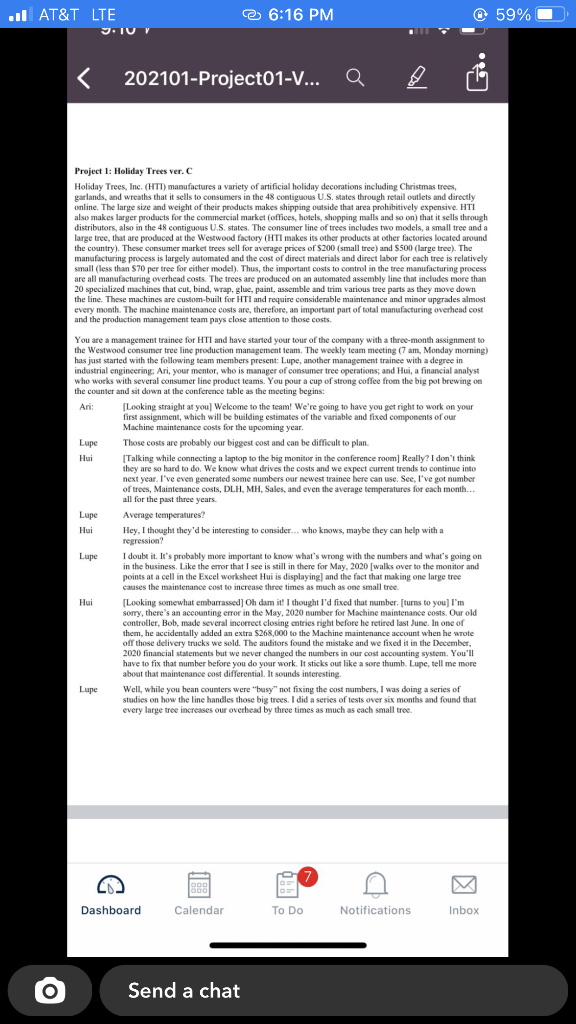
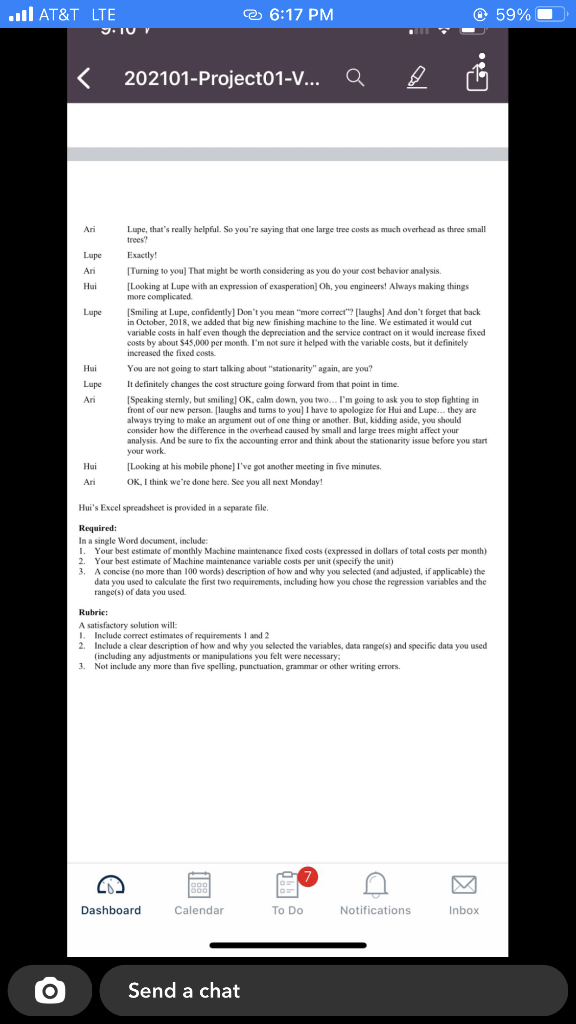
11 AT&T LTE e 6:16 PM 59% 202101-Project01-V... Q Project 1: Holiday Trees ver. C Holiday Trees, Inc. (HTI) manufactures a variety of artificial holiday decorations including Christmas trees, garlands, and wreaths that it sells to consumers in the 48 contiguous U.S. states through retail outlets and directly online. The large size and weight of their products makes shipping outside that area prohibitively expensive. HTI also makes larger products for the commercial market (offices, hotels, shopping malls and so on) that it sells through distributors, also in the 48 contiguous U.S. states. The consumer line of trees includes two models, a small tree and a large tree, that are produced at the Westwood factory (HTI makes its other products at other factories located around the country). These consumer market trees sell for average prices of $200 (small tree) and S500 (large tree). The manufacturing process is largely automated and the cost of direct materials and direct labor for each tree is relatively small (less than $70 per tree for either model). Thus, the important costs to control in the tree manufacturing process are all manufacturing overhead costs. The trees are produced on an automated assembly line that includes more than 20 specialized machines that cut, bind, wrap, glue, paint, assemble and trim various tree parts as they move down the line. These machines are custom-built for HTI and require considerable maintenance and minor upgrades almost every month. The machine maintenance costs are, therefore, an important part of total manufacturing overhead cost and the production management team pays close attention to those costs. You are a management trainee for HTI and have started your tour of the company with a three-month assignment to the Westwood consumer tree line production management team. The weekly team meeting (7 am, Monday morning) has just started with the following team members present: Lupe, another management trainee with a degree in industrial engineering, Ari, your mentor, who is manager of consumer tree operations, and Hui, a financial analyst who works with several consumer line product teams. You pour a cup of strong coffee from the big pot brewing on the counter and sit down at the conference table as the meeting begins: Ari: Looking straight at you] Welcome to the team! We're going to have you get right to work on your first assignment, which will be building estimates of the variable and fixed components of our Machine maintenance costs for the upcoming year. Lupe Those costs are probably our biggest cost and can be difficult to plan. Hui [Talking while connecting a laptop to the big monitor in the conference room] Really? I don't think they are so hard to do. We know what drives the costs and we expect current trends to continue into next year. I've even generated some numbers our newest trainee here can use. See, I've got number of trees, Maintenance costs, DLH, MH, Sales, and even the average temperatures for each month... all for the past three years. Lupe Average temperatures? Hui Hey, I thought they'd be interesting to consider... who knows, maybe they can help with a regression? I doubt it. It's probably more important to know what's wrong with the numbers and what's going on in the business. Like the error that I see is still in there for May, 2020 [walks over to the monitor and points at a cell in the Excel worksheet Hui is displaying) and the fact that making one large tree causes the maintenance cost to increase three times as much as one small tree. Hui Looking somewhat embarrassed] Oh damit! I thought I'd fixed that number. (turns to you] I'm sorry, there's an accounting error in the May, 2020 number for Machine maintenance costs. Our old controller, Bob, made several incorrect closing entries right before he retired last June. In one of them, he accidentally added an extra $268,000 to the Machine maintenance account when he wrote off those delivery trucks we sold. The auditors found the mistake and we fixed it in the December, 2020 financial statements but we never changed the numbers in our cost accounting system. You'll have to fix that number before you do your work. It sticks out like a sore thumb. Lupe, tell me more about that maintenance cost differential. It sounds interesting. Lupe Well, while you bean counters were "busy" not fixing the cost numbers, I was doing a series of studies on how the line handles those big trees. I did a series of tests over six months and found that every large tree increases our overhead by three times as much as each small tree. Lupe DOO Dashboard Calendar To Do Notifications Inbox o Send a chat 11 AT&T LTE 6:17 PM @ 59% 202101-Project01-V... a Ari Lupe Ari Hui Lupe Lupe, that's really helpful. So you're saying that one large tree costs as much overhead as three small trees? Exactly! [Turning to you) That might be worth considering as you do your cost behavior analysis. Looking at Lupe with an expression of exasperation) Oh, you engineers! Always making things more complicated [Smiling at Lupe, confidently] Don't you mean "more correct? (laughs) And don't forget that back in October, 2018, we added that big new finishing machine to the line. We estimated it would cut variable costs in half even though the depreciation and the service contract on it would increase fixed costs by about $45,000 per month. I'm not sure it helped with the variable costs, but it definitely increased the fixed costs. You are not going to start talking about "stationarity" again, are you? It definitely changes the cost structure going forward from that point in time. Speaking sternly, but smiling] OK, calm down, you two... I'm going to ask you to stop fighting in front of our new person. [laughs and turns to you] I have to apologize for Hui and Lupe... they are always trying to make an argument out of one thing or another. But, kidding aside, you should consider how the difference in the overhead caused by small and large trees might affect your analysis. And be sure to fix the accounting error and think about the stationarity issue before you start your work [Looking at his mobile phone] I've got another meeting in five minutes. OK, I think we're done here. See you all next Monday! Hui Lupe Ari Hui Ari Hui's Excel spreadsheet is provided in a separate file. Required: In a single Word document, include: 1. Your best estimate of monthly Machine maintenance fixed costs (expressed in dollars of total costs per month) 2. Your best estimate of Machine maintenance variable costs per unit (specify the unit) 3. A concise (no more than 100 words) description of how and why you selected (and adjusted, if applicable) the data you used to calculate the first two requirements, including how you chose the regression variables and the range(s) of data you used. Rubric: A satisfactory solution will: 1. Include correct estimates of requirements 1 and 2 2. Include a clear description of how and why you selected the variables, data rangels) and specific data you used (including any adjustments or manipulations you felt were necessary; 3. Not include any more than five spelling, punctuation, grammar or other writing errors. DOO Dashboard Calendar To Do Notifications Inbox Send a chat 11 AT&T LTE e 6:16 PM 59% 202101-Project01-V... Q Project 1: Holiday Trees ver. C Holiday Trees, Inc. (HTI) manufactures a variety of artificial holiday decorations including Christmas trees, garlands, and wreaths that it sells to consumers in the 48 contiguous U.S. states through retail outlets and directly online. The large size and weight of their products makes shipping outside that area prohibitively expensive. HTI also makes larger products for the commercial market (offices, hotels, shopping malls and so on) that it sells through distributors, also in the 48 contiguous U.S. states. The consumer line of trees includes two models, a small tree and a large tree, that are produced at the Westwood factory (HTI makes its other products at other factories located around the country). These consumer market trees sell for average prices of $200 (small tree) and S500 (large tree). The manufacturing process is largely automated and the cost of direct materials and direct labor for each tree is relatively small (less than $70 per tree for either model). Thus, the important costs to control in the tree manufacturing process are all manufacturing overhead costs. The trees are produced on an automated assembly line that includes more than 20 specialized machines that cut, bind, wrap, glue, paint, assemble and trim various tree parts as they move down the line. These machines are custom-built for HTI and require considerable maintenance and minor upgrades almost every month. The machine maintenance costs are, therefore, an important part of total manufacturing overhead cost and the production management team pays close attention to those costs. You are a management trainee for HTI and have started your tour of the company with a three-month assignment to the Westwood consumer tree line production management team. The weekly team meeting (7 am, Monday morning) has just started with the following team members present: Lupe, another management trainee with a degree in industrial engineering, Ari, your mentor, who is manager of consumer tree operations, and Hui, a financial analyst who works with several consumer line product teams. You pour a cup of strong coffee from the big pot brewing on the counter and sit down at the conference table as the meeting begins: Ari: Looking straight at you] Welcome to the team! We're going to have you get right to work on your first assignment, which will be building estimates of the variable and fixed components of our Machine maintenance costs for the upcoming year. Lupe Those costs are probably our biggest cost and can be difficult to plan. Hui [Talking while connecting a laptop to the big monitor in the conference room] Really? I don't think they are so hard to do. We know what drives the costs and we expect current trends to continue into next year. I've even generated some numbers our newest trainee here can use. See, I've got number of trees, Maintenance costs, DLH, MH, Sales, and even the average temperatures for each month... all for the past three years. Lupe Average temperatures? Hui Hey, I thought they'd be interesting to consider... who knows, maybe they can help with a regression? I doubt it. It's probably more important to know what's wrong with the numbers and what's going on in the business. Like the error that I see is still in there for May, 2020 [walks over to the monitor and points at a cell in the Excel worksheet Hui is displaying) and the fact that making one large tree causes the maintenance cost to increase three times as much as one small tree. Hui Looking somewhat embarrassed] Oh damit! I thought I'd fixed that number. (turns to you] I'm sorry, there's an accounting error in the May, 2020 number for Machine maintenance costs. Our old controller, Bob, made several incorrect closing entries right before he retired last June. In one of them, he accidentally added an extra $268,000 to the Machine maintenance account when he wrote off those delivery trucks we sold. The auditors found the mistake and we fixed it in the December, 2020 financial statements but we never changed the numbers in our cost accounting system. You'll have to fix that number before you do your work. It sticks out like a sore thumb. Lupe, tell me more about that maintenance cost differential. It sounds interesting. Lupe Well, while you bean counters were "busy" not fixing the cost numbers, I was doing a series of studies on how the line handles those big trees. I did a series of tests over six months and found that every large tree increases our overhead by three times as much as each small tree. Lupe DOO Dashboard Calendar To Do Notifications Inbox o Send a chat 11 AT&T LTE 6:17 PM @ 59% 202101-Project01-V... a Ari Lupe Ari Hui Lupe Lupe, that's really helpful. So you're saying that one large tree costs as much overhead as three small trees? Exactly! [Turning to you) That might be worth considering as you do your cost behavior analysis. Looking at Lupe with an expression of exasperation) Oh, you engineers! Always making things more complicated [Smiling at Lupe, confidently] Don't you mean "more correct? (laughs) And don't forget that back in October, 2018, we added that big new finishing machine to the line. We estimated it would cut variable costs in half even though the depreciation and the service contract on it would increase fixed costs by about $45,000 per month. I'm not sure it helped with the variable costs, but it definitely increased the fixed costs. You are not going to start talking about "stationarity" again, are you? It definitely changes the cost structure going forward from that point in time. Speaking sternly, but smiling] OK, calm down, you two... I'm going to ask you to stop fighting in front of our new person. [laughs and turns to you] I have to apologize for Hui and Lupe... they are always trying to make an argument out of one thing or another. But, kidding aside, you should consider how the difference in the overhead caused by small and large trees might affect your analysis. And be sure to fix the accounting error and think about the stationarity issue before you start your work [Looking at his mobile phone] I've got another meeting in five minutes. OK, I think we're done here. See you all next Monday! Hui Lupe Ari Hui Ari Hui's Excel spreadsheet is provided in a separate file. Required: In a single Word document, include: 1. Your best estimate of monthly Machine maintenance fixed costs (expressed in dollars of total costs per month) 2. Your best estimate of Machine maintenance variable costs per unit (specify the unit) 3. A concise (no more than 100 words) description of how and why you selected (and adjusted, if applicable) the data you used to calculate the first two requirements, including how you chose the regression variables and the range(s) of data you used. Rubric: A satisfactory solution will: 1. Include correct estimates of requirements 1 and 2 2. Include a clear description of how and why you selected the variables, data rangels) and specific data you used (including any adjustments or manipulations you felt were necessary; 3. Not include any more than five spelling, punctuation, grammar or other writing errors. DOO Dashboard Calendar To Do Notifications Inbox Send a chat




