







Question: URGENT: Hello, please help completing the following Problem I N C++: (I WILL RATE. THANK YOU.) Exercise 2.19: The maximum contiguous subsequence sum algorithms in
URGENT: Hello, please help completing the following Problem IN C++: (I WILL RATE. THANK YOU.)
Exercise 2.19: The maximum contiguous subsequence sum algorithms in the text do not give any indication of the actual sequence. Modify them so that they return in a single object the value of the maximum subsequence and the indices of the actual sequence.
Write a program that solves Exercise 2.19 in C++. You need to modify the programs for each of the 4 algorithms for the maximum-subsequence-sum problem so that the program not only returns the maximum sums of subsequences of the given integer array but also returns/outputs the actual subsequence where the sum of integers is maximum.
I HAVE THE CODE AND WILL BE ATTACHED BELOW THE ALGORITHMS. I NEED HELP IN THE FOLLOWING PART: Run each algorithm on three randomly generated integer arrays of sizes N=1,000, 10,000, and 100,000, measure the running times, and determine if they are consistent with the theoretical analysis results of those algorithms given in class, i.e., if the running time of algorithm 1 for the MSS problem is proportional to N3 and that for Algorithm 2 is proportional to N2 , etc. Include a table in your report that summarizes the actual running times (in appropriate time units) and narrative about your observations regarding whether the implemented algorithms indeed demonstrate behaviors entailed by theoretical analysis.
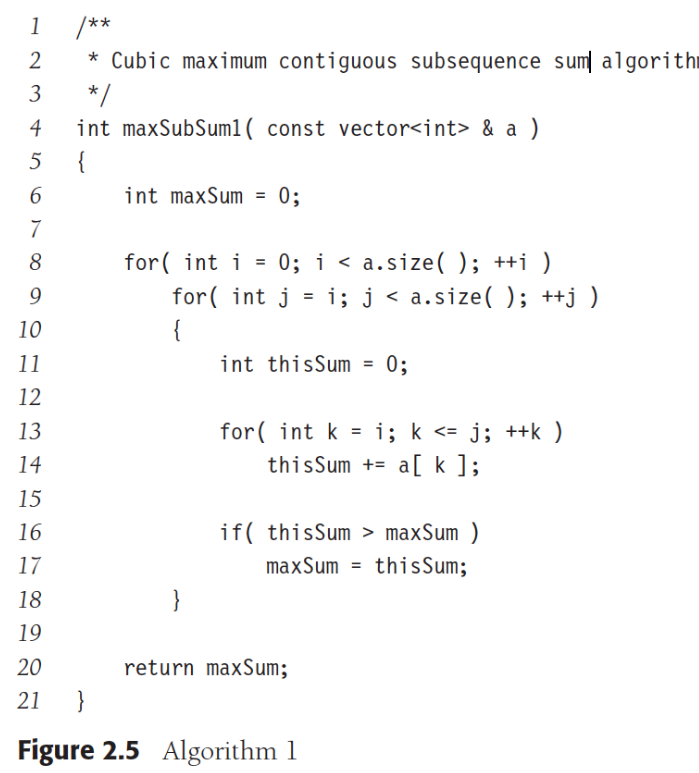
Algorithm 1:
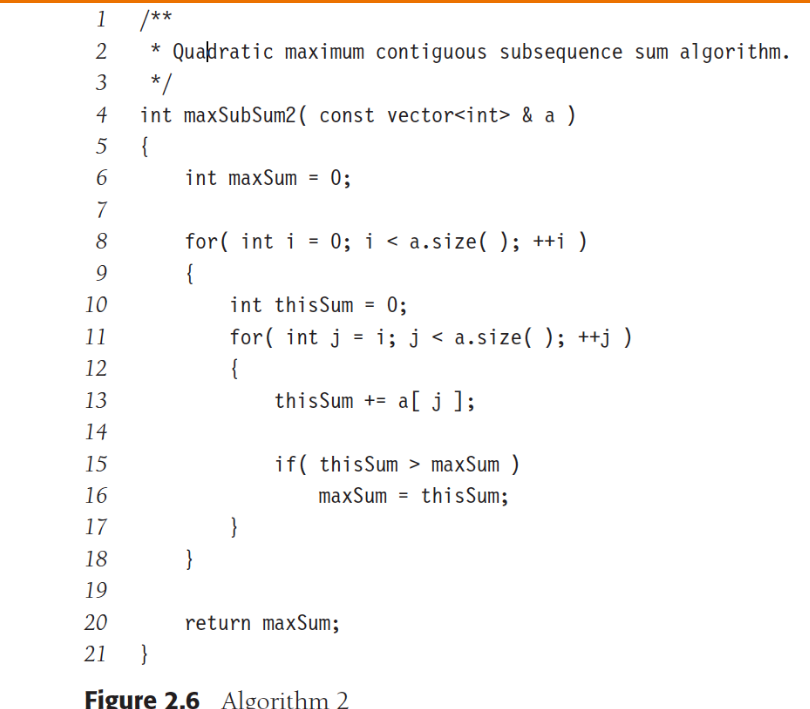
ALGORITHM 2:
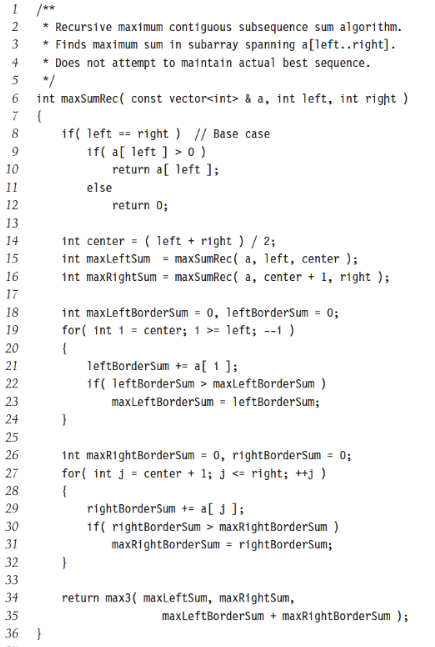
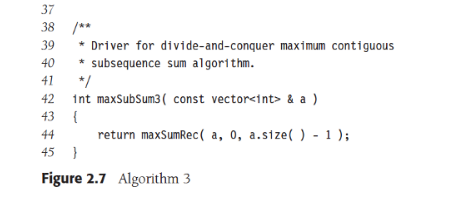
ALGORITHM 3:
ALGORITHM 4:
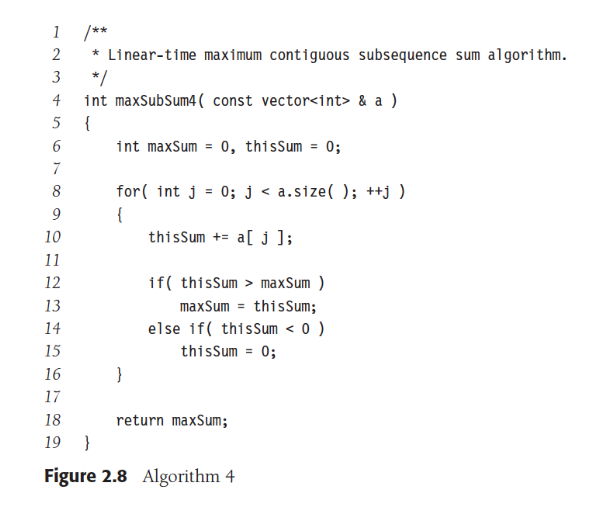
CODE:
#include "stdafx.h"
#include
#include
using namespace std;
// Cubic maximum contiguous subsequence sum algorithm.
int maxSubSum1(const vector & a)
{
int maxSum = 0;
for (int i = 0; i
for (int j = i; j
{
int thisSum = 0;
for (int k = i; k
thisSum += a[k];
if (thisSum > maxSum)
maxSum = thisSum;
}
return maxSum;
}
//Quadratic maximum contiguous subsequence sum algorithm.
int maxSubSum2(const vector & a)
{
int maxSum = 0;
for (int i = 0; i
{
int thisSum = 0;
for (int j = i; j
{
thisSum += a[j];
if (thisSum > maxSum)
maxSum = thisSum;
}
}
return maxSum;
}
// Return maximum of three integers.
int max3(int a, int b, int c)
{
return a > b ? a > c ? a : c : b > c ? b : c;
}
/**
* Recursive maximum contiguous subsequence sum algorithm.
* Finds maximum sum in subarray spanning a[left..right].
* Does not attempt to maintain actual best sequence.
*/
int maxSumRec(const vector & a, int left, int right)
{
if (left == right) // Base case
if (a[left] > 0)
return a[left];
else
return 0;
int center = (left + right) / 2;
int maxLeftSum = maxSumRec(a, left, center);
int maxRightSum = maxSumRec(a, center + 1, right);
int maxLeftBorderSum = 0, leftBorderSum = 0;
for (int i = center; i >= left; i--)
{
leftBorderSum += a[i];
if (leftBorderSum > maxLeftBorderSum)
maxLeftBorderSum = leftBorderSum;
}
int maxRightBorderSum = 0, rightBorderSum = 0;
for (int j = center + 1; j
{
rightBorderSum += a[j];
if (rightBorderSum > maxRightBorderSum)
maxRightBorderSum = rightBorderSum;
}
return max3(maxLeftSum, maxRightSum,
maxLeftBorderSum + maxRightBorderSum);
}
// Driver for divide-and-conquer maximum contiguous
// subsequence sum algorithm.
int maxSubSum3(const vector & a)
{
return maxSumRec(a, 0, a.size() - 1);
}
// Linear-time maximum contiguous subsequence sum algorithm.
int maxSubSum4(const vector & a)
{
int maxSum = 0, thisSum = 0;
for (int j = 0; j
{
thisSum += a[j];
if (thisSum > maxSum)
maxSum = thisSum;
else if (thisSum
thisSum = 0;
}
return maxSum;
}
// main
int main()
{
// Declaration of a vector.
vector a(8);
a[0] = 6; a[1] = -7; a[2] = 2; a[3] = -3;
a[4] = -5; a[5] = 4; a[6] = 6; a[7] = -4;
// Declaration of a variable of integer datatype.
int maxisum;
maxisum = maxSubSum1(a);
cout
maxisum = maxSubSum2(a);
cout
maxisum = maxSubSum3(a);
cout
maxisum = maxSubSum4(a);
cout
system("pause");
return 0;
}
2 Quadratic maximum contiguous subsequence sum algorithm. 4 int maxSubSum2( const vector
Step by Step Solution
There are 3 Steps involved in it

Get step-by-step solutions from verified subject matter experts
 Study Help