







Question: urgent solution required An infinitely long, solid insulating cylinder with radius Ra is placed concentric within a conducting cylindrical shell of inner radius Ry and
urgent solution required
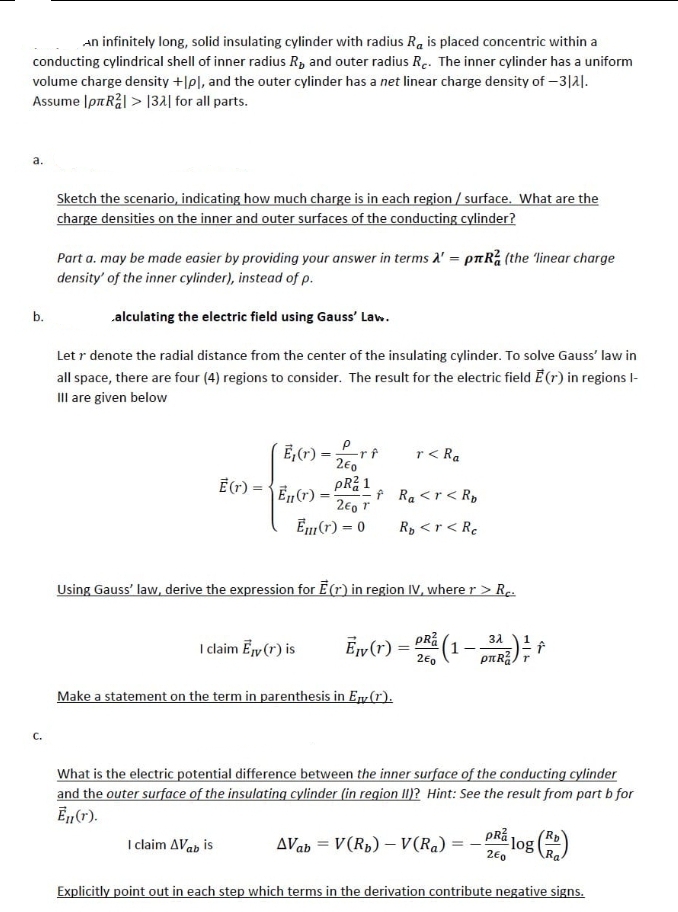
An infinitely long, solid insulating cylinder with radius Ra is placed concentric within a conducting cylindrical shell of inner radius Ry and outer radius Rc. The inner cylinder has a uniform volume charge density +|pl, and the outer cylinder has a net linear charge density of - 3|1|. Assume IpnRal > |31| for all parts. a Sketch the scenario, indicating how much charge is in each region / surface. What are the charge densities on the inner and outer surfaces of the conducting cylinder? Part a. may be made easier by providing your answer in terms A' = pIRa (the 'linear charge density' of the inner cylinder), instead of p. b. calculating the electric field using Gauss' Law. Let r denote the radial distance from the center of the insulating cylinder. To solve Gauss' law in all space, there are four (4) regions to consider. The result for the electric field E(r) in regions I- Ill are given below E,(r ) = 7 r Rc. I claim Er (r) is Elv(r) = - PRa 31 Make a statement on the term in parenthesis in Er(r). C. What is the electric potential difference between the inner surface of the conducting cylinder and the outer surface of the insulating cylinder (in region II)? Hint: See the result from part b for En( r). I claim AVab is AVab = V(Rb) - V(Ra) = -PRa log (RD) Explicitly point out in each step which terms in the derivation contribute negative signs
Step by Step Solution
There are 3 Steps involved in it

Get step-by-step solutions from verified subject matter experts
 Study Help